
Pre-Adverse Action Notice
The notice an employer sends before rejecting someone over a background check, with a copy of the report and a summary of their rights.
 ChatGPT
 Gemini
 Claude
 Grok
 Perplexity
A pre-adverse action notice is the letter an employer must send before rejecting a candidate, withdrawing an offer or acting against an employee because of something in a background check report. Under the Fair Credit Reporting Act (FCRA), the notice includes a copy of the report and a summary of the person's rights, so they can spot errors or explain before the decision is final.
Why does a pre-adverse action notice matter for enterprise HR?
A pre-adverse action notice matters because it is a legal step, not a courtesy. Background check companies make mistakes: a record can belong to someone with the same name, a dismissed charge can show up as a conviction, or an old entry can appear that should have dropped off.
The notice gives the person a fair chance to catch that before they lose the job.
The rule comes from section 1681b of the Fair Credit Reporting Act, which says an employer must give the person a copy of the report and a written description of their rights before taking any adverse action based in whole or in part on it.
The cost of skipping the step is real. Under section 1681n of the FCRA, a person can recover actual damages or statutory damages of $100 to $1,000 for each willful violation, plus punitive damages and attorney fees.
For an enterprise that screens thousands of hires a year, one broken template repeated across every rejection becomes a class action risk, not a single complaint.
The notice also protects hiring quality. Some candidates flagged by a report turn out to have a clean record once an error is fixed. Losing a strong hire because of a mismatched record is a cost the business never sees on a report.
Core components of a pre-adverse action notice
A pre-adverse action notice has two parts the FCRA requires and a few more that good practice or state law add. The FTC's guidance for employers lists the two federal items: a copy of the report the decision relies on and a copy of "A Summary of Your Rights Under the Fair Credit Reporting Act".
A copy of the background check report
The full report, not an excerpt. The person needs to see exactly what the employer saw, including the name of the consumer reporting agency that prepared it.
A Summary of Your Rights Under the FCRA
The standard federal form explains the right to see the file, dispute errors and get a free copy of the report. Most background check providers attach the current version automatically.
The items that may lead to the decision
The FCRA does not require the employer to name the specific record, but California does for conviction history, and naming it makes the letter far clearer. "Your report shows a 2019 conviction for theft" is easier to answer than a bare attachment.
A response deadline and a contact
The notice should say how many days the person has to respond, how to reach the hiring team, and that they can dispute errors directly with the background check company.
A statement that no final decision has been made
The letter should say the application or offer is on hold, not withdrawn. Language like "we have decided not to hire you" turns a pre-adverse notice into a final one and defeats its purpose.
State and city additions
Some places add steps. California requires an individualized assessment for conviction history, and New York City requires a written Fair Chance Notice with the employer's analysis.
Those additions sit on top of the federal notice, never instead of it.
How do you send a pre-adverse action notice?
Sending a pre-adverse action notice follows a fixed order that starts long before the report arrives. The steps below suit most US employers; check state and city rules for each location you hire in.
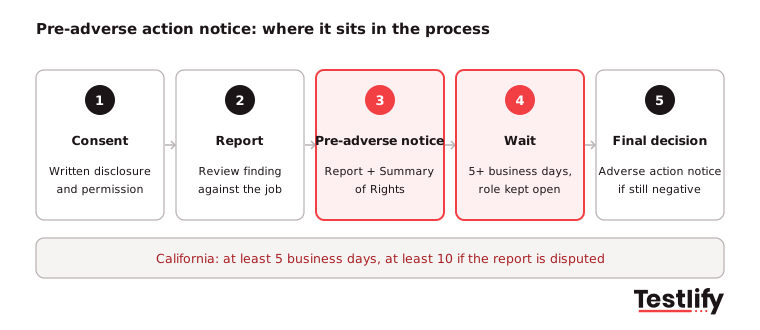
Step 1: Get written consent first
Before ordering a background check, give the candidate a standalone written disclosure that a report may be obtained, and get their written permission. A pre-adverse notice cannot fix a check that was ordered without consent.
Step 2: Review the report against the job
Decide whether the finding is relevant to the role. For criminal records, weigh the nature of the offense, the time that has passed and the duties of the job. Apply the same standard to every candidate.
Step 3: Send the pre-adverse action notice
Include the report, the Summary of Rights, the items of concern, the deadline and a contact. Email works if the candidate agreed to electronic notices. Keep proof of delivery.
Step 4: Wait and keep the role open
The FCRA does not set a number of days, but five business days is the common minimum. The California Civil Rights Department's Fair Chance Act fact sheet gives the person at least five business days to respond. It gives at least ten if they are challenging the accuracy of the report.
Step 5: Review anything the person sends
A dispute, court papers or evidence of rehabilitation must be read before deciding. If the person disputes the report with the background check company, which has 30 days to investigate, many employers wait for the corrected report.
Step 6: Make the final decision and close the loop
If the decision stays negative, send the final adverse action notice. If the person is cleared, move them forward and tell them so.
There is one federal exception. For transport roles regulated by the US Department of Transportation, where the candidate applied only by mail, phone or online, the FCRA lets the employer skip the pre-adverse step and send a single notice within three business days of the decision.
Pro tip: Build the waiting period into your ATS as a separate stage, such as "Pre-adverse sent", with an automatic date. A stage that cannot be skipped protects you better than a recruiter's calendar reminder.
Pre-adverse action notice vs adverse action notice
A pre-adverse action notice and an adverse action notice are two letters in the same process, sent at different times for different reasons.
The first says "we may decide against you, here is why, tell us if it is wrong". The second says "we have decided, and here is how to dispute the report".
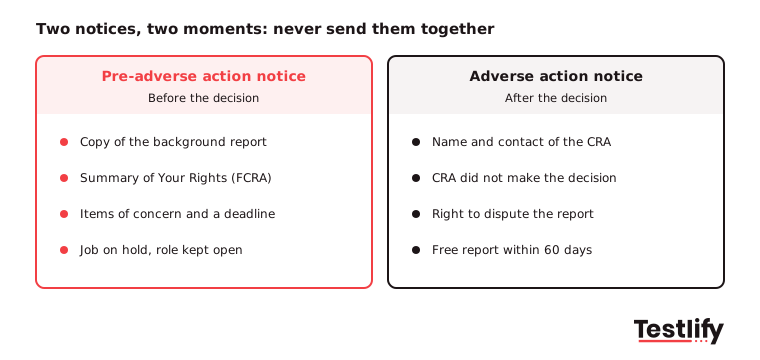
Aspect | Pre-adverse action notice | Adverse action notice |
|---|---|---|
When it is sent | Before the decision is final | After the decision is made |
Purpose | Lets the person review and respond | Tells the person the outcome |
Must include | Copy of the report and the Summary of Rights | Name, address and phone of the background check company, a statement that it did not make the decision, the right to dispute and to a free report within 60 days |
Format | Written, often by email with the report attached | Oral, written or electronic under the FCRA (written is safer) |
Job status | On hold, role kept open | Closed for that person |
A related term is adverse impact, which is different again. Adverse impact describes a hiring practice that screens out a protected group at a higher rate, and blanket criminal record bans are a common cause.
A careful pre-adverse process, with the same rules for everyone, helps avoid it.
Key takeaway: The two notices are never combined. Sending them together, or on the same day, removes the response window the law exists to protect.
What are the best practices for pre-adverse action notices?
Pre-adverse action best practices come down to consistency, timing and records. The five habits below cover most audit findings.
- Use one approved template per jurisdiction: Legal reviews a federal version plus state and city versions once, so recruiters never write their own letters.
- Start the check only after a conditional offer: California, New York City and many other places bar criminal history questions before an offer, and checking later also keeps the offer letter terms clear.
- Apply the same standard to every candidate: According to the EEOC's joint guidance with the FTC, rejecting one group for a record you overlook in another is discrimination.
- Keep every record: Store the consent, the report, both notices, delivery proof and any reply. The EEOC expects hiring records to be kept for at least one year after the decision.
- Write like a person: A plain, respectful letter keeps the candidate experience intact for people who are cleared and later hired.
For the wider set of checks to run before a hire, see our legal compliance checklist for hiring and the glossary entry on background checks.
A pre-adverse action notice only matters once a hiring decision rests on a background report. The stronger the evidence before that point, the fewer judgment calls the report has to carry.
Teams that use job-relevant skills assessments earlier in the funnel make the offer on demonstrated ability. They then use the background check for what it is meant to do.
Final thoughts
A pre-adverse action notice protects both the candidate and the employer. Send it before any final decision, include the report and the Summary of Rights, and give the person real time to respond.
A background check should confirm a hiring decision, not carry it alone. Read how Testlify approaches legal compliance in hiring tests and what to check before you rely on a report.
Ready to bring consistent, skills-based screening in earlier in your process? Book a demo and talk it through with the Testlify team.
Frequently asked questions (FAQs)
A pre-adverse action notice is not a rejection, so yes, many people are still hired. If the report has an error, or the person explains a record the employer finds unrelated to the job, the employer can clear them and proceed.
Cite this page
Copy a ready-made citation for this page in your preferred style.
- APA
Testlify. (2026). Pre-Adverse Action Notice. https://testlify.com/hr-glossary/pre-adverse-action-notice/
- MLA
"Pre-Adverse Action Notice." Testlify, 28 October 2026, https://testlify.com/hr-glossary/pre-adverse-action-notice/.
- Chicago
Testlify. "Pre-Adverse Action Notice." Testlify. Last modified October 28, 2026. https://testlify.com/hr-glossary/pre-adverse-action-notice/.
- HTML link
<a href="https://testlify.com/hr-glossary/pre-adverse-action-notice/">Pre-Adverse Action Notice</a>, Testlify (2026)
Related terms
Premium Only Plan (POP)
Premium Only Plan (POP) is a type of benefit plan that allows employers to set up a salary reduction agreement with their employees, under which employees can have a portion of their gross salary withheld and deposited into a pre-tax account, which can be used to pay for certain qualified benefit expenses.
Principal agent problem
Principal-Agent Problem is a problem that arises when an agent is entrusted to act on behalf of a principal, but their interests are not fully aligned which can lead to inefficiencies and reduced productivity.
Probation
Probation is a form of community supervision where an offender who has been convicted of a crime is released into the community under the supervision of a probation officer, rather than being incarcerated.
Probationary arrangement
Probationary Arrangement is a trial period of employment during which a new employee’s performance is evaluated by their employer, to ensure they are a good fit for the company and have necessary skills for the job.
Professional employer organization (PEO)
Professional Employer Organization (PEO) is a third-party service provider that acts as a co-employer of a company’s workers, providing services such as HR management, payroll, benefits administration, and liability and workers’ compensation insurance.
Profit sharing
Profit-sharing aligns employee incentives with company success, boosting morale and attracting talent, but can be difficult to implement and may create tension among employees.
Get started.
Hire on proof, not resumes.
Run your first skills-based assessment free — no credit card required.