
Negative PTO Balance
A negative PTO balance is paid time off an employee used before earning it, so the bank sits below zero until future accruals repay it.
 ChatGPT
 Gemini
 Claude
 Grok
 Perplexity
A negative PTO balance is the paid time off an employee has taken beyond what they have accrued, so their leave bank shows less than zero. The employer has, in effect, advanced paid leave against future accruals. The balance is repaid as new hours accrue, or, where the law and the policy allow, recovered from final pay when the employee leaves.
Why does a negative PTO balance matter for enterprise HR?
A negative PTO balance matters because every hour below zero is wages paid for work not yet done, and the rules for getting that money back change by employee type and by state. For a company with thousands of employees across several states, small advances add up to a real liability on the books.
Paid leave banks are now common, so the exposure is wide. The US Bureau of Labor Statistics reports that in 2026, 91 percent of private industry workers in the largest establishments had paid vacation, and 52 percent of nonunion private industry workers had access to a consolidated leave plan, the single PTO bank where negative balances usually appear.
Three costs follow when negative balances are left unmanaged:
- Unrecovered pay. When an employee with a minus 40 hour balance leaves from a state that bars deductions, that week of pay is gone.
- Wage claims. An unlawful deduction from final pay can lead to back pay, penalties and a state labor complaint.
- Unequal treatment. When one manager approves advances and another refuses them, employees notice, and the HR compliance risk becomes a fairness problem too.
What causes a negative PTO balance?
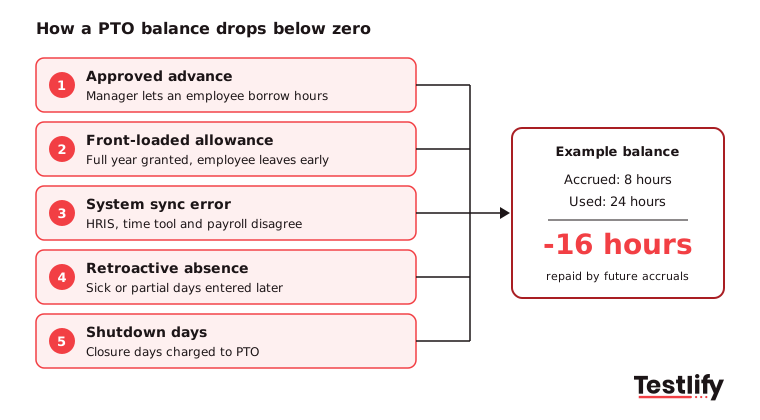
A negative PTO balance usually comes from one of five sources: an approved advance, a front-loaded allowance, a tracking error, a retroactive absence entry or a company-wide closure. Only the first is a deliberate choice, so HR teams should know which cause applies before deciding how to recover the hours.
Approved PTO advance
An employee asks to borrow hours they have not yet earned, often for a wedding, a family emergency or a trip booked early in the year. A manager approves it and the bank drops below zero.
Front-loaded allowance
Some employers grant the full year's PTO on January 1. An employee who uses 15 days in March and leaves in June has used more than the pro rata share they earned.
Payroll or system sync errors
The time-off tool, the HRIS and payroll can disagree. A missed accrual run, a wrong accrual rate or a duplicate request can push a balance below zero without anyone approving it.
Retroactive absence entries
Sick days entered after the fact, or partial-day absences charged as full days, can overdraw a bank that looked healthy when the employee booked other leave.
Company shutdown days
When a business closes between holidays and charges those days to PTO, newer employees with small balances often end up negative.
Can employers deduct a negative PTO balance from a final paycheck?
Employers can sometimes deduct a negative PTO balance from a final paycheck, but the answer depends on federal rules, the employee's exemption status and state wage laws. Under the federal Fair Labor Standards Act, recovery from a nonexempt employee is generally allowed; for exempt employees it is risky; and several states restrict or ban it.
For nonexempt employees, a Fair Labor Standards Act (FLSA) opinion letter from the US Department of Labor (FLSA-834, 1984) says advanced vacation pay can be recouped from final pay, even below minimum wage, when the employee understood it was an advance. The same letter says interest or admin fees cannot cut into minimum wage, and that a written agreement, while not required, is "desirable".
According to FrankCrum's 2024 guidance on negative PTO at the end of employment, later DOL guidance adds two conditions: the policy was shared before the leave was advanced, and the deduction uses the pay rate in effect when the leave was taken.
For exempt employees, the salary basis test in DOL Fact Sheet 17G says a salary cannot be reduced for the quantity of work, so most advisers do not recommend the deduction. HRMorning's write-up of O'Donnell v. Robert Half, a 2009 Massachusetts case, shows the risk: an exempt employee sued over a negative PTO deduction from his final pay, and the court sent the case toward trial.
Situation | Federal position | What HR should do |
|---|---|---|
Nonexempt employee, policy disclosed in writing | Deduction generally allowed, at the rate when leave was taken | Confirm state law, keep the signed agreement |
Nonexempt employee, no prior notice | Weak position | Do not deduct; treat as a loss or ask for voluntary repayment |
Exempt employee | Salary basis rules make it risky | Avoid salary deductions; limit advances instead |
California | Labor Commissioner bars deducting advanced vacation from final pay | Do not deduct; control advances up front |
Connecticut | Needs written authorization on a Labor Commissioner-approved form | Get the approved form signed before the advance |
According to the CBIA HR Hotline, Connecticut's wage law (section 31-71e) only allows the deduction with that approved, signed form. Whether the employee quits or is fired does not change the right to deduct, but state final pay rules still set the timing. This page is general information, not legal advice; check each state's wage payment law with counsel.
How do you build a negative PTO balance policy?
A negative PTO balance policy is built in six steps: decide whether to allow advances, set a cap, define who approves, set the repayment method, state what happens at separation, and get written consent. Each step should appear in the employee handbook and in the leave system's settings.
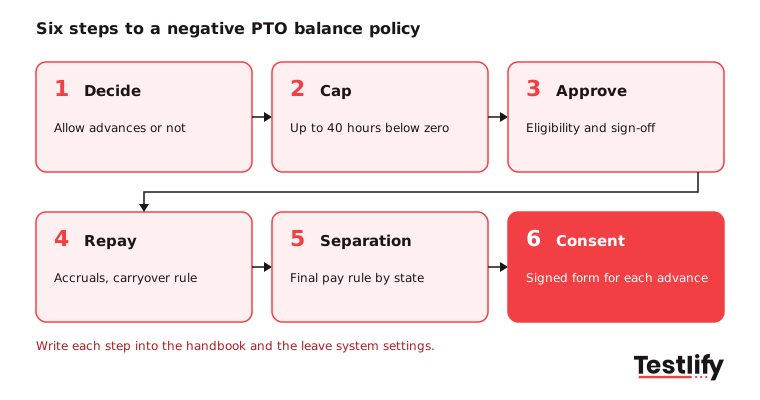
- Decide whether to allow advances: Some employers ban them and use unpaid leave instead. Others allow them as a retention benefit.
- Set a cap: A common limit is 40 hours, or one week, below zero. Cap it in the leave system so it cannot be exceeded by mistake.
- Define eligibility and approval: For example, employees past probation, with manager and HR approval for anything over the cap.
- Set the repayment method: Future accruals repay the balance first. State whether a negative balance carries into the next year.
- State what happens at separation: Spell out whether a remaining balance will be deducted from final pay, by state. The California Labor Commissioner's vacation FAQ says employers cannot deduct advanced vacation from final wages, so a multi-state policy needs state carve-outs.
- Get written consent at the time of the advance: A signed advance form for each request is stronger evidence than a handbook line signed on day one.
Pro tip: Show the employee's projected balance on the request screen. When people see "this request takes you to minus 16 hours", fewer advances turn into surprises at exit.
How is a negative PTO balance different from unpaid leave?
A negative PTO balance is paid now and repaid later, while unpaid leave is time off with no pay at all. The choice changes the employee's paycheck, the employer's risk at exit and how the absence is recorded in leave management reports.
Negative PTO balance | Unpaid leave | PTO payout at exit | |
|---|---|---|---|
Pay during the absence | Full pay | No pay | Not applicable |
Balance after | Below zero | Unchanged | Zero |
Employer risk | Unrecovered pay if the employee leaves | Lower | Required in some states |
Recovery | Future accruals or final pay where legal | None needed | None |
Best for | Short, planned needs of trusted staff | Long or open-ended absences | Earned, unused hours at separation |
What are the best practices for managing negative PTO balances?
The best practices for managing negative PTO balances are to cap them in the system, apply the rules to everyone, report on them monthly and plan the exit case in advance. These habits keep advances a benefit rather than a hidden liability.
- Cap advances in the leave system: A hard limit stops balances drifting past what the policy allows.
- Apply the policy the same way to every team: Consistent approval protects against discrimination and retaliation claims.
- Report negative balances monthly: A list of employees below zero, by department, lets finance see the exposure.
- Fix sync errors fast: Audit accrual runs each quarter so system mistakes do not look like employee debt.
- Avoid advances during notice periods: An employee who has resigned should not be advanced more hours.
- Treat exempt staff differently: Limit their advances rather than relying on salary deductions.
Read why managing employee absences matters for the wider absence picture, including annual leave planning.
Key takeaway: A negative PTO balance is a short loan of paid time. Recovery rules vary by state and exemption status, so the safest policy controls advances up front instead of relying on final pay.
What skills does an HR team need to run PTO policy well?
An HR team needs working knowledge of wage law, payroll accuracy and clear written policy to run PTO well. When hiring HR generalists, payroll specialists or benefits administrators, skills-based hiring helps check those abilities before the offer. Testlify's test library has 3,500+ tests, including HR role and HR compliance skills tests, so hiring teams can see who can apply leave rules before they own them.
Frequently asked questions (FAQs)
A negative PTO balance is legal in the US; federal law does not stop employers from advancing paid leave. The legal questions start when the employer tries to recover it, because state wage laws and exempt salary rules limit deductions.
Cite this page
Copy a ready-made citation for this page in your preferred style.
- APA
Testlify. (2026). Negative PTO Balance. https://testlify.com/hr-glossary/negative-pto-balance/
- MLA
"Negative PTO Balance." Testlify, 26 October 2026, https://testlify.com/hr-glossary/negative-pto-balance/.
- Chicago
Testlify. "Negative PTO Balance." Testlify. Last modified October 26, 2026. https://testlify.com/hr-glossary/negative-pto-balance/.
- HTML link
<a href="https://testlify.com/hr-glossary/negative-pto-balance/">Negative PTO Balance</a>, Testlify (2026)
Related terms
Negligent Hiring
Negligent hiring refers to an employer’s failure to properly screen job candidates, resulting in harm to a third party.
Negligent Referral
Negligent referral is when an employer refers an employee to a third party, knowing or having reason to know that the employee poses a risk of harm, and the employee subsequently causes harm to the third party.
Negligent Retention
Negligent retention is the failure of an employer to terminate an employee when they knew or should have known that the employee posed a danger to others.
Negotiation
Negotiation is a process of communication with the aim of reaching an agreement or understanding through discussion and compromise.
Nepotism
Nepotism is the practice of showing favoritism to friends and family members in the workplace, often involving hiring or promotions.
Net Salary
Net salary is the amount of money an employee receives after all deductions, such as taxes, insurance, and retirement contributions, have been subtracted from their gross salary.
Get started.
Hire on proof, not resumes.
Run your first skills-based assessment free — no credit card required.