
Generational Talent
Generational talent is a person whose ability in a field is so rare that someone at the same level appears only about once in a generation.
 ChatGPT
 Gemini
 Claude
 Grok
 Perplexity
Every recruiter has heard a hiring manager say, "This candidate is generational." Generational talent is a person whose ability is so rare that someone at their level appears only about once in a generation.
In hiring, the label can stretch pay bands and skip steps, so it needs evidence. This post shows how to test the claim and tell a rare candidate from a strong one.
Why does generational talent matter for enterprise HR?
Generational talent matters for enterprise HR because the label changes how a hiring decision gets made. When a hiring manager calls a candidate "generational", pay bands stretch, interview steps get skipped and doubts get waved away.
That can be the right call for a truly rare hire, and an expensive mistake for a good hire wrapped in hype.
The phrase has spread well beyond sports. We have seen managers ask for "a generational talent" when what the team needs is a strong, coachable hire who can be trained in three months.
Three reasons the term deserves a clear definition inside your hiring process:
- Rare hires are judged on hope: The word invites the halo effect, where one standout trait colours every other score.
- Rare hires are hard to keep: SHRM's 2024 "Generation Why" column says the next generation may hold 10 to 14 employers, at two to four years each. A rare hire who leaves in two years still leaves a gap.
- Searching only for stars shrinks the pool: The LinkedIn Economic Graph Skills-Based Hiring 2025 Report found that looking for people with the right skills, not only the right past job titles, expands talent pools by a median 6.1x globally.
What are the types of generational talent?
Generational talent is used in four different ways at work. Knowing which one a stakeholder means saves a lot of confusion in an intake meeting.
Proven generational talent
A proven generational talent has a long record that sets them apart from everyone in the field. Think of the engineer who built the system the whole industry now copies, or the seller who opened a market alone.
The evidence already exists, so the hiring question is fit and cost, not ability.
Projected generational talent
A projected generational talent is an early-career candidate whose results so far point to a rare ceiling. Sports drafts run on this idea.
In hiring, the risk is highest here, because the claim rests on a short record and a lot of hope.
Specialist spike
A specialist spike is a person who is rare in one narrow skill and average elsewhere. A data scientist who is the best you have ever seen at one modelling method fits here.
The question is whether the role needs that one skill enough to build around it.
Generational cohort talent
Generational cohort talent is the second meaning of the phrase: talent grouped by generation, such as Baby Boomers, Gen X, Millennials and Generation Z. HR teams search "multi-generational talent management" to plan hiring, learning and benefits for a workforce that spans four or five age groups.
Type | What the label claims | Evidence available | Main hiring risk |
|---|---|---|---|
Proven | Rare, sustained results | Long track record | Overpaying, poor team fit |
Projected | Rare future ceiling | Short record, early signals | Hype outruns ability |
Specialist spike | Rare in one skill | Deep work in one area | Role needs more breadth |
Cohort | Talent from one generation | Group trends, not individuals | Stereotyping by age |
How do you identify generational talent in hiring?
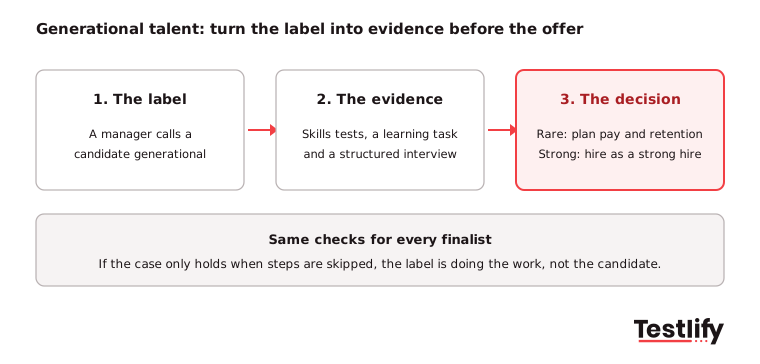
Identifying generational talent in hiring means turning a big claim into checks you can score. Use the same steps for every finalist so the rare candidate is compared fairly against the rest.
1. Write down what "rare" means for this role
A clear definition of "rare" comes first. Name the two or three results that would set someone apart, such as shipping a product in half the usual time. Without this, the label is just a feeling.
2. Test the core skills directly
Role-based skills tests and work samples give every candidate the same starting point. Have every finalist take them, so scores sit on one scale.
3. Check how fast the person learns
A short task in an unfamiliar area shows how quickly the work improves with feedback. Speed of learning is what separates a rare ceiling from a strong current level.
4. Run a structured interview with several raters
A structured interview uses fixed questions and a shared scorecard. This keeps one impressive answer from swinging the whole decision.
5. Verify the track record with specifics
Reference checks work best when they ask for detail. Ask what the person did, how often and with what result, not whether they are "brilliant".
6. Decide on the role, not the label
The final decision should follow the evidence. If it shows a rare candidate, plan pay, scope and growth around it. If it shows a strong candidate, hire them as one.
Key takeaway: A generational talent should still pass the same scored checks as everyone else. If the case only holds when the checks are skipped, the label is doing the work, not the candidate.
Generational talent vs high-potential employee
Generational talent is often confused with a high-potential employee (HiPo), and with multigenerational talent. The table shows how the three differ.
Factor | Generational talent | High-potential employee | Multigenerational talent |
|---|---|---|---|
What it describes | One rare individual | Employees likely to grow into bigger roles | A workforce spread across age groups |
How common | A handful in a field per generation | Often a set share of staff in a talent review | Every large employer |
Main evidence | Results far above peers | Performance plus learning agility | Workforce demographics |
HR process | Selective hiring, retention plans | Talent reviews, succession planning | Hiring, learning and benefits design |
Best practices for generational talent
Use these practices whether you are hiring a rare candidate or simply hearing the label in an intake meeting:
- Ask "rare compared to whom?" A candidate who is the best in one city or one company may be strong but not generational. A clear comparison group keeps pay offers grounded.
- Keep the process the same for everyone: Skipping steps for a "sure thing" removes the evidence you need later and is unfair to other candidates.
- Keep age out of the language: "Generational" next to phrases like "digital native" can read as an age preference in a job ad. Watch for ageism and describe the skills you need instead.
- Plan retention before the offer: Rare performers have options. Agree on scope, growth and a mentor up front rather than after a counter-offer arrives.
- Build a bench, not a shrine: Pair the rare hire with people who can learn from them, so the team does not stall if they move on.
Pro tip: Across the teams we speak with, the most useful intake question is simple: "What would this person do in the first 90 days that a strong hire could not?" If nobody can answer, you are hiring for a strong performer, and that is fine.
The second meaning of the term points the same way. A skills-based approach helps every generation get a fair look: LinkedIn's 2025 report found it would expand the talent pool by 5.8x for Gen X, 6.1x for Millennials and 6.8x for Gen Z.
Whichever meaning you have in mind, the fair way to spot rare ability is to measure skills the same way for every candidate. For more data on this shift, see our skills-based hiring statistics.
Ready to see Testlify in action?
Testlify's test library has 3,500+ tests across technical and non-technical roles. A "generational" candidate and a strong one can be scored on the same scale before anyone makes an offer.
Book a demo to see how Testlify scores every candidate on the same scale. Our team can walk you through the setup for your roles.
Frequently asked questions (FAQs)
Generational talent means a person whose ability is so rare that someone at the same level appears only about once in a generation. The phrase started in sports scouting and is now used in business and hiring for exceptional candidates.
Cite this page
Copy a ready-made citation for this page in your preferred style.
- APA
Testlify. (2026). Generational Talent. https://testlify.com/hr-glossary/generational-talent/
- MLA
"Generational Talent." Testlify, 28 October 2026, https://testlify.com/hr-glossary/generational-talent/.
- Chicago
Testlify. "Generational Talent." Testlify. Last modified October 28, 2026. https://testlify.com/hr-glossary/generational-talent/.
- HTML link
<a href="https://testlify.com/hr-glossary/generational-talent/">Generational Talent</a>, Testlify (2026)
Related terms
Genetic-Based Discrimination
Genetic-based discrimination refers to the unfair treatment of individuals based on their genetic makeup, particularly in regards to inherited diseases or risk of developing them.
Geographic Differential
Geographic differential refers to the difference in pay or compensation based on the location of the job or employee, accounting for variations in cost of living, taxes, and other factors.
Ghent System
The Ghent System is a method of providing unemployment benefits through trade unions, primarily used in Denmark, Iceland, Finland and Sweden, with benefits based on previous earnings.
Gig Worker
A gig worker is an individual who works on a project-by-project or task-by-task basis, not considered traditional employees and often work as independent contractors, freelancers, or temporary workers.
Glass Ceiling
The invisible barrier that prevents women and minorities from advancing to higher-level positions within a company or organization.
Global Human Resource Management
GHRM is the process of managing the recruitment, selection, and management of an organization’s human resources on a global scale, including managing cultural and legal differences across countries and regions.
Get started.
Hire on proof, not resumes.
Run your first skills-based assessment free — no credit card required.