
How to hire a room attendant: a step-by-step guide for hotels
A practical guide for hotels: room attendant duties, skills to test, a 7-step hiring process, interview questions, pay and retention tips.
One no-show on a Saturday can leave a whole floor of rooms uncleaned. Housekeeping is the hardest hotel role to fill, so a slow or careless hiring process costs you shifts and reviews.
Here is how to hire a room attendant in three moves. Test skills first, keep the interview short, then confirm with a paid trial clean in a real room.
TL;DR:
- A room attendant cleans and resets guest rooms, and the title is nearly the same as housekeeper in most hotels.
- Testing skills before interviews saves supervisor time, because a short online test shows who can do the job before anyone books a slot.
- The 7-step hiring process runs in two to three weeks, so you can fill shifts before the busy season starts.
- A paid trial clean scored on a sheet shows real speed and standards, which a CV and an interview cannot.
- Pay averages about $15 to $17 an hour in 2026, but a faster hiring process often costs less than a higher hourly rate.
- Retention starts in the first two weeks, so a buddy shift, a fair quota and early schedules keep you from hiring for the same shift again.
 ChatGPT
 Gemini
 Claude
 Grok
 Perplexity
What does a room attendant do?
A room attendant cleans, resets and restocks guest rooms in a hotel, resort or serviced apartment so every room meets the property's standard before the next guest arrives. Room attendants work from a daily room list, split between checkouts (a full clean) and stayovers (a lighter service).
Typical duties include:
- Making beds and changing linen: to the hotel's standard, including tight corners and pillow layout.
- Cleaning bathrooms: toilet, shower, sink, glass and floors, with the right chemical for each surface.
- Dusting and vacuuming: high and low surfaces, under furniture and along edges.
- Restocking amenities: towels, toiletries, coffee and minibar items, to a room checklist.
- Reporting issues: broken fittings to maintenance, and lost property to the housekeeping office.
- Respecting guest privacy: following Do Not Disturb and key control rules.
- Updating room status: marking rooms clean, inspected or out of order in the housekeeping app or PMS.
A good room attendant protects your review scores. Guests rarely praise a clean room, but they always mention a dirty one.

Room attendant vs housekeeper: what is the difference?
A room attendant is a housekeeping team member who focuses on guest rooms, while "housekeeper" is a broader title that can cover public areas, laundry and private homes. In most hotels the two titles mean almost the same job, and many job boards use them as synonyms.
Title | Main area | Typical setting |
|---|---|---|
Room attendant (guest room attendant) | Guest rooms and bathrooms | Hotels, resorts, serviced apartments |
Housekeeper / housekeeping attendant | Rooms plus corridors, lobbies, laundry | Hotels, hospitals, private homes |
House attendant / houseman | Heavy lifting, linen runs, public areas | Larger hotels |
Room inspector / floor supervisor | Checks rooms cleaned by attendants | Mid-size and large hotels |
If you are hiring for a home or a cleaning company rather than a hotel, our guide on how to hire maids and housekeeping cleaners fits better.
What skills should a room attendant have?
Room attendants need a mix of practical cleaning skill, speed, care and honesty. Formal education is rarely required, and many good hires have no hotel experience at all, so judge what candidates can do rather than where they worked.
Indeed's hiring guide lists work ethic, reliability, integrity, discretion and flexible availability as the traits to check first.
Skill | Why it matters | Best way to check it |
|---|---|---|
Cleaning technique | Rooms meet the standard first time | Online test, then trial clean |
Attention to detail | Hair, dust and smudges drive bad reviews | Trial clean, photo comparison questions |
Time management | Every room is cleaned before check-in | Timed trial clean, prioritising scenarios |
Chemical and safety knowledge | Prevents injuries and damaged fittings | Test questions, trial clean |
Customer service | Attendants meet guests in corridors and rooms | Scenario questions, short interview |
Honesty and discretion | Attendants handle guest belongings daily | Lost property and privacy scenarios, references |
Reliability | One no-show leaves a whole floor uncleaned | Reference checks, attendance history |
Physical stamina | The job means lifting, bending and walking all shift | Trial clean, honest job preview |
The Room Attendant test covers five of these in 15 minutes: cleaning technique, attention to detail, time management, organization and customer service.
Pro tip: Do not screen out candidates for lack of hotel experience. Cleaning in hospitals, offices or homes transfers well, and a 15-minute test tells you more than a CV line.
How to hire a room attendant: what are the 7 steps?
Hiring a room attendant takes seven steps: plan headcount and shifts, write a clear job ad, source locally, screen with a short skills test, run a structured interview, confirm with a paid trial clean, then make the offer and onboard. Most hotels can run all seven in two to three weeks.
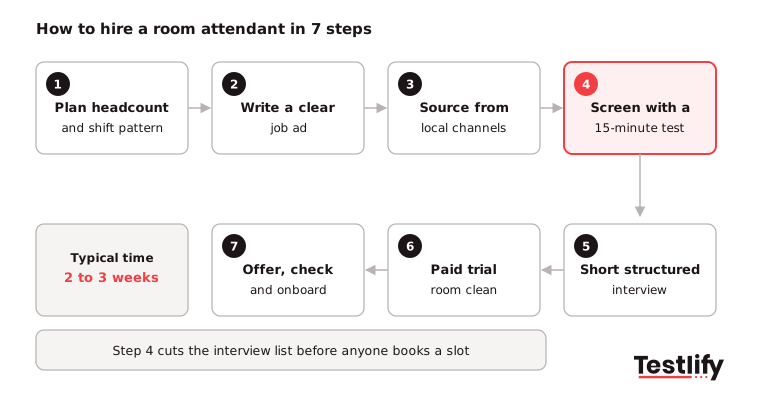
- Plan headcount and shift pattern. Work out how many rooms you clean on a peak day and divide by a realistic rooms-per-shift target. Decide the split of full-time, part-time and seasonal staff. A city hotel with steady occupancy needs a full-time core; a resort may need seasonal hires for peak months.
- Write a clear job ad. State pay, shifts, weekends and the physical demands up front. Candidates for hourly roles skip ads that hide the rate. Use the outline in the job description section below, or adapt our housekeeper job description template.
- Source from local channels. Room attendants live near the property, so local job boards, referrals and community groups beat national campaigns. More on this below.
- Screen with a 15-minute skills test. Send every applicant the same short test before anyone books an interview slot. Shortlist by score and availability, not by CV. Mobile-friendly tests matter here, because most hourly candidates apply from a phone.
- Run a short structured interview. Fifteen to twenty minutes, same questions for every candidate, scored on a simple 1 to 5 scale. Focus on scenarios, availability and honesty.
- Confirm with a paid trial clean. Ask the top candidates to clean one checkout room with a supervisor watching, scored on a sheet (see the next section). Pay for the time.
- Offer, check and onboard. Check references and right to work (in the US, complete Form I-9 within three business days of the start date), make the offer within 24 to 48 hours of the trial, and book a buddy shift for day one.
Step 4 does most of the work in volume hiring. When a new property opens or summer starts, one housekeeping manager may face hundreds of applicants.
A test filters them in a day, so interviews go only to people who can do the job. Our volume hiring page covers how teams run this at scale.
How do you test a room attendant's skills?
Room attendant skills are best tested in two stages: a short online test to shortlist, and a paid trial clean to confirm. The online test checks knowledge and judgment for every applicant at low cost.
The trial clean shows real speed and standards, but takes supervisor time, so keep it for the final two or three candidates.
Stage 1: the online test. A blue-collar skills test such as the Room Attendant test asks 15 questions on cleaning methods, room setup, prioritising, organization and guest service.
Add a few situational judgment questions on lost property or a guest asking for extra cleaning. Add a time management test if your rooms-per-shift target is tight.
Stage 2: the trial clean. Pick a checkout room, give the candidate your standard checklist and the cart, and set a time target for that room type.
A supervisor scores six areas.
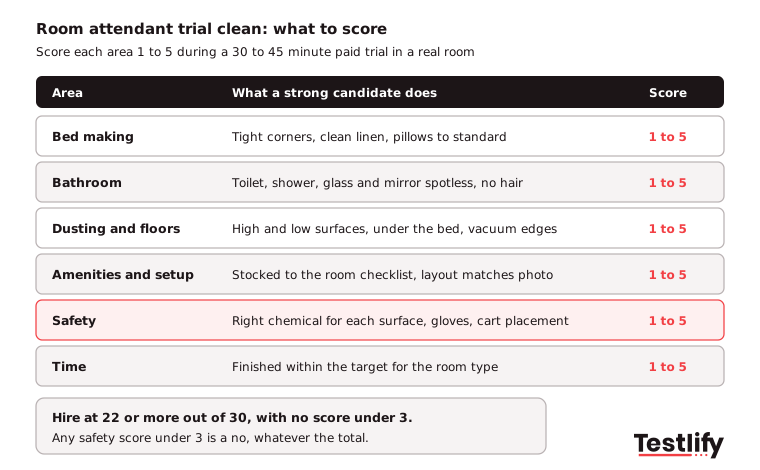
Score safety separately from the total. A candidate who mixes bleach with an acid cleaner, or uses glass cleaner on a marble top, needs training before they work alone, whatever their speed.
The OSHA Hazard Communication standard requires employers to train staff on the chemicals they use. The trial also tells you how much training each hire needs.
What interview questions should you ask a room attendant?
Room attendant interviews work best with 8 to 10 scenario and availability questions, asked the same way to every candidate. Scenario questions show how candidates think when nobody is watching, which matters in a job done alone behind a closed door.
### Cleaning and standards
- Walk me through how you clean a checkout room. Good answer: a clear order (strip the bed, start chemicals in the bathroom, dust top to bottom, floors last) and a final check.
- You have 14 rooms and two late checkouts. How do you plan your shift? Good answer: stayovers and early checkouts first, a call to the supervisor about the late rooms, no corners cut.
- Which products would you use on a mirror, a marble counter and a toilet? Good answer: names the right type of product for each and mentions gloves and never mixing chemicals.
### Honesty and guest privacy
- You find cash and a watch under the bed of a checked-out room. What do you do? Good answer: does not touch more than needed, logs it and hands it straight to the housekeeping office, following the lost property process.
- A room shows Do Not Disturb all day. What do you do? Good answer: does not enter, tells the supervisor, follows the hotel's welfare check rule.
- A guest comes back while you are cleaning and asks you to leave. How do you respond? Good answer: polite, offers to return at a set time, updates the room status.
### Teamwork and reliability
- Tell me about a time you could not finish your work on time. What happened? Good answer: owns the problem, asked for help early, learned something.
- A colleague keeps skipping parts of the checklist. What would you do? Good answer: raises it with them, then a supervisor if it continues.
- Which shifts, weekends and holidays can you work? Good answer: a clear, honest answer you can plan around.
- Why do you want to work in housekeeping here? Good answer: a real reason, such as hours that fit, the location or growth into a supervisor role.
Score each answer 1 to 5 on a shared sheet. Two interviewers comparing scores is fairer than one person's gut feel, and it gives you a record if a hiring decision is ever questioned.
Where can you find good room attendants?
Good room attendants are usually found locally: through employee referrals, local job boards, community groups and nearby training programs. National job ads bring volume, but a long commute makes early shifts and split shifts hard to keep, so recruit close to the property.
- Employee referrals: your best attendants know others who work like them. Pay a referral bonus after the new hire passes 60 or 90 days.
- Job boards: Indeed and local boards, with pay and shifts in the title. Keep the application short and mobile-friendly.
- Community and language groups: many strong candidates are reached through local community centers, churches and language groups. Post the ad in the languages your team speaks.
- Hospitality schools and workforce programs: local colleges, job centers and resettlement programs often run housekeeping courses.
- Rehires and alumni: seasonal staff who did well last year are the fastest hires you will make. Keep their details and call them first.
- Internal moves: laundry or public-area staff who want more hours can move into rooms quickly.
For a wider view of hotel staffing, read our guide on how to hire hotel and hospitality staff.
How much does it cost to hire a room attendant?
Room attendants in the US earn about $15 to $17 an hour on average in 2026, with pay above $20 an hour in high-cost cities and unionized hotels. Indeed's salary data shows an average of $15.48 an hour and a most common rate of $16.73, with a range from $7.25 to $30.80 depending on location, property type and experience.
Factor | Effect on pay |
|---|---|
Location | Large coastal cities and resort towns pay the most |
Property type | Luxury and resort hotels pay more than economy hotels |
Union contract | Sets rates, room quotas and raises in many big-city hotels |
Shift | Weekend, night and holiday shifts often carry a premium |
Experience | Supervisor-ready attendants and inspectors earn more |
Pay alone does not fix staffing. An AHLA survey run with Hireology found 65% of US hotels short-staffed in early 2025, with housekeeping the hardest role to fill at 38%, ahead of front desk at 26%.
A year later, the AHLA Front Desk Feedback survey from 2026 showed more than half of hotels were still short-staffed, even though 70% had raised pay.
The hidden cost is the empty shift. When an attendant quits, the rooms still need cleaning, so you pay overtime or agency rates, or leave rooms out of order. A faster, better hiring process is often cheaper than a higher hourly rate.
What should a room attendant job description include?
A room attendant job description should include the pay rate, shift pattern, a short list of duties, the physical demands, the must-have requirements and how to apply in one or two steps. Put pay and shifts in the first lines: hourly candidates scan for them before anything else.
Use this outline:
- Job title: Room Attendant (or Guest Room Attendant), plus property name and location.
- Pay and shifts: hourly rate, full-time or part-time, weekend and holiday expectations.
- About the property: one or two lines on the hotel and team.
- Duties: five to seven bullets, from bed making to reporting maintenance issues.
- Requirements: availability, ability to stand and lift for a full shift, right to work. Keep "nice to haves" (prior hotel experience, a second language) separate.
- Benefits: meals, uniform, transport help, hotel discounts, flexible scheduling, training and promotion paths.
- How to apply: a short mobile form, then a 15-minute skills test.
How do you keep room attendants after you hire them?
Room attendants stay when the first two weeks go well, schedules are predictable and the room quota is fair. The first weeks are when new hourly staff decide whether to stay, so retention starts at onboarding, not at the annual review.
- Give a buddy for the first shifts: pair each new hire with an experienced attendant for two or three shifts before working alone.
- Ramp up the quota: start below the full rooms-per-shift target and build up over two weeks.
- Publish schedules early: two weeks ahead where you can. In the AHLA 2026 survey, flexible scheduling and hotel discounts were each offered by 54% of hotels, so candidates now expect them.
- Explain the chemicals and the equipment: short, practical safety training in the language each attendant reads best.
- Show a path up: room inspector, floor supervisor, then assistant executive housekeeper. A clear path keeps your best people.
- Check in at 30, 60 and 90 days: ask what is getting in the way and fix one thing each time.
We have seen the clearest signal come from comparing the test score with the trial clean result: when both are strong, the new hire is usually ready for the full quota sooner, and when they disagree, the onboarding plan should cover the gap. Our guide to pre-hire assessments for hospitality goes deeper on this.
Key takeaway: Hire on a skills test plus a trial clean, then protect the first month. That combination fixes more housekeeping vacancies than pay rises alone.
How does Testlify help you hire room attendants?
Testlify helps hotel and hospitality teams screen room attendant applicants with a ready-made Room Attendant test, so the interview list is built on skills rather than CVs. Candidates take the 15-minute test online, and the hiring team sees a ranked shortlist with scores for each skill.
- Ready-made tests: the Room Attendant test and the Maids and Housekeeping Cleaners test, plus situational judgment and time management tests, from a library of 3,500+ tests. You can add your own questions, such as scenarios built around your room standard, from 25+ question types.
- Built for volume: auto-invites, score thresholds that shortlist automatically and WhatsApp invites and reminders, useful when hiring hundreds of attendants for a new opening or a busy season.
- Short video answers: one-way video questions let candidates answer two or three scenario questions on their own time, so supervisors only meet the best fits.
- Fair and consistent: every candidate gets the same questions and scoring, with 20+ proctoring checks for remote tests.
- Works with your ATS: 100+ ATS and HRIS integrations, so scores land where your recruiters already work.
- Multilingual teams: the platform supports 15+ languages, which helps when your housekeeping team speaks several.
Want to screen room attendants across several properties? Book a demo and see how Testlify fits your hiring process.
Frequently asked questions (FAQs)

Human Resources Lead
Snehi Parmar leads People at Testlify, owning hiring, culture, performance, and retention for a 90-person team. She writes on practical HR strategy and building people processes that scale.
Related resources
View all
Hiring Guide
How to hire a retail sales associate?

Hiring Guide
How to hire a repair technician?

Hiring Guide
How to hire a machine operator?

Hiring Guide
How to Hire Logistics and Shipping Workers: A 2026 Guide
Hiring Guide
How to find the perfect digital marketer for your business’s growth
Hiring Guide
How to hire a landscaper?
Get started.
Hire on proof, not resumes.
Run your first skills-based assessment free — no credit card required.