
How to hire a delivery rider?
Hire delivery riders by evaluating driving skills, punctuality, and knowledge of routes to ensure reliable and efficient service.
Hiring a delivery rider is not simply about finding someone who can get from point A to point B. A late delivery, missed order, or unsafe decision can quickly turn into a poor customer experience and higher operating costs.
The challenge is finding riders who can handle traffic, follow routes, communicate clearly, manage time, and stay reliable when the pressure picks up. That means your hiring process needs to assess more than driving ability.
In this guide, we’ll cover the skills that actually predict rider performance, what riders cost, where to find them, and how to test for reliability before a package is ever handed over.
 ChatGPT
 Gemini
 Claude
 Grok
Grok Perplexity
TL;DR
- Delivery riders are screened on evidence, not resumes: route sense, time management, customer handling and care with goods are all testable before an interview.
- Median pay for delivery drivers and driver/sales workers was $43,950 a year, or $21.13 an hour, in 2025, and the role needs about 152,700 new people every year.
- Transportation and warehousing sheds roughly 3.8 percent of its workforce every single month, so retention belongs in the hiring plan, not in a separate project.
- Your cheapest reliable channels are referrals from current riders, local community boards and a short application form. Paid job ads work, but they are the expensive option.
- Employee or contractor is a legal classification, not a preference. Get it wrong and the savings turn into back pay.
- A 20-minute skills test plus a structured interview beats an hour of gut feel, and it scales when you need 30 riders instead of 3.

What does a delivery rider actually do?
A delivery rider collects goods from a store, restaurant, warehouse or hub and delivers them to a customer, usually on a motorcycle, scooter, bicycle or small van, within a promised time window. The job is part navigation, part customer service, part cash-and-goods handling, and almost entirely unsupervised.
That last detail matters more than any line on a resume. Once the rider leaves the hub, nobody is watching. Every decision about speed, route, parking, how a fragile order gets handled and how an annoyed customer gets talked down happens alone, in traffic, against a clock.
Rider and driver are often used as if they mean the same thing, and they do not. A rider generally works two wheels, short urban hops, high drop counts per shift and direct customer contact at the door. A driver covers longer routes in a van or truck, fewer stops, more load handling.
If your role is really the second one, our hiring guide for delivery drivers maps that process more closely. The screening logic below still applies.
Demand is not softening. Census Bureau figures put e-commerce at 17.1 percent of total US retail sales in the second quarter of 2026, worth $340.2 billion in that quarter alone. Every one of those orders ends with somebody at a door.
What skills does a delivery rider need?
A delivery rider needs route and navigation sense, time management under pressure, safe vehicle handling, careful goods handling, clear customer communication, and the judgment to solve small problems alone. Hard skills keep the parcel intact and on time. Soft skills decide whether the customer orders from you again.
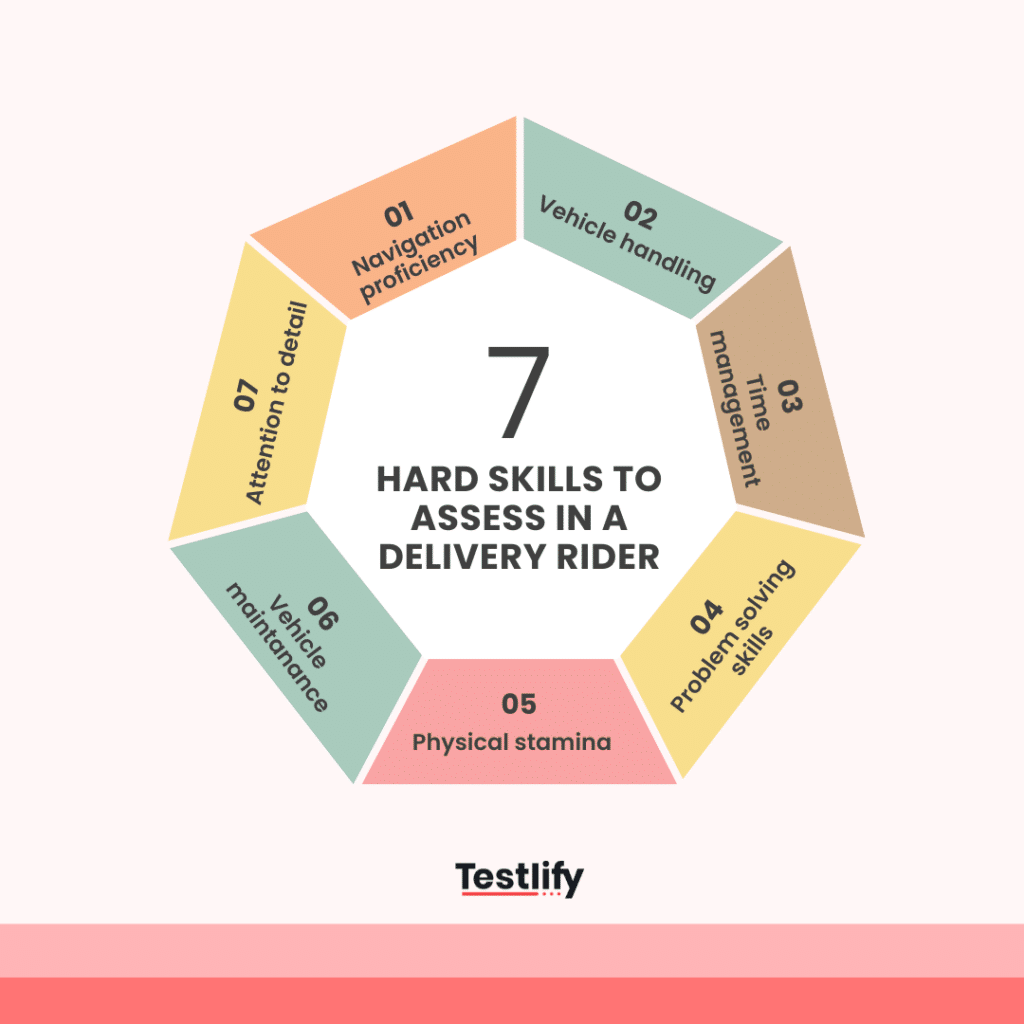
Hard skills to assess in a delivery rider
These are the abilities that show up in delivery metrics within two weeks of a rider starting. They are also the easiest to test for, which is why so few employers bother.
Navigation and route planning
A good rider can read a map, sequence multiple deliveries efficiently, and adjust when a road is closed or traffic changes. Use a realistic scenario with 10 to 15 stops rather than asking candidates whether they are “good with GPS.”
Time management
Riders need to understand delivery windows, estimate travel times realistically, and decide which order to prioritize when schedules overlap. A time management assessment can help measure this skill more objectively.
Safe vehicle handling and basic maintenance
Riders should know how to perform basic checks such as inspecting tire pressure, brakes, chains, fuel, and load balance. These simple habits can prevent breakdowns, delays, and avoidable safety issues.
Goods and cash handling
Delivery riders may be responsible for protecting fragile goods, maintaining food at the required temperature, collecting cash, and confirming proof of delivery. Assess whether candidates can follow handling procedures accurately even when they are working under time pressure.
Attention to detail
The right parcel must reach the right customer at the right address. An attention to detail test can assess whether candidates can spot mismatched names, addresses, order numbers, and delivery instructions before a mistake reaches the customer.
App and device fluency
Modern riders rely on delivery apps for navigation, order updates, customer communication, scanning, and proof of delivery. Candidates should also understand basic device management, such as maintaining battery life throughout a long shift.
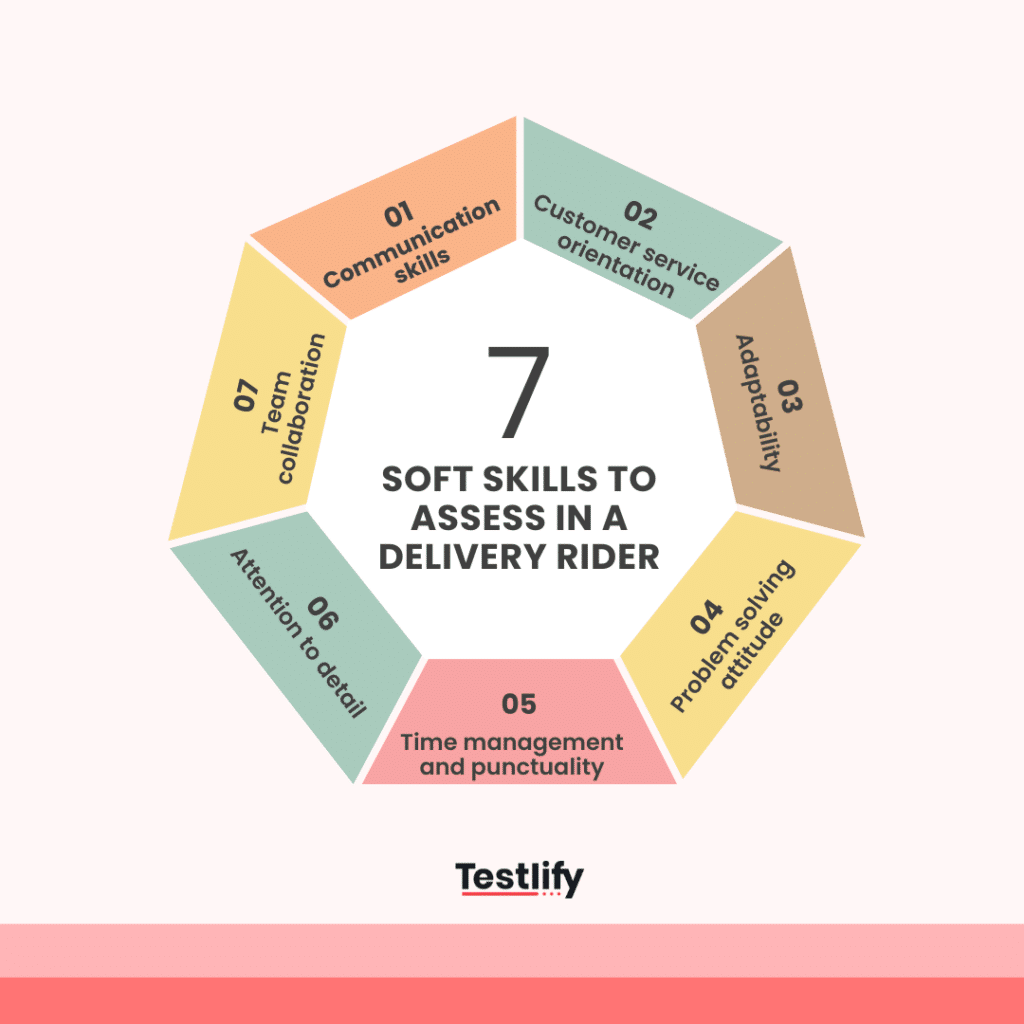
Soft skills to assess in a delivery rider
Riders are the only human contact most customers ever have with your brand. Treat these as core requirements, not as nice extras.
Customer communication
Riders need to communicate clearly, politely, and quickly, especially when customers are frustrated. A customer service assessment can show how candidates respond to complaints and difficult situations.
Problem solving
Wrong addresses, unavailable customers, blocked entrances, and damaged packages are part of the job. A problem solving test can reveal whether candidates can resolve common issues without escalating every problem.
Reliability and self-management
A reliable rider shows up on time, manages their route, and completes deliveries without constant supervision. This may sound basic, but consistency is one of the strongest indicators of day-to-day performance.
Patience and composure
Traffic, bad weather, difficult customers, and unexpected delays can quickly test a rider's patience. Assess whether candidates can stay calm and professional when a routine delivery becomes stressful.
Adaptability
Routes change, order volumes spike, and delivery apps can behave unexpectedly. An adaptability test can help identify candidates who can adjust quickly without letting disruptions affect their performance.
Pro tip: Rank these skills by route type before you write a single interview question. A rider doing 40 restaurant drops in a dense city centre needs speed, composure and customer handling. A rider carrying high-value electronics across suburbs needs care, documentation discipline and honesty. Same job title, different hire.
Delivery rider hiring process, step by step
Delivery rider hiring works best as a short, ordered funnel with one decision at each stage. Anything longer leaks candidates to whoever replied faster. Here is the sequence that holds up at volume.
1. Define the route, not the role
Start with the actual work. Define the vehicle type, shift pattern, expected drop count, average distance, cash handling, and whether the rider provides their own vehicle.
2. Set the employment classification
Decide whether you are hiring an employee, contractor, or agency worker before you advertise. The classification affects the pay structure, job ad, documentation, and onboarding process.
3. Write the ad to filter
Put the pay, working hours, delivery area, vehicle requirements, and key responsibilities upfront. A vague ad may generate more applications, but volume means little if most applicants cannot meet the requirements.
4. Screen with a short assessment
Use a focused 20-minute assessment to test route planning, time management, problem solving, and customer handling. It gives you a faster way to narrow the pool before investing time in interviews.
5. Interview the top group using a structure
Ask every shortlisted candidate the same core questions in the same order. Use consistent scoring notes so candidates are compared on evidence rather than gut feeling.
6. Verify licenses and required documents
Check the candidate's driving license, vehicle documents, insurance, and right to work before finalizing the hire. It is far easier to verify these requirements upfront than to fix a documentation problem after onboarding.
7. Make the offer quickly and in writing
Once you have made your decision, send the offer promptly with the pay, schedule, responsibilities, and start date clearly stated. A slow hiring process can give qualified riders time to accept another opportunity.
8. Onboard with a live first route
Do not expect a new rider to learn everything from a handbook. Shadow the first route, walk through the delivery app and operating procedures, and schedule a first-week check-in to address problems early.
Key takeaway
To hire a delivery rider, define the route and vehicle first, write a job ad that screens rather than flatters, test navigation, time management, and customer handling before the interview, then check license, vehicle, and right-to-work documents. The whole loop should take days, not weeks. Riders accept the first decent offer that arrives.
Best and most cost-effective ways to hire delivery riders
The cheapest reliable source of delivery riders is a referral from a rider you already employ, followed by local community channels and a very short application form. Paid job boards work at volume but cost the most per hire, and agency riders cost more again in exchange for speed.
Ranked by what they actually cost per rider who is still there in month three:
- Rider referrals: A small bonus paid at the 30-day mark, not on day one. Riders know who is reliable and they do not refer people who will embarrass them.
- Local and community channels: Neighborhood groups, colleges, community centres, shop windows near your hub. Unfashionable. Still works, because riders live near the routes they want.
- Your own careers page and a short form: Four fields and a phone number. Every extra field is a rider who gave up halfway.
- Job boards: Fast, broad, and priced accordingly. Worth it for a launch or a seasonal spike but wasteful as a permanent channel.
- Staffing agencies: The premium option. Sensible when you need 25 riders in two weeks and have no bench.
Dedicated rider solutions vs gig platforms
A dedicated rider solution means riders who work your routes only, whether they are your employees, your contractors or supplied by an agency. Gig and on-demand platforms mean shared riders who take your job when it pays best. The choice sets your ceiling on service quality.
Factor | Dedicated riders | Gig or on-demand platform |
|---|---|---|
Cost shape | Fixed, predictable per shift | Variable, spikes at peak demand |
Brand control | Uniform, training, your standards | Limited, rider works for several brands |
Availability at peak | Guaranteed by roster | Competitive, you bid against others |
Speed to scale | Weeks | Same day |
Best for | Steady volume, fragile or high-value goods, repeat customers | Launches, seasonal peaks, unpredictable demand |
Plenty of operations run both: a dedicated core sized to normal volume, with platform capacity absorbing the peaks. That hybrid only works if the dedicated core is genuinely reliable, which puts the weight back on screening.
How to apply as a delivery rider
To apply as a delivery rider, you need a valid license for the vehicle, proof of right to work, insurance that covers delivery use, a roadworthy vehicle if you supply your own, and a phone that can run a delivery app all day. Most employers ask for a short application, a skills check and one interview.
Riders reading this: apply to the employer directly rather than through an aggregator where possible, have your documents photographed and ready before you start the form, and ask about pay structure, fuel or mileage, and who covers insurance. Those three questions tell you more about a job than any advert will.
Employers, this section is worth your attention too, because it is where funnels leak. If you want to know why a job ad pulled 200 clicks and 11 applications, look at what you asked a rider to do on a phone, standing in the street, between deliveries.
Every document upload, every account creation, every "tell us about yourself" box costs you candidates who were perfectly qualified and slightly busy. Ask for the minimum at application, verify documents at offer stage, and let the assessment do the filtering instead of the form.
How much does it cost to hire a delivery rider?
Pay is the highest single cost and the easiest to benchmark. The Bureau of Labor Statistics reports median pay for delivery truck drivers and driver/sales workers at $43,950 a year, or $21.13 an hour, in 2025, across 1,511,400 jobs, with employment projected to grow 7 percent through 2035 and about 152,700 openings a year. Two-wheeled urban riders typically sit below that band, van-based couriers above it, and local rates move the number more than any national figure suggests.
The costs people forget:
- Vehicle and fuel: Either you provide and maintain them, or you pay a rate high enough that riders can. There is no third option that keeps riders.
- Insurance: Personal cover usually excludes delivery use. Check it explicitly.
- Kit: Thermal bags, phone mounts, safety gear, uniform.
- Training and the first week: A rider shadowing routes is a cost, not a delivery.
- Turnover: The expensive one. Every replacement means advertising, screening, onboarding and two weeks of below-rate productivity, all over again.
Whether riders are employees or independent contractors changes the economics completely, and it is not simply a matter of preference. If you control their schedules, routes, and how they perform the work, they may legally be employees regardless of what the paperwork says.
Misclassification can result in back pay and other liabilities, turning a short-term saving into a debt with interest.
How do you test a delivery rider's skills?
Test a delivery rider with a short pre-hire assessment covering route sense, time management, customer handling and attention to detail, then confirm the physical side with a supervised trial route. Twenty minutes of testing before the interview ranks candidates on evidence and removes most of the guesswork from the shortlist.
Three things worth getting right:
- Test before you interview, not after: An assessment sent at application stage sorts 60 applicants into a shortlist worth talking to. Run it after the interview and you have already spent the expensive hour.
- Use scenarios, not trivia: "Which app do you use?" tells you nothing. "Two orders are due at 7:15, and one customer is not answering the door, what do you do?" tells you plenty.
- Score against the route: A rider who scores brilliantly on customer handling and poorly on care with goods is a great hire for hot food and a bad one for glassware.
The delivery rider assessment covers the core sub-skills in one sitting, and you can add a communications test or a teamwork test when riders work in hub-based crews.
A trial route still matters. Assessments predict judgment and reliability; they do not tell you whether somebody is comfortable on a loaded scooter in rain. Pair the two.
Delivery rider job description template
Keep it short, concrete, and honest about the hard parts. Riders read job ads on a phone, usually while doing something else.
Job title: Delivery Rider (state vehicle type and area)
About the role: One paragraph. Shift pattern, typical drop count, the area covered, who supplies the vehicle, and the pay range as a number.
Responsibilities:
- Collect and deliver orders within agreed time windows across a defined area.
- Plan and adjust routes using the delivery app and local knowledge.
- Handle goods with care, including temperature-sensitive and fragile items.
- Confirm deliveries, capture proof of delivery and reconcile any cash collected.
- Carry out daily vehicle safety checks and report faults immediately.
- Represent the brand at the door: polite, prompt, professional.
Requirements:
- Valid license for the vehicle class and a clean recent driving record.
- Right to work, plus insurance that covers commercial delivery use.
- Smartphone fluency and confidence with navigation apps.
- Physical fitness for repeated lifting and long shifts in all weather.
What we offer: Pay range, shift options, fuel or mileage terms, kit provided, referral bonus, and any progression into dispatch or hub roles. More job description templates are available if you are hiring across several positions, and if this is your first hourly hiring push.
What should you ask in a delivery rider interview?
Ask questions that force a specific story rather than a statement of intent. Every candidate says they are reliable. Few can describe what they did the last time a delivery went badly wrong.
- Walk through your last shift with 12 or more drops. How did you decide the order?
- Tell us about a delivery that went wrong. What happened, and what did you do in the next 10 minutes?
- A customer is angry about a late order that was late because of traffic. What do you say at the door?
- You have two deliveries due in the same 15-minute window on opposite sides of town. Which one moves, and how do you tell the customer?
- What checks do you do on your vehicle before a shift, and when did you last find a problem?
- How do you handle a delivery address that turns out to be wrong or inaccessible?
- What makes you stay in a rider job longer than a few months?
Score each answer against the same rubric, written before the first interview. Structured scoring is boring and it is the reason two managers can compare candidates they never both met.
Hire delivery riders on evidence, not gut feel
Pick the three competencies your route genuinely depends on, test for them at application stage, and interview only the riders who clear the bar. You can book a demo to see how Testlify can help you build a faster, evidence-based hiring process.
Key takeaways
- Define the route before the role. Vehicle, drop count, goods type and shift pattern decide which skills matter, and they differ more between rider jobs than most employers expect.
- Screen with a short assessment before interviewing. It ranks a large applicant pool on evidence and saves the expensive hour for the people worth meeting.
- Move fast. A 48-hour offer window is not a nicety in this market, it is the difference between hiring your first choice and your fourth.
- Budget for retention, not just recruitment. With transportation and warehousing separating 3.8 percent of staff monthly, the hiring plan that ignores month three is a plan to hire twice.
- Settle classification and documents early. License, insurance and employment status are cheap to check up front and expensive to fix afterwards.
FAQs

Senior Product Delivery Manager
Sankalp Menon leads Product Delivery at Testlify and builds repeatable, structured operating processes across teams. He writes on turning hiring into a measurable, repeatable workflow.
LinkedIn





Get started.
Hire on proof, not resumes.
Run your first skills-based assessment free — no credit card required.