
How can an NLP test unveil candidates hidden abilities?
What an NLP skills test measures, how it surfaces ability a resume cannot prove, and how hiring teams should use and read the scores.

A candidate’s resume may show what they have done, but does it reveal how well they think, understand language, and solve problems? In many cases, a candidate’s strongest abilities remain hidden because traditional hiring methods focus more on qualifications and experience than actual skills.
An NLP (natural language processing) test can help bridge this gap by evaluating how candidates interpret language, recognize patterns, understand context, and communicate ideas.
In this article, we’ll explore how an NLP test can uncover candidates’ hidden abilities, what skills it evaluates, and how recruiters can use it to make more informed hiring decisions.
TL;DR:
- An NLP test reveals hidden abilities by scoring what a candidate can do with language data, not what the CV claims, so strong people without an "NLP engineer" title still stand out.
- In hiring, NLP means natural language processing. It is not a neuro-linguistic programming or personality quiz.
- A good NLP test covers preprocessing, syntax and semantics, statistical and classical ML, embeddings, transformers, and evaluation and bias.
- The Testlify NLP test has 40 questions in 30 minutes at an intermediate level and suits NLP engineers, AI engineers and data scientists.
- Use it early to narrow a long list, pair it with machine learning and coding tests, then probe weak skill areas in the interview.
- Demand is rising: the US Bureau of Labor Statistics projects data scientist jobs to grow 35% from 2025 to 2035.
- An NLP test cannot judge seniority, product sense or teamwork on its own, and a person should make the final decision.
 ChatGPT
 Gemini
 Claude
 Grok
 Perplexity
What is an NLP test in hiring?
An NLP test in hiring is a timed skills assessment that checks how well a candidate understands and applies natural language processing, the branch of AI that lets software read, interpret and generate human language. Recruiters use it to screen NLP engineers, AI engineers and data scientists before spending interview hours on them.
The search term is confusing, so it is worth being clear. Search for "NLP test" and you will also find neuro-linguistic programming quizzes about thinking styles, and articles on using NLP to automate software testing.
Neither is a hiring test for language AI skills. Older articles, including earlier versions of this one, mixed these meanings and described NLP tests as personality profiles. A modern NLP skills test does not read personality. It measures technical knowledge and judgment on language data.
For the exact definition of the field itself, explore Testlify's tech glossary entry on natural language processing.

How can an NLP test unveil candidates' hidden abilities?
An NLP test unveils candidates' hidden abilities by replacing proxies with evidence. A CV shows tools, titles and schools. A test shows whether the candidate can choose the right preprocessing for messy text, explain why a transformer beats a simpler model on a task, or spot that accuracy is the wrong metric for imbalanced classes.
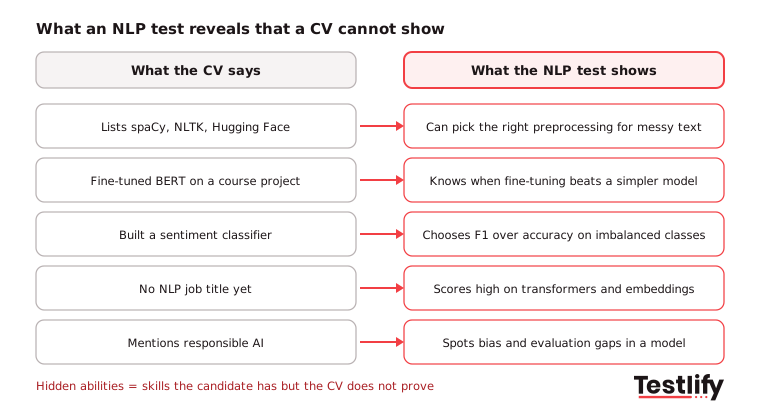
Hidden abilities usually show up in four ways:
- Ability without the title: A backend developer or analyst who has built NLP side projects can outscore people with "NLP" in their job title. A CV filter would have rejected them.
- Depth behind the keywords: Many resumes list spaCy, NLTK and Hugging Face. Scenario questions show who understands tokenization, embeddings and attention, and who only copied a tutorial.
- Judgment, not recall: Good questions ask what to do next with a real problem, such as a support ticket classifier that misses rare categories. That reveals problem solving that rarely comes through in a resume.
- Spiky profiles: Scores by skill area show strengths a single overall grade hides, for example a candidate who is weak on classical statistics but excellent on modern transformer models.
Key takeaway: The hidden ability is not mysterious. It is skill the candidate already has but the CV cannot prove, and a structured test gives every applicant the same chance to prove it.
What skills does an NLP test measure?
An NLP test measures the core knowledge an NLP practitioner uses every day, from cleaning raw text to judging whether a model is fair. The Testlify Natural Language Processing (NLP) test covers 12 skill areas, which group into six skill groups as seen in the table below:
Skill group | What it covers | Why it matters on the job |
|---|---|---|
Foundations and preprocessing | Tokenization, normalization, lemmatization, stemming, slang, emoji, Unicode | Real text is messy, and bad preprocessing breaks every model downstream |
Linguistic analysis | Morphology, part-of-speech tagging, constituency and dependency parsing, word sense | Shows the candidate understands language structure, not only libraries |
Statistical and classical ML | N-grams, smoothing, HMMs, CRFs, classification, sentiment, summarization | Simpler models are often cheaper and good enough |
Embeddings and vector semantics | Word2Vec, GloVe, contextual embeddings | The basis of search, recommendations and RAG systems |
Deep learning and transformers | RNNs, LSTMs, attention, BERT, GPT, T5, fine-tuning, compression | The models most production NLP work now runs on |
Evaluation, ethics and bias | Accuracy, F1, BLEU, ROUGE, perplexity, fairness, explainability | Decides whether a model is ready to ship |
The test also checks how candidates apply these ideas to use cases in healthcare, finance, legal, retail and customer service, which is where problem solving becomes visible.
Pro tip: Read the per-skill breakdown, not only the total. A candidate with a middling total but top marks in transformers and evaluation may be exactly right for an LLM product team.
Which roles should take an NLP test?
NLP tests suit any role that builds, tunes or evaluates language models. Testlify lists natural language processing engineers, AI engineers, data scientists and computer vision engineers as the main fits, and the test also works for machine learning engineers moving into language work and for computational linguists.
Match what you expect to the level you are hiring for:
Level | What a strong score should show | What to add |
|---|---|---|
Entry (0 to 2 years) | Solid preprocessing, tagging, basic classification and metrics | A Python coding test |
Mid (3 to 4 years) | Embeddings, transformers, fine-tuning, error analysis | A machine learning test and a short take-home task |
Senior (5+ years) | Trade-offs between model types, evaluation design, bias checks | A system design interview and portfolio review |
For a full role playbook, the NLP engineer hiring guide includes a job description, sourcing tips and interview questions.
Why do NLP tests matter for hiring decisions now?
NLP tests matter now because demand for language AI skills is growing faster than the supply of people who can prove them. The US Bureau of Labor Statistics projects data scientist employment to grow 35% from 2025 to 2035, with a median pay of $120,230 in May 2025. High pay attracts many applicants with thin experience, which makes screening harder.
Five reasons hiring teams add an NLP test:
- Faster screening: Automated scoring ranks a large applicant pool in hours, so engineers interview only the strongest candidates.
- Role relevance: You choose the skill areas that match the job, instead of testing generic coding alone.
- Fairer comparison: Everyone gets the same questions and scoring, which cuts down on judgments based on school, employer brand or how polished the CV looks.
- Better use of engineer time: Senior engineers spend interview hours on depth and design, not on checking basics.
- Data for the decision: Per-skill scores give the hiring panel shared evidence to discuss, instead of competing gut feelings.
AI tools also raise the bar. The Stack Overflow Developer Survey 2025 found 84% of developers use or plan to use AI tools, while 45.7% distrust the accuracy of AI output and only 32.7% trust it. Teams need NLP hires who can judge when a model's output is wrong, which is exactly what scenario questions test.
How do you add an NLP test to your hiring process?
You add an NLP test by placing it right after the application and before the first technical interview, then using the scores to decide who moves on and what to ask next.
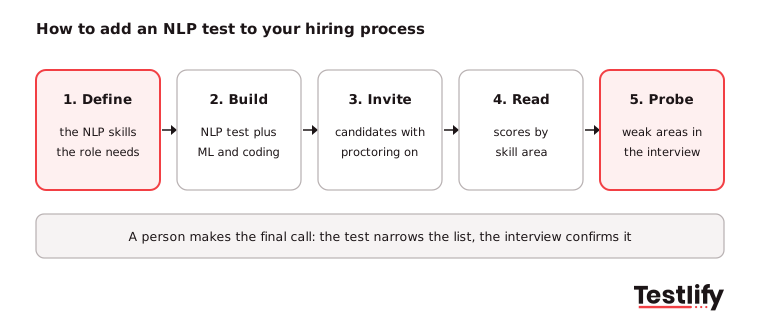
From assessing machine learning fundamentals to evaluating Python skills and problem-solving abilities, each stage should reveal something meaningful about the candidate's capabilities. Here are five steps to follow:
- Define the skills: List the NLP skills the role needs and the level for each. A search relevance role leans on embeddings and evaluation; a chatbot role leans on transformers and dialogue.
- Build the assessment: Combine the NLP test with the machine learning test and a Python coding task. The Testlify hiring guide also suggests a problem-solving test for structured reasoning.
- Invite candidates fairly: Explain what the test covers and how long it takes, give the same time limit to all, and switch on anti-cheating and proctoring so scores reflect the candidate's own work.
- Read the scores: Set a pass mark from the role level, then review per-skill results for candidates near the line instead of cutting them automatically.
- Probe in the interview: Turn each weak area into one or two interview questions. The NLP specialist interview questions are a good starting bank.
If your team runs on an ATS such as Greenhouse, Lever or Workday, Testlify's 100+ ATS integrations send invites and push scores back so recruiters do not copy results by hand.
How should you read NLP test results?
NLP test results should be read as a map of strengths and gaps, not a single verdict. Start with the overall score to narrow the list, then use the skill breakdown to decide what each finalist needs to prove in the interview.
A simple way to read them:
- High overall, even profile: Move forward. Use the interview for system design, past projects and team fit.
- High overall, one weak area: Move forward and probe the gap. A weak evaluation score, for example, deserves a question on choosing metrics for an imbalanced dataset.
- Middling overall, one standout area: Look closer. This is where hidden abilities often sit, especially for career switchers.
- Low on foundations, high on transformers: Be careful. The candidate may use models well but struggle when data is messy or a simpler method fits better.
- Low across the board: Reject with clear, polite feedback.
Two cautions from the older advice still hold. First, a test score is one input. Combine it with interviews and a work sample before you decide. Second, compare scores within one role and level; a pass mark for a junior data scientist is not right for a senior NLP lead.
What can an NLP test not tell you?
An NLP test cannot tell you how a candidate designs a system end to end, works with product managers, or handles ambiguity on a real project over weeks. A 30-minute test samples knowledge and judgment; it does not replace a take-home task, a portfolio review or a structured interview.
Keep three limits in mind:
- Seniority: Senior NLP work is about trade-offs and leadership. Test fundamentals, then judge seniority in design interviews.
- AI assistance: Candidates have chatbots a tab away. Proctoring helps, and scenario questions are harder to paste into a chatbot than definitions are.
- Compliance: If a tool scores candidates automatically, local law may apply. New York City's Local Law 144 on automated employment decision tools requires a bias audit within one year before use, public audit results and candidate notice, and has been enforced since July 5, 2023. Testlify publishes its own NYC bias audit.
Other vendors sell NLP tests too. TestGorilla's runs about 10 minutes, iMocha's has 10 questions in 20 minutes, and Adaface's has 12 questions in 25 minutes, according to their own test pages. Shorter tests are quicker for candidates but sample fewer skill areas, so check coverage before you choose.
Find hidden NLP talent with Testlify
Testlify gives hiring teams the NLP test alongside 3,500+ tests in the test library, so you can pair NLP with machine learning, Python and problem solving in one assessment.
Every candidate gets the same questions, 20+ proctoring checks guard the results, and per-skill reports show strengths a CV would miss. Start a 7-day free trial with no credit card, or book a demo to see the NLP test with your own roles.
Frequently asked questions (FAQs)

Head of Assessments
Usha brings a rare depth of expertise to Testlify’s assessment function, over 40 years of multidisciplinary experience spanning banking, insurance, healthcare, automotive, IT services, manufacturing, pharmaceuticals, and enterprise software. At Testlify, she ensures that every assessment, scoring methodology, and competency structure meets the highest standards of enterprise-grade transparency, fairness, and consistency, the kind that holds up under audit and earns the trust of the world’s most rigorous hiring teams.
LinkedInRelated resources
View all
Skill assessment
How can a performance marketing test unveil candidates’ hidden abilities?

Skill assessment
How to assess adaptability in candidates: a 2026 guide

Skill assessment
How can an accounting manager test unveil candidates’ hidden abilities?

Skill assessment
How can a product manager assessment unveil candidates’ hidden abilities?

Skill assessment
How to evaluate candidates’ skills with an Engineering Manager assessment
Skill assessment
How to evaluate candidates with a Google Analytics assessment
Get started.
Hire on proof, not resumes.
Run your first skills-based assessment free — no credit card required.