
What is an analytical test? Types, examples and how to use one in hiring
A plain guide to analytical tests for hiring teams: what they measure, the main types, sample questions and how to run one fairly.

A polished resume can hide a weak thinker, and a plain one can hide your best hire. You often find out which only after hours of interviews.
An analytical test fixes that by checking how candidates break down information, spot patterns and reason to a sound conclusion. If you are asking what is an analytical test, it is a timed assessment with the same problems and scoring for everyone.
This guide shows what an analytical test measures, the six main types, sample questions and how to run one fairly. You will leave with a clear process you can add to your next opening.
TL;DR:
- An analytical test is a timed assessment of how a candidate reads information, spots patterns and reasons to a sound conclusion.
- The six main types are numerical, logical, inductive, verbal, critical thinking and data interpretation. Match the type to what the role relies on.
- Demand is high: the World Economic Forum found seven in 10 companies call analytical thinking essential in 2025.
- Keep screening tests to 20 to 40 minutes and send them to every applicant before a resume reaches a reviewer.
- Set the cut score from benchmark data for similar roles, not a round number like 70%.
- Read sub-scores, not just the total. Two candidates with the same score can have very different strengths.
- Treat the score as one signal. Pair it with a work sample and a structured interview, and check pass rates across groups.
 ChatGPT
 Gemini
 Claude
 Grok
 Perplexity
What is an analytical test?
An analytical test is a standardized assessment that measures how well someone collects information, interprets it and works to a logical conclusion under time pressure. Most versions mix numerical, logical, verbal and data questions, and the result is a score per area that hiring teams compare across candidates.
The term has a second meaning outside hiring. In laboratories, "analytical testing" means chemical analysis of a material or sample.
This guide is about the employment sense: the pre-employment test that reads a candidate's reasoning.
An analytical test is different from a knowledge test. It does not ask what a candidate has memorized about accounting or code.
It asks whether they can reason through information they have never seen before, which is closer to what most jobs ask of people every day.

What does an analytical test measure?
An analytical test measures the working parts of clear thinking: reading data correctly, following rules to a valid conclusion, spotting patterns, drawing accurate conclusions from text and separating relevant facts from noise. Good tests report a score for each area rather than one blended number.
The breakdown matters more than the headline score. A finance hire and a support lead both need analytical strength, but the finance role leans on numerical reasoning while the support lead leans on spotting cause and effect fast.
Two candidates can share the same total score and have very different profiles.
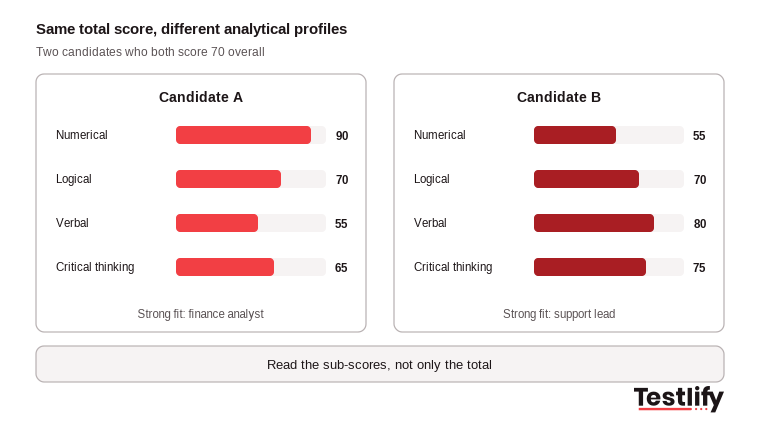
Reading the sub-scores is how you tell them apart. Ask your provider for an area-by-area report before you buy, because a single number hides exactly the detail a hiring manager needs.
What are the main types of analytical tests?
The main types of analytical tests are numerical reasoning, logical (deductive) reasoning, inductive or abstract reasoning, verbal reasoning, critical thinking and data interpretation. Each reads a different slice of the skill, so match the type to what the role demands instead of using one format for every opening.
Test type | What it asks the candidate to do | Best for |
|---|---|---|
Numerical reasoning | Read tables, charts and figures to reach the right value or trend | Finance, analytics, operations, sales ops |
Logical (deductive) reasoning | Follow rules or statements to a conclusion that must be true | Engineering, product, QA, technical roles |
Inductive or abstract reasoning | Spot the rule behind a sequence of shapes or numbers and predict the next one | Engineering, IT, science, graduate schemes |
Verbal reasoning | Draw accurate conclusions from a written passage | Legal, research, content, policy, comms |
Critical thinking | Weigh evidence, find flawed arguments and decide under pressure | Leadership, consulting, strategy, management |
Data interpretation | Combine several data sources and judge what they show | Data analysts, business analysts, marketing |
Many teams run a short mixed battery that samples two or three types, then go deeper on the one the role depends on most. You can build either from the numerical reasoning test, the logical reasoning test and the data interpretation test in the library.
What do analytical test questions look like?
Analytical test questions are short, self-contained problems with one correct answer, usually multiple choice. Candidates get all the information they need in the question, so prior knowledge does not help much.
Here is one sample per type, written for this guide.
- Numerical reasoning: Revenue grew 15% this year to $1,150,000. What was revenue last year? Answer: $1,000,000, because 1,150,000 divided by 1.15 is 1,000,000.
- Logical reasoning: All approved invoices are signed by a manager. Invoice 42 is not signed by a manager. What follows? Answer: Invoice 42 is not approved.
- Inductive reasoning: What comes next: 3, 6, 11, 18, 27? Answer: 38, because the gap grows by two each time (3, 5, 7, 9, 11).
- Verbal reasoning: A passage says a new policy cut overtime in two of three warehouses. Is "the policy cut overtime everywhere" true, false or impossible to tell? Answer: false.
- Critical thinking: Sales rose in the month a new ad ran. Does that prove the ad caused the rise? Answer: no. Other causes such as seasonality have not been ruled out.
- Data interpretation: A chart shows ticket volume up 20% and the support team unchanged. A second table shows average handling time flat. What most likely happened to response times? Answer: they got longer.
Real tests add a clock, often about a minute per question, and harder items as the test goes on. Scores are usually reported as a percentile against a benchmark group rather than a fixed pass mark.
Pro tip: Take the test yourself before you send it to candidates. If your own team finds an item ambiguous, candidates will too, and a confusing question measures patience, not reasoning.
What is an analytical test used for in hiring?
An analytical test is used in hiring to screen candidates on reasoning before interviews, so the shortlist is built on evidence rather than on who writes the smoothest resume. It gives every applicant the same problems and the same scoring, which makes comparisons fairer and faster.
Demand for the skill is the main reason. The World Economic Forum's Future of Jobs Report 2025 found that analytical thinking remains the top core skill for employers, with seven out of 10 companies considering it essential in 2025. The same report says employers expect 39% of workers' core skills to change by 2030, which makes the ability to learn and reason through new problems even more valuable.
Hiring teams usually see four benefits:
- Faster, more consistent shortlists: A scored test turns a stack of 50 applications into a ranked list in hours instead of days, and it removes the fatigue effect where the tenth resume gets a kinder read than the fiftieth.
- A fairer read across every candidate: Everyone faces the same task and the same scoring, so strong candidates from non-traditional backgrounds are not filtered out by resume style. See how Testlify helps reduce bias in hiring.
- Less interview time: Hiring managers talk only to the candidates who showed the skill, which saves time on both sides.
- A documented reason for every decision: A score gives a clear, recorded reason for advancing or rejecting someone, which matters if a decision is ever questioned.
Which roles need an analytical test?
Roles that run on judgment and data need an analytical test most: data and business analysts, finance and audit, operations, product and project management, engineering, consulting and most leadership positions. In these jobs a weak analytical hire shows up as slow or shaky decisions that cost far more than the test.
Employers look for the skill well beyond analyst titles. NACE's Job Outlook 2025 survey found that nearly 90% of employers look for evidence of problem-solving on new graduates' resumes, more than any other attribute.
The test is also worth running in roles people do not call analytical. A customer success lead who finds the real reason behind a churn pattern is doing analytical work.
So is an operations manager rebalancing shifts against demand, or a marketing strategist reading campaign data to decide where the next budget goes. If the day involves reading a situation and choosing a next step, an analytical test tells you something useful.
How do you choose the right analytical test?
Choosing the right analytical test starts with the role: list the reasoning the job really needs, then pick a test whose sections match it. After that, check six things before you commit, because a polished test that measures the wrong skill produces confident but misleading scores.
- Fit to the job: The question types should mirror the work. A numerical-heavy test suits an analyst; a critical-thinking test suits a team lead.
- Evidence it works: Ask the provider how the test was built and reviewed, and whether scores have been checked against on-the-job results for similar roles.
- Consistent results: The same candidate should score about the same on a retake. Ask for the provider's consistency data.
- Benchmarks: You need a comparison group, such as candidates for similar roles, to turn a raw score into a meaningful percentile.
- Candidate experience: Keep it short (20 to 40 minutes), mobile friendly and clear. Long, clunky tests push good candidates to drop out.
- Integrity and access: Look for proctoring that fits remote testing and support for accommodations such as extra time.
If no ready-made test fits, a custom test built from your own scenarios can work, as long as subject matter experts write and review it first. The wider cognitive ability tests range is the place to start when you need a broader read of how someone learns.
How do you add an analytical test to your hiring process?
Adding an analytical test to your hiring process works best as six steps: define the reasoning the role needs, pick matching sections, send the test to every applicant before human review, set the cut score from a benchmark, pair the score with other evidence and review sub-scores with the hiring manager.
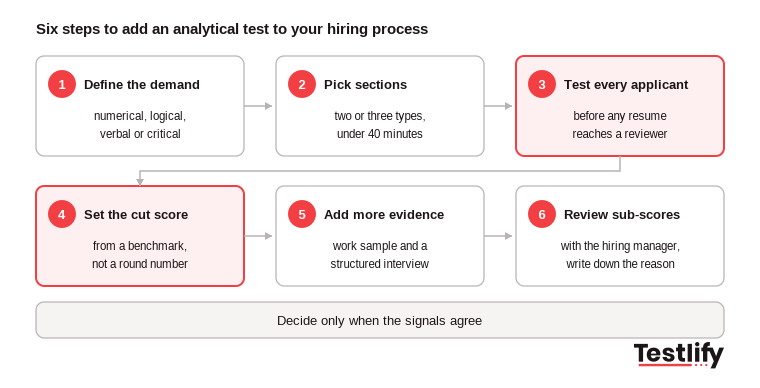
- Define the demand before you write the job post: Decide whether the role leans numerical, logical, verbal or critical thinking. A mismatched format measures the wrong skill.
- Pick the sections and the length: Choose two or three types and keep the test under 40 minutes for early screening. Save a deeper test for the shortlist if you need one.
- Screen every applicant before human review: Send the test before a resume reaches a reviewer, so the shortlist is built on a score rather than on reading order.
- Set the cut score from a real benchmark: Use the provider's benchmark data for similar roles instead of a round number like 70%. An arbitrary cutoff screens out qualified people for no reason you can defend.
- Pair the score with a work sample and a structured interview: Two or three role-relevant signals that agree give far more confidence than one. Read why a consistent hiring process matters.
- Review sub-scores with the hiring manager: Walk through the area scores and write down why the chosen candidate won. That written reason makes the decision easy to explain later.
As a rough example, a company hiring 20 analysts a year that tests before the first call might move from screening 50 applicants by resume to interviewing the 12 who showed the skill. That kind of cut is where most of the saved interview hours come from.
Key takeaway: An analytical test only helps if the score actually changes who you interview. Running the test and then picking the familiar resume anyway wastes the candidate's time and yours.
How should you prepare candidates for an analytical test?
Preparing candidates for an analytical test means telling them what it measures, how long it takes, how the result will be used and how to ask for adjustments. Clear instructions and a practice set lower anxiety, so the score reflects reasoning rather than surprise.
- Explain the purpose: Say that the test checks problem-solving and reasoning for the role and that everyone takes the same version.
- Share the format: Tell candidates the sections, the time limit and whether a calculator is allowed.
- Offer practice: A short practice test or sample questions help candidates, especially those who have not taken one before.
- Offer adjustments: Make it easy to request extra time or another format. The EEOC's guidance on employment tests says tests that screen out a protected group must be job-related and consistent with business necessity, and employers must provide reasonable accommodations for people with disabilities.
- Close the loop: Tell candidates when they will hear back, and give short feedback where you can.
What are the limits of analytical tests?
Analytical tests measure reasoning, not motivation, integrity or how someone works with a team. Used carelessly, they can screen out strong people for the wrong reasons, so treat the score as one signal in a wider decision.
- A score does not show motivation or values: Use a structured interview or references for those.
- Timed formats can penalize some strong performers: Some people reason well but freeze under a clock. A work sample catches them before you lose them.
- A poor cut score filters out good candidates: Set the line from benchmarks, then check it against how hires actually perform and adjust.
- Fairness needs checking: Review pass rates across groups regularly. If one group passes at a much lower rate, look at the test content and the cut score.
- Cheating is easier unsupervised: Remote tests need proctoring. Testlify includes 20+ anti-cheating and proctoring checks such as full-screen enforcement, tab monitoring and AI assistance detection.
How does Testlify run analytical tests?
Testlify runs analytical tests as part of one assessment: you pick ready-made reasoning tests or generate a role-specific assessment from your job description, invite candidates, and get a ranked list with a per-skill breakdown. Testlify's analytical ability test scores problem-solving, reasoning and decision-making in one standardized screen.
- Pick or build: Combine the analytical test with verbal reasoning, critical thinking and role-specific tests from a library of 3,500+ tests, or let the AI test builder suggest a test from your job description.
- Score and compare: Reports show per-skill scores, benchmarks and AI-written candidate insights, so hiring managers see where each candidate is strong.
- Fair and secure: 20+ proctoring checks, 15+ languages and a third-party bias audit of Testlify's matching model under New York City Local Law 144.
- Fits your stack: Results sync with 100+ ATS and HRIS tools, including Workday, Greenhouse and Lever.
Ready to screen for reasoning before the first interview?
Add an analytical test to your next opening and see a ranked, scored shortlist before you schedule a single call. Book a demo to see it on your roles, or start a 7-day free trial of Testlify, no credit card required.
Frequently asked questions (FAQs)

Head of Assessments
Usha brings a rare depth of expertise to Testlify’s assessment function, over 40 years of multidisciplinary experience spanning banking, insurance, healthcare, automotive, IT services, manufacturing, pharmaceuticals, and enterprise software. At Testlify, she ensures that every assessment, scoring methodology, and competency structure meets the highest standards of enterprise-grade transparency, fairness, and consistency, the kind that holds up under audit and earns the trust of the world’s most rigorous hiring teams.
LinkedInRelated resources
View all
HR & recruitment
How to simplify candidate screening with video interview

HR & recruitment
Why do you need Management test in your hiring process

HR & recruitment
Why do you need project manager test in your hiring process

HR & recruitment
Why do you need sql test in your hiring process

HR & recruitment
How to hire top talent using sql test

HR & recruitment
How to hire top talent using Javascript test
Get started.
Hire on proof, not resumes.
Run your first skills-based assessment free — no credit card required.