
40 ecommerce manager interview questions to ask in 2026
Ask ecommerce manager candidates about margin, growth, data, platforms and compliance, then score every answer on the same 1 to 5 scale.

Ecommerce manager interview questions test whether a candidate can grow online revenue at a healthy margin: setting prices and promotions, improving conversion, running the store platform and data, staying compliant and leading a team. The 40 questions below are grouped by skill area, with what a strong answer includes, sample answers, a scoring rubric and the red flags to watch for.
TL;DR / Key Takeaways
- Ask about margin before traffic. A strong ecommerce manager talks about contribution margin, discounts and returns, not only sessions and revenue.
- Cover five areas: commercial judgment, growth and conversion, platform and data, compliance and risk, and leadership.
- Use the same questions and the same 1 to 5 scale for every candidate, and score each answer during the interview, not from memory afterwards.
- Add a short case task, such as a 90-day plan to lift repeat purchases, because it shows real thinking better than any rehearsed answer.
- The biggest red flags are answers with no numbers, no failures and no clear decision.
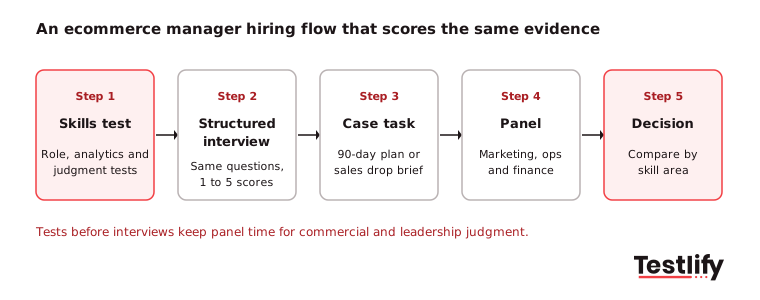
- Run a skills test before the interviews so the panel spends its time on judgment, not on checking basics.
 ChatGPT
 Gemini
 Claude
 Grok
 Perplexity
What does an ecommerce manager do?
An ecommerce manager owns the online sales channel: the store, its products and prices, the traffic and conversion targets, and the team or agencies that run it. In many companies the role also covers marketplaces such as Amazon, inventory planning with operations and the customer experience after the order.
O*NET's profile of online merchants lists tasks such as setting product prices, managing inventory, analyzing website usage data, optimizing storefront content for search and handling customer complaints. A senior ecommerce manager adds budget ownership and strategy on top of that list.

Which skills should ecommerce manager interview questions test?
Ecommerce manager interview questions should test five skill areas, because the role fails in different ways when any one is missing. A growth-only marketer can buy traffic at a loss; an operator without data skills cannot tell why sales dropped.
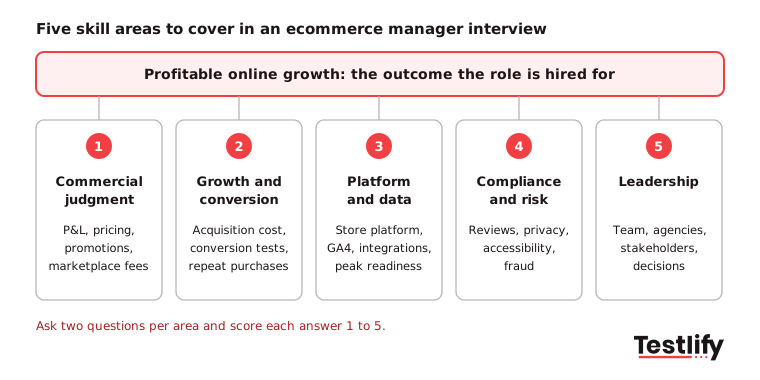
Skill area | What to test | A strong signal |
|---|---|---|
Commercial judgment | P&L, pricing, promotions, marketplace fees | Talks about contribution margin per order |
Growth and conversion | Acquisition cost, conversion rate, retention | Runs tests with a hypothesis and a stop rule |
Platform and data | Store platform, GA4, integrations, peak readiness | Knows where the data breaks and how to fix it |
Compliance and risk | Reviews, privacy, accessibility, fraud | Names the rule and the control they put in place |
Leadership | Team, agencies, cross-team alignment | Shows a decision they owned, including a failure |
If you are hiring a junior analyst rather than a manager, our separate list of ecommerce interview questions focuses on analysis and reporting skills.
Which commercial and P&L questions should you ask?
Commercial questions come first because an ecommerce manager is judged on profitable revenue. The channel is large and still growing: the US Census Bureau's quarterly e-commerce report puts US retail e-commerce sales at $340.2 billion in the second quarter of 2026, 17.1% of all retail sales, up 12.2% year on year while total retail grew 6.7%. A weak hire in this seat shows up quickly in revenue and margin, so ask for numbers from the candidate's own work.
- Walk me through the P&L of the last online store you ran. Which three lines did you watch every week? Look for: revenue, gross margin, acquisition cost, fulfillment and returns cost, with a reason for each.
- How do you decide whether a promotion is worth running? Look for: a margin check before launch, a control group or baseline, and a view on how discounts train customers to wait.
- How do you set and change prices for a catalog of several hundred products? Look for: cost and competitor inputs, price tests on a subset, and rules for slow-moving stock.
- When does it make sense to sell on a marketplace as well as your own site? Look for: fees, data ownership, channel conflict and the effect on brand pricing.
- How do you forecast demand for a peak season such as Black Friday? Look for: last year's data, marketing plan inputs, stock buffers and a plan for both a sell-out and an overstock.
- Which five numbers would you report to the CEO each week, and why those? Look for: a short list tied to profit, not a dashboard of every metric.
- How do you reduce return rates without hurting conversion? Look for: better product content and sizing data, return reason analysis, and fair return policies.
Which growth, conversion and retention questions should you ask?
Growth questions show whether the candidate grows revenue with discipline or only spends more. Ask for one real test they ran from start to finish.
- Tell me about one conversion test you ran. What was the hypothesis, the result and the decision? Look for: a clear hypothesis, sample size or run time, and what changed after the test, even when it lost.
- How would you lower customer acquisition cost by 15% in six months? Look for: channel mix, creative testing, landing page fixes and better targeting, not just cutting budget.
- How do you increase repeat purchase rate? Look for: email and SMS flows, loyalty or subscription ideas, post-purchase experience and a cohort view of results.
- Our mobile conversion rate is half our desktop rate. Where do you start? Look for: speed, checkout steps, payment options and form friction, checked with data before redesigning.
- How are you preparing the store for AI search assistants and shopping agents? Look for: clean structured product data, clear policies and reviews, and tracking of AI referral traffic.
- How do you decide what to personalize on the site? Look for: a few high-value segments, consent-based data and a test to prove the lift.
- How do you work with the SEO team or agency on category and product pages? Look for: content plans tied to search demand and shared targets. If SEO is the core of the role, add questions from our digital marketing manager interview questions.
Which platform, data and operations questions should you ask?
Platform and data questions separate managers who run the store from those who only report on it. Ask about a time the data or the site broke.
- How would you choose between two ecommerce platforms for a business our size? Look for: total cost, integrations with ERP and inventory, catalog complexity, team skills and migration risk.
- Describe a platform migration you led. How did you protect search rankings and orders? Look for: redirect mapping, a freeze period, test orders and a rollback plan.
- Our GA4 revenue does not match the platform's orders report. How do you find the gap? Look for: checking consent banners, duplicate or missing purchase events, refunds and currency settings.
- How do you measure the effect of site speed on sales? Look for: Core Web Vitals or speed data joined with conversion by page or device.
- Which integrations matter most between the store and the rest of the business? Look for: inventory, order management, payments, customer service and finance, and who owns each.
- How do you prepare the site and team for a peak sales event? Look for: load testing, a code freeze, stock checks, customer service staffing and a war-room plan.
- How do you keep inventory accurate across the site and marketplaces? Look for: one source of truth, sync frequency, safety stock and alerts for oversells.
Which compliance and risk questions should you ask?
Compliance questions are missing from most question lists, yet an ecommerce manager makes daily choices that carry legal risk. Ask what rule they follow and how they enforce it.
- How do you collect and show product reviews? What would you never do? Look for: no paid or fake reviews, disclosure of incentives, and no hiding negative reviews. The FTC's final rule on fake reviews bans fake and AI-generated reviews, undisclosed insider reviews and review suppression, with civil penalties for knowing violators.
- How do you handle tracking consent and customer data across regions? Look for: consent management, data minimization, and knowing when GDPR or US state privacy laws apply.
- How do you make sure the store is accessible to shoppers with disabilities? Look for: WCAG checks, testing with assistive tools and fixing checkout first.
- How do you reduce payment fraud without blocking good customers? Look for: fraud tools, review rules, chargeback tracking and a balance between false declines and losses.
- A marketing partner wants to run a "lowest price ever" claim. What do you check? Look for: price history evidence and legal or compliance review before launch.
Which leadership and behavioral questions should you ask?
Behavioral questions ask for past situations, because past decisions are the best evidence of how a candidate will act. Use a structured interview so every candidate gets the same questions in the same order.
- Tell me about an ecommerce launch that failed. What did you learn and change? Look for: ownership, a clear cause and a change in process, not blame.
- Describe a time you disagreed with a senior stakeholder about the online strategy. What happened? Look for: data, respectful challenge and a decision both sides could accept.
- How do you manage agencies and freelancers? How do you know they deliver? Look for: clear briefs, shared targets and regular reviews of results.
- How have you structured an ecommerce team, and what would you change? Look for: clear roles across trading, marketing, content and tech, and a reason for the design.
- Tell me about a time you had to choose between two good projects with one budget. Look for: expected impact, effort, risk and the courage to say no.
- How do you work with merchandising, operations and customer service? Look for: shared goals, regular rhythms and examples of solved conflicts.
- Describe a decision you made with incomplete data. Look for: a reasoned bet, a way to check it early and a fallback.
Which scenario and case questions should you ask?
Scenario questions show how a candidate thinks in real time. Give them a short problem and ask them to talk through their first steps.
- Online sales dropped 20% this week. Walk me through your first hour. Look for: checks on tracking, site errors, stock, traffic sources and campaigns before any big change.
- The site slows down during a major sale. What do you do right now? Look for: a contact with the tech team, a check on recent releases, removing heavy page elements and clear updates to customers.
- Reviews for a best-selling product are falling. What do you do? Look for: reading the reviews for a pattern, working with product and operations, and replying to customers.
- You have a fixed budget and must grow revenue 10% next quarter. How do you split it? Look for: a plan tied to margin and the strongest channels, with a test budget.
- What would your 30-60-90 day plan be in this role? Look for: listening and an audit first, quick wins next, then a strategy with targets.
- What is the first thing you would change on our website, and why? Look for: a specific, evidence-based idea from research done before the interview.
- How would you know, a year from now, that you were the right hire? Look for: clear, measurable outcomes the candidate is willing to be judged on.
Pro tip: For senior roles, turn question 37 into a take-home case. Give a one-page brief with real or sample numbers, ask for a 10-minute presentation and score it on the same rubric as the interview.
What do strong answers to ecommerce manager interview questions sound like?
Strong answers name the situation, the action, the number and the decision. Use these sample answers to calibrate the panel, not as a script candidates must match.
Sample answer for question 2 (promotions): "Before a promotion, I model the margin at the discount level and the extra volume we need to break even. On our last spring sale we needed 30% more orders to match normal profit. We got 18%, so we moved to targeted offers for lapsed buyers the next quarter." Why it works: The candidate checked margin first, measured against a baseline and changed course.
Sample answer for question 8 (conversion test): "We believed shipping costs at checkout caused drop-off, so we tested showing them on the product page. The test ran three weeks with enough traffic to read. Conversion rose slightly but average order value fell, so we kept it only for orders under the free-shipping line." Why it works: The hypothesis, the run time and a decision based on two metrics, not one.
Sample answer for question 17 (data gap): "I would first compare orders by day between the two systems to find where the gap starts. Common causes are consent banners blocking tags, a purchase event firing twice on the thank-you page and refunds missing from GA4. I would fix the tagging, then agree which system is the source of truth for revenue." Why it works: A clear method and knowledge of the usual causes.
Sample answer for question 27 (failure): "We launched a subscription option without testing the cancel flow. Complaints rose within a month. I paused new sign-ups, fixed the flow with customer service, and now every launch includes a customer service review." Why it works: Ownership, a fast fix and a lasting process change.
Key takeaway: The best answers are specific and include a decision. Polished answers with no numbers often hide a lack of hands-on work.
How do you score ecommerce manager interview answers?
Score each answer on a 1 to 5 scale right after the candidate answers, using the same scale for every interviewer. An interview scorecard keeps notes and scores in one place so the panel compares evidence, not impressions.
Score | What the answer shows |
|---|---|
5 | A real example with numbers, a clear decision and what they learned |
4 | A real example with a decision, numbers partly missing |
3 | Correct but general, no personal example |
2 | Vague, mostly theory or buzzwords |
1 | No example, wrong approach or off-topic |
Compare candidates by skill area, not only by total score. A candidate who scores 5 on growth and 2 on commercial judgment is a risk for a role that owns a P&L.
Which red flags should you watch for?
Red flags in ecommerce manager interviews usually show up as missing detail rather than wrong answers. Watch for these:
- No numbers: The candidate cannot name the conversion rate, margin or order volume of a store they ran.
- Only top-line growth: Every success story is about revenue, never about profit or cost.
- No failures: The candidate has never had a test lose or a launch go wrong.
- Tool lists instead of decisions: Answers list platforms and apps but never explain a choice.
- Blaming others: Problems were always the agency's, the developers' or the market's fault.
- No view on compliance: The candidate sees reviews, privacy and accessibility as someone else's job.
Where do skills tests fit in ecommerce manager hiring?
Skills tests fit before the first interview, so the panel only meets candidates who already show the core skills. This saves interview time for judgment, strategy and fit.
On Testlify, hiring teams combine role tests from a library of 3,500+ tests into one assessment. For this role, a useful mix is the E-commerce marketing manager test or the E-commerce marketplace manager test, a Google Analytics test and a data analysis test. A situational judgment test adds evidence on decisions with customers and stakeholders.
Testlify can also run structured AI interviews with the same questions for every candidate, protect results with 20+ proctoring checks and sync scores to your ATS through 100+ integrations. We have seen hiring teams move the "can they do the basics" questions from the interview into the test, which leaves the panel free for the commercial and leadership questions above.
Ready to hire your next ecommerce manager?
Build a role-specific assessment from the Testlify test library, invite your shortlist and compare every candidate on the same skills before the panel. Start a 7-day free trial with no credit card, or book a demo to see the e-commerce tests in action.
FAQs

Wordpress Developer
Yash Patel is a Wordpress and SEO Specialist at Testlify with 3+ years of experience in technical SEO, on-page optimization, and content strategy. He works on improving Testlify's organic presence and produces content focused on hiring, talent assessment, and HR technology.
LinkedInRelated resources
View all
HR & recruitment
60 Training Coordinator interview questions to ask job applicants

HR & recruitment
60 Procurement Coordinator interview questions to ask job applicants

HR & recruitment
60 vendor relations manager interview questions to ask job applicants

HR & recruitment
60 Media Relations Specialist interview questions to ask job applicants

HR & recruitment
40 sales operations analyst interview questions to ask in 2026

HR & recruitment
60 Community Manager interview questions to ask job applicants
Get started.
Hire on proof, not resumes.
Run your first skills-based assessment free — no credit card required.