
50 content marketing specialist interview questions to ask job applicants
Interview questions for content marketing specialists, grouped by skill, with sample answers, red flags, a scorecard and a work sample.

Content marketing specialist interview questions help you find the person who will plan, write, optimize and promote your content every week, not the one who only talks well about strategy. The best questions ask for real pieces, real numbers and real decisions, and every answer is scored against the same criteria.
TL;DR / Key Takeaways
- The best content marketing specialist interview questions ask candidates to walk through one piece they planned, wrote, optimized and promoted, with the numbers it produced.
- Test six skills: writing and editing, SEO and AI search, distribution, analytics, audience and strategy, and responsible use of AI tools.
- AI tools are now standard. CMI and MarketingProfs found 88% of B2B marketers use AI content tools, so ask how candidates check accuracy and keep brand voice.
- Score every answer on a 1 to 5 scale with agreed anchors. Structured, scored interviews give fairer and more consistent decisions than free-form chats.
- Run a skills test and a short, timed work sample before the final interview, so the interview probes real work instead of a polished portfolio.
- Red flags: vanity metrics only, no editing process, AI drafts published without checks, and blaming others for weak results.
Pro tip: Pair these questions with the content marketer test so only candidates who pass the skills screen reach the interview.
 ChatGPT
 Gemini
 Claude
 Grok
 Perplexity
What does a content marketing specialist do?
A content marketing specialist creates and runs the content that brings in and converts a target audience: blog posts, landing pages, emails, social posts, case studies and short videos. The specialist usually owns execution, from research and writing to SEO, publishing, promotion and reporting, while a manager or strategist sets the wider plan.
The role sits in a large job family. The US Bureau of Labor Statistics groups it with market research analysts and marketing specialists: 952,700 jobs in 2025, a median pay of $78,760 a year and about 82,000 openings a year, with 7% growth expected from 2025 to 2035, according to the BLS Occupational Outlook Handbook.
Scope differs by title, so match your questions to the job you are hiring for:
Content marketing specialist | Content marketing manager | Content strategist | |
|---|---|---|---|
Main job | Plan, write, optimize and promote content | Own the program, team and budget | Decide what to publish, for whom and why |
Typical output | Posts, emails, landing pages, social | Calendar, team goals, reporting to leadership | Audience research, content model, roadmap |
What to test | Writing, SEO, distribution, analytics | People leadership, budget, planning | Research, prioritization, measurement design |
Interview focus | Real pieces and their results | Team results and trade-offs | Decisions and the evidence behind them |
If you are hiring a broader content generalist, the content marketing interview questions for digital content specialists cover more formats. Set expectations early with a clear marketing specialist job description.

Which skills should content marketing specialist interview questions test?
Content marketing specialist interview questions should test six skills: writing and editing, SEO and AI search, distribution, analytics, audience and strategy, and judgment with AI tools. Writing and SEO are the core. Analytics and AI judgment separate specialists who publish a lot from specialists who publish content that works.
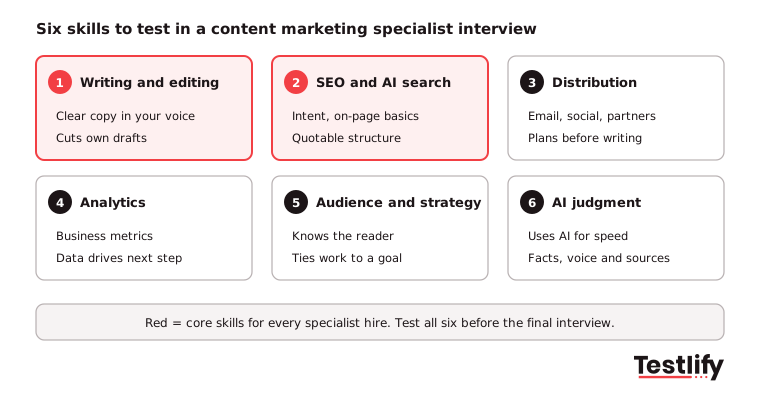
Pressure on these skills is rising. The CMI and MarketingProfs report B2B Content and Marketing Trends: Insights for 2027 found that 65% of B2B marketers felt pressure to produce content faster in the past year, and 43% of marketers who rated their marketing effective named team skills as a reason.
What are the best general content marketing specialist interview questions?
The best general content marketing specialist interview questions ask for one real piece of work, followed from idea to result. They show how the candidate thinks, what they own and how honestly they report numbers.
- Walk me through one piece of content you planned, wrote, published and promoted. What was the goal and what happened?
- Which piece of your work do you rate highest, and which one do you wish you could redo? Why?
- How do you decide what to write next when you have ten ideas and time for two?
- Who has been involved in your content process before, and how much editing did your work usually need?
- What does a good content brief include, and which part do writers most often skip?
- How do you research a topic you know little about, such as a technical B2B product?
- Which content formats have you produced, and which one do you understand best?
- How do you keep a content calendar on track when launches and requests keep changing it?
- Tell me about a piece that did not perform. What did you change afterward?
- What would you want to know about our audience before writing your first piece here?
Look for: Specific pieces, clear ownership ("I wrote", "I chose") and numbers the candidate can explain. Answers that stay at "we grew traffic" with no detail usually mean the candidate was near the work, not doing it.
Which questions test writing, editing and brand voice?
Writing and editing questions show whether a candidate can produce clear copy, take feedback and adapt to a voice that is not their own. Ask them alongside a short timed writing task, because a polished portfolio piece may have been edited by several people.
- How do you adapt your writing when a brand's voice is very different from your own style?
- Walk me through how you edit your own first draft. What do you usually cut?
- Tell me about the heaviest feedback you have had on a piece. How did you respond?
- How do you make a dense, technical topic easy to read without making it wrong?
- What is the difference between writing a landing page and writing a blog post?
- How do you check facts, numbers and quotes before you publish?
- Show me a headline you rewrote. Why was the second version better?
- How do you write for readers who skim on a phone?
Look for: A real editing routine, comfort with criticism and a fact-checking habit. For more writing-only questions, see these content writer interview questions.
Which questions test SEO and AI search knowledge?
SEO and AI search questions test whether the candidate understands search intent, not just keywords. In 2026, a content marketing specialist also needs to know how AI answers change clicks, because traffic from search is less predictable than it was.
- How do you choose the primary keyword for a new article, and how do you check the intent behind it?
- What do you look at on the first page of results before you write?
- How do you update an older post that has slipped in rankings?
- Which on-page elements do you always check before publishing?
- How do you structure an article so AI assistants and search features can quote it?
- Traffic to a key page fell 30% but rankings did not move. What do you check first?
- Which SEO tools have you used, and what do you use each one for?
- How do you avoid two of our own pages competing for the same search?
Question 24 matters more than it used to. In the CMI and MarketingProfs 2027 research, 31% of B2B marketers saw website traffic fall, and 79% of that group blamed AI-powered search. A strong candidate will mention AI answers, zero-click results and search features, then talk about what to measure besides clicks. For deeper SEO screening, use the SEO copywriting test.
Which questions test distribution and promotion?
Distribution questions show whether a candidate plans how content will reach people before writing it. Specialists who only publish and wait tend to produce good pieces that few people read.
- How do you plan distribution for a new piece before it is written?
- How do you turn one long article into content for email, social and sales?
- Which channel has worked best for you, and how did you know?
- How do you work with sales or customer success so they actually use your content?
- Have you worked with influencers, partners or guest contributors? How did you manage disclosure of paid or free arrangements?
- How would you promote a piece with no paid budget?
Question 31 is a compliance check as well as a skills check. The FTC Endorsement Guides FAQ says paid, free-product and affiliate connections should be clearly disclosed in the content itself. A specialist who runs creator or partner content should know this without prompting.
Which questions test analytics and reporting?
Analytics questions show whether the candidate measures what the business cares about and uses data to decide what to do next. Strong specialists connect content to pipeline, sign-ups or retention, not only page views.
- Which metrics do you report on for a blog program, and which ones do you ignore?
- Tell me about a decision you changed because of data.
- How do you show that a piece of content helped sales or sign-ups?
- What would you put in a one-page monthly content report for leadership?
- How do you run a simple test, such as two headlines or two email subject lines?
- Which analytics tools have you used, and what can you build in them without help?
Look for: One or two business metrics, a clear method and honesty about attribution limits. If the role leans on reporting, add the data analysis test to the screen.
How should a content marketing specialist use AI tools?
A content marketing specialist should use AI tools for research, outlines, first drafts and repurposing, then check every fact, keep the brand's voice and add original insight a model cannot. The CMI and MarketingProfs 2027 research found 88% of B2B marketers use AI content tools, and their top problems were accuracy (54%), quality control (54%) and brand voice (52%).
These questions show whether a candidate uses AI with judgment:
- Where in your process do you use AI tools today, and where do you never use them?
- How do you check an AI-assisted draft for accuracy before it goes live?
- How do you keep AI-assisted content in the brand's voice?
- What would you add to an article that an AI tool could not write?
- Should we tell readers when content is AI-assisted? How would you decide?
- Tell me about a time an AI tool gave you something wrong. How did you catch it?
Question 43 has no single right answer. The same research found 52% of B2B teams have no AI disclosure policy, so listen for a reasoned view rather than a rule.
Key takeaway: Do not screen out candidates who use AI. Screen out candidates who cannot explain how they check its output.
Which behavioral questions show how a specialist works with others?
Behavioral questions ask for past situations, which shows how the candidate actually works with editors, designers, subject experts and sales. Ask for one specific example and follow up on what the candidate did, not what the team did.
- Tell me about a time a subject expert would not give you time for an interview. What did you do?
- Describe a project where priorities changed halfway through.
- Tell me about a disagreement with a manager or client about a piece of content.
- Describe a time you missed a deadline. What happened next?
- Tell me about a time you convinced a stakeholder to change a piece of content.
- Describe a time you had to deliver results with almost no budget.
To keep these consistent across interviewers, use the same questions for every candidate and score them against agreed anchors, as explained in this guide to the structured interview.
What do strong answers to content marketing specialist interview questions sound like?
Strong answers to content marketing specialist interview questions name one piece of work, the candidate's own role, the method and the result, with numbers they can explain. The six samples below show the level of detail to expect. Treat them as examples, not scripts.
Q1. Walk me through one piece of content you planned, wrote, published and promoted.
Look for: A goal, a reader, a method and a result the candidate owned.
Sample answer: "Our sales team kept getting the same pricing objection, so I wrote a comparison guide aimed at buyers in their second call. I interviewed two account executives, wrote the draft and briefed design on one table. After launch, sales used it in follow-up emails and it became our second-highest converting page that quarter."
Q12. Walk me through how you edit your own first draft.
Look for: A repeatable routine and evidence they cut, not just polish.
Sample answer: "I leave the draft overnight, then read it aloud. I cut the intro to two sentences, check every number against its source and remove any paragraph that does not help the reader act. A 1,800-word draft usually ends near 1,400."
Q19. How do you choose the primary keyword for a new article?
Look for: Search intent, not only volume, and a check of the live results.
Sample answer: "I start with what our buyers ask sales, then check search volume and difficulty. Before I commit, I read the top results. If they are all product pages, a blog post will not rank, so I either change the keyword or change the format."
Q35. How do you show that a piece of content helped sales or sign-ups?
Look for: A clear method and honesty about attribution limits.
Sample answer: "I track assisted conversions in analytics and ask sales which pages they share. For one guide, 40 trial sign-ups had read it in the 30 days before signing up. I report that as influence, not as sole credit."
Q40. How do you check an AI-assisted draft for accuracy?
Look for: A real checking routine and ownership of the final text.
Sample answer: "I treat the AI draft like a junior writer's first pass. Every stat gets traced to its original source, and anything I cannot find is cut. I rewrite the intro and examples myself, because that is where our voice and our customers' stories live."
Q47. Tell me about a disagreement with a manager about a piece of content.
Look for: Evidence-based persuasion and respect for the final decision.
Sample answer: "My manager wanted a product-heavy launch post. I thought readers would leave, so I suggested we test it. We published a version that taught first and mentioned the product in the second half. It kept readers longer, and we used that structure for the next three launches."
What red flags should you watch for in a content marketing specialist interview?
Red flags in a content marketing specialist interview are signs that the candidate cannot show their own work, measure it honestly or take feedback. One weak answer is not a reason to reject someone, but a pattern across questions is.
- Only vanity metrics: Page views and likes, with no link to sign-ups, pipeline or retention.
- "We" with no "I": The candidate cannot say what they personally wrote, decided or changed.
- No editing process: Drafts go straight to publish, or editing means fixing typos.
- AI with no checks: The candidate publishes AI drafts as they are, or cannot say how they verify facts.
- Blame for weak results: The algorithm, the designer or the budget is always the reason.
- No questions about your audience: The candidate pitches ideas before asking who your readers are.
- A portfolio that does not match the work sample: The polished samples read very differently from the timed task.
How do you score content marketing specialist interview answers?
Score content marketing specialist interview answers on a 1 to 5 scale for each skill, using written anchors that every interviewer agrees on before the first interview. Each interviewer scores alone, then the panel compares and discusses large gaps. This keeps decisions consistent and easy to explain.
The US Office of Personnel Management notes that more structured interviews show higher rater agreement and less adverse impact, and that the best ones are built from job analysis and scored against proficiency benchmarks (OPM on structured interviews).
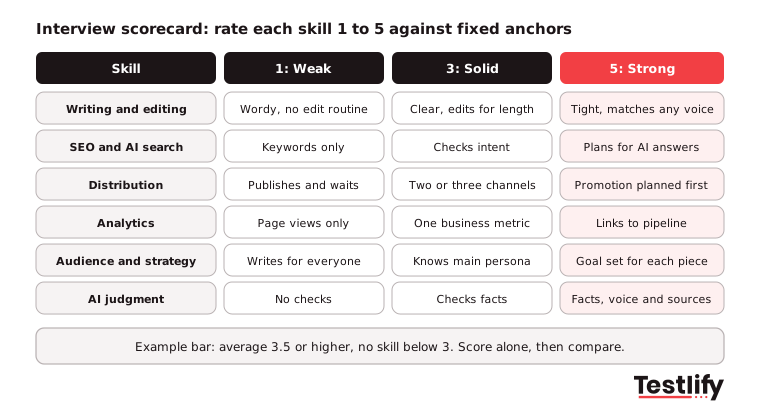
Set a bar before you interview, for example an average of 3.5 with no skill below 3. For a ready-made template, see how to build an interview scorecard.
Which skills test and work sample should you use?
Use a short skills test to screen applicants, then a timed work sample for the shortlist, before the final interview. The skills test checks knowledge at scale. The work sample shows how the candidate writes under realistic limits, and gives the interview something concrete to discuss.
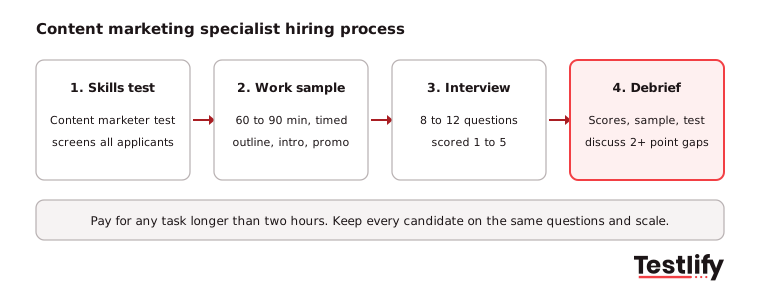
- Screen with a skills test: The 20-minute content marketer test covers content strategy, creation, distribution and measurement. Add the content writer test when writing quality is the priority.
- Set a 60 to 90 minute work sample: Give a short brief: audience, goal, keyword and two source links. Ask for an outline, an intro of about 200 words and a three-line distribution plan.
- Run the structured interview: Use 8 to 12 questions from this list, picked for the role, and score with the scorecard above.
- Debrief on evidence: Compare scores, the work sample and the test result. Discuss any skill where interviewers differ by two points or more.
Keep the take-home short and pay for anything longer than two hours. A timed, proctored task inside the assessment is fairer to busy candidates and harder to outsource. For more ideas, read these tips to evaluate content marketing skills.
Ready to hire your next content marketing specialist on proof?
Testlify lets you screen content marketing specialists on real skills before anyone books an interview. Pick the content marketer test, add a writing task with file upload or Google Docs questions, and send one link to every applicant. Copy-paste tracking and AI assistance detection, part of 20+ proctoring checks, help confirm the work is the candidate's own.
Browse 3,500+ tests in the Testlify test library, or start a 7-day free trial with no credit card. Want a walkthrough first? Book a demo.
Frequently asked questions

Wordpress Developer
Yash Patel is a Wordpress and SEO Specialist at Testlify with 3+ years of experience in technical SEO, on-page optimization, and content strategy. He works on improving Testlify's organic presence and produces content focused on hiring, talent assessment, and HR technology.
LinkedInRelated resources
View all
HR & recruitment
60 Partnership Manager interview questions to ask job applicants

HR & recruitment
60 Sales Support Specialist interview questions to ask job applicants

HR & recruitment
25 Business Operations Analyst interview questions to ask job applicants

HR & recruitment
60 Office Manager interview questions to ask job applicants

HR & recruitment
Best data entry specialist interview questions (2026)

HR & recruitment
60 Financial Planner interview questions to ask job applicants
Get started.
Hire on proof, not resumes.
Run your first skills-based assessment free — no credit card required.