
Testlify vs AQai: A detailed comparison
Discover the perfect solution for evaluating your candidates’ skills with Testlify. Dive into our comprehensive Testlify vs AQai comparison…
Testlify and AQai both sit a person in front of a structured assessment, and that is about where the resemblance stops. Testlify screens candidates on whether they can actually do a specific job. AQai measures adaptability, how someone copes when the work changes underneath them, and it was built mainly for coaching and development rather than for hiring. So the honest way to read a Testlify vs AQai comparison is to ask which of those two questions you need answered this quarter.
Trusted by 1,500+ hiring teams, from fast-scaling startups to enterprise talent acquisition functions
 ChatGPT
 Gemini
 Claude
 Grok
Grok Perplexity
TL;DR: Testlify vs AQai in 30 seconds
- They answer different questions. Testlify answers "can this candidate do the job?" AQai answers "how well does this person handle change?"
- Testlify is a pre-hire screening platform: role-based skills tests, coding tests, cognitive and personality tests, proctoring, and multi-reviewer scoring across a library of 3,500+ tests.
- AQai is an adaptability assessment built on its A.C.E. model, delivered mostly through certified coaches and consultants, and used for development more than selection.
- Pick AQai if you want to develop people you have already hired. Pick Testlify if you need to rank a pile of applicants before the first interview.
- They are not mutually exclusive. Adaptability is a real hiring signal, and it is one input among several rather than the whole picture.

What is the difference between Testlify and AQai?
Testlify is a pre-hire talent assessment platform that scores candidates on job-relevant skills before you interview them. AQai is an adaptability assessment that profiles how a person responds to change, and it reaches most buyers through certified coaches rather than as self-serve hiring software. One narrows a shortlist. The other develops a person.
That distinction matters more than any feature checklist, because it decides who inside your company owns the tool. Skills screening usually lives with talent acquisition and hiring managers who are measured on time-to-hire and quality of hire. Adaptability profiling usually lands with learning and development, or with an external coach running a leadership programme. Buying one when you needed the other is the most common mistake on this comparison, and no amount of feature parity fixes it.
Adaptability itself is not a soft nice-to-have. World Economic Forum research found that employers expect 39% of the skills a job needs to change by 2030, and it ranks resilience, flexibility and agility among the skills rising fastest in demand. The question is not whether adaptability counts. It is whether a standalone adaptability score is what you should be buying when the immediate problem is 400 applicants and two open roles.
How does AQai work?
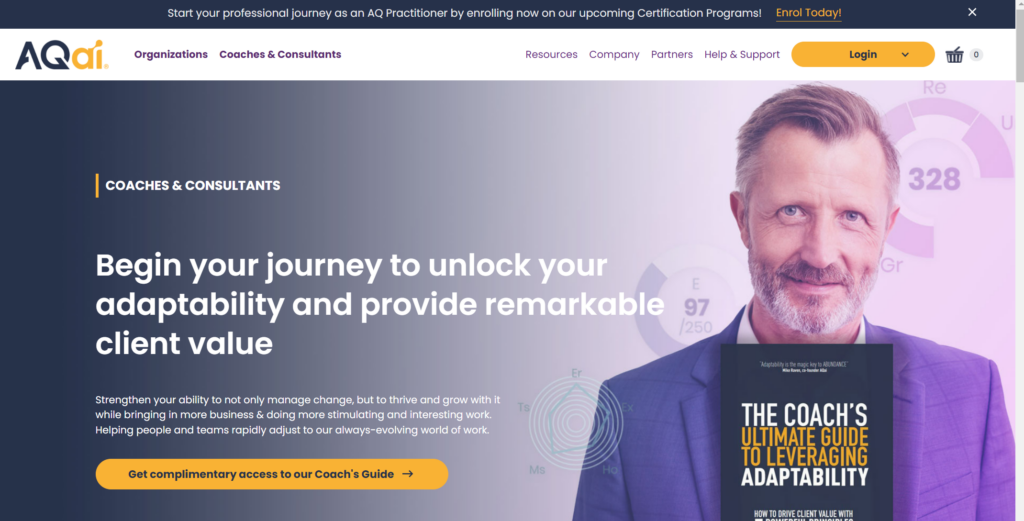
AQai measures what it calls the Adaptability Quotient through the A.C.E. model: Ability, Character and Environment. Each of those three dimensions carries five sub-dimensions, so a finished profile is 15 scored measures covering things like grit, mindset, unlearning, emotional health, team support and work stress. Candidates take a conversational assessment that runs roughly 25 minutes and returns a personal dashboard and report.
The delivery model is the part people miss. AQai leans heavily on a practitioner network, with certification tracks (a Level 1 foundation course and a Level 2 professional course) that train coaches and consultants to read and debrief the results. There are more than 150 certified practitioners across 20-plus countries. That works well for a leadership cohort where somebody sits down with each person and walks them through their profile. It works less well when you need 300 candidates screened by Friday and nobody has a debrief slot.
Its science partnerships are genuine, and the framing of adaptability as something measurable rather than vibes-based is useful. The catch is scope. AQai does not attempt role-specific skill measurement, coding evaluation, or the anti-cheating controls that hiring teams need when a test result decides who gets an interview.
How does Testlify work?
Testlify starts from the role. You pick or build an assessment from a library of 3,500+ tests spanning role-specific skills, cognitive ability, personality, situational judgment, software skills and coding across 45+ programming languages, then send it to your applicant pool and get a ranked shortlist back. Candidates are scored the same way against the same criteria, which is what makes the result defensible when a rejected applicant asks why.
Under that sits the Testlify Multi-Signal Talent Evaluation Model: the idea that one signal is fragile and several independent signals create confidence. A candidate should not move forward because of one polished interview or one strong test score. They should move forward when a skills assessment, an interview, and structured reviewer feedback all point the same direction. AI assists the evaluation. People still make the call.
The practical difference shows up in throughput. Because assessments are sent in bulk and scored automatically, screening scales with your applicant volume rather than with your recruiters' calendars. Proctoring controls (session recording, snapshot capture, copy-paste lockdown, IP and location checks) keep the scores trustworthy when nobody is in the room. And results push into your AI-assisted assessment workflow and your ATS rather than sitting in a separate report.
Honest limit: Testlify measures pre-hire evidence. It is not an ATS, it is not an HRIS, and it does not run your onboarding. It plugs into those systems.
How do Testlify and AQai compare on features?
The table below is the side-by-side on test coverage, assessment building, candidate experience, anti-cheating, reporting and support. Read it with the scope difference in mind: a row where AQai shows no coverage usually means that capability is outside what an adaptability assessment sets out to do, not that it was built badly.
Features | Testlify | AQai |
|---|---|---|
Test Library | ||
Role-specific tests | ✓ | ✗ |
Cognitive ability tests | ✓ | ✓ |
Programming Tests | ✓ | ✗ |
No. of programming languages supported | 45+ | ✗ |
Situational judgment tests | ✓ | ✗ |
Typing test | ✓ | ✗ |
Software skills tests | ✓ | ✗ |
Non-technical tests | ✓ | ✗ |
Psychometric tests | ✓ | ✓ |
Personality tests | ✓ | ✗ |
Motivation test | ✓ | ✗ |
Assessment templates | ✓ | ✗ |
Custom assessments creation | ✓ | ✗ |
Test recommendations for different job roles | ✓ | ✗ |
Coding tests | ✓ | ✗ |
Assessments | ||
Custom assessment builder | ✓ | ✗ |
Custom coding questions | ✓ | ✗ |
Multiple-choice questions | ✓ | ✓ |
Descriptive questions | ✓ | ✗ |
Video interview questions | ✓ | ✗ |
Assessments curated by I/O psychologists | ✓ | ✓ |
Google doc | ✓ | ✗ |
Google sheets | ✓ | ✗ |
Google slides | ✓ | ✗ |
Audio questions | ✓ | ✗ |
Qualifier questions | ✓ | ✗ |
File upload questions | ✓ | ✗ |
Quality check | Extensive process incl. peer reviews, sample testing, review by psychometrician & more | Not published |
Video interview questions | ||
One-way video interview | ✓ | ✗ |
Custom video questions creation | ✓ | ✗ |
Candidate's recording attempts per question | ✓ | ✗ |
Live video interview | ✗ | ✗ |
Candidate experience | ||
Fully customizable email templates | ✓ | ✗ |
Custom invitation and rejection email | ✓ | ✗ |
Mobile-friendly | ✓ | Not published |
Candidate support | ✓ | ✗ |
Instructions before assessment | ✓ | ✓ |
Average assessment length | 40-60 minutes | Not published |
Anti-cheating features | ||
Session recording | ✓ | ✗ |
Snapshot capturing | ✓ | ✗ |
Mouse tracking | ✓ | ✗ |
Copy-paste disabled | ✓ | ✗ |
Microphone and camera access | ✓ | ✗ |
Location access | ✓ | ✗ |
IP address tracking | ✓ | ✗ |
Randomization of question sequence | ✓ | ✗ |
Time limit on tests | Yes, typically 10 minutes | Not published |
Reporting and analytics | ||
Detailed reports | ✓ | ✓ |
Easy to share reports and scorecards | ✓ | ✗ |
Exportable/downloadable reports | ✓ | ✓ |
Recruiting analytics | ✓ | ✗ |
Candidate benchmarking | ✓ | ✗ |
Completion rate and response insights | ✓ | ✗ |
Enterprise friendly | ||
White label feature | ✓ | ✗ |
Custom branding | ✓ | ✗ |
ATS integration | ✓ | Not published |
User, role, and access management | ✓ | ✓ |
Bulk candidate invite | ✓ | Not published |
Share public link invite to candidates | ✓ | Not published |
Candidate pipeline management | ✓ | ✓ |
Internationalization | ✓ | Not published |
Campus hiring support | ✓ | ✗ |
Dedicated account manager | ✓ | ✗ |
GDPR compliant | ✓ | ✓ |
Multilingual abilities | ✓ | ✓ |
Customer support | ||
24/7 support | ✓ | ✗ |
On-call support | ✓ | ✗ |
Email support | ✓ | ✓ |
Product demo | ✓ | ✓ |
Training & onboarding tour | ✓ | ✗ |
How much do Testlify and AQai cost?
AQai does not publish pricing. Buyers request a quote, and in practice a lot of AQai spend arrives bundled inside a certification programme or a coaching engagement rather than as a straight software line item. Assessment credits are often sold in blocks attached to that programme.
Testlify publishes its plans openly and runs a 7-day free trial, so a hiring team can price the thing before talking to anyone. That transparency is worth something on its own: procurement cycles stall on quote-only vendors, and a talent acquisition lead who cannot answer "what will this cost us per hire" rarely gets budget approved on the first pass.
Whatever you pay either vendor, size it against what a hiring mistake costs. Gallup puts the cost of replacing an employee at one-half to two times their annual salary, and that is the conservative end of its estimate. Against a single avoided mis-hire on a mid-level salary, both tools are rounding errors. The real question is which one reduces that risk for the roles you are filling right now.
Which tool fits your hiring process?
Choose AQai when the people are already yours. It earns its keep on a leadership cohort heading into a restructure, a team you are trying to make less brittle, or a coaching engagement where somebody will actually sit with each person and unpack a 15-dimension profile. Development is what it was designed for, and there is budget moving that way: 85% of employers say they plan to prioritise upskilling their workforce by 2030.
Choose Testlify when you are still deciding who to let in. If the bottleneck is applicant volume, inconsistent interviews, or hiring managers making calls on gut feel, a skills assessment is the intervention that moves the number. Adaptability can absolutely be one of the signals you score, alongside role skills and cognitive ability, rather than the only thing you measure.
Take a regional insurance firm hiring 30 claims handlers over two quarters, an illustrative case rather than a named customer. Adaptability matters in that job, because claims volumes spike unpredictably and the software changes twice a year. But the first filter still has to be whether an applicant can read a policy document, do the arithmetic, and write a clear rejection letter. Screen on those, then look at behavioural fit inside the shortlist. Run it the other way around and you get an adaptable shortlist that cannot do the work.
Pro tip: before you compare vendors at all, write down the one decision the assessment has to improve, and who will act on the output. If nobody owns the debrief, an adaptability report is a PDF that gets filed. If nobody trusts the shortlist, a skills score is a number people argue with. Tool choice follows that answer, not the other way round.
Worth saying plainly: churn is what keeps this problem alive. In January 2024, 22% of US wage and salary workers had been with their employer a year or less, according to the Bureau of Labor Statistics. Screening is not a project you finish. It is something your team does continuously, which is why the cost and the speed of each screen compounds.
How should you evaluate an assessment tool?
Run both vendors through the same five checks instead of comparing feature grids. It takes about a week and it settles most arguments.
- Name the decision. Write the one call the tool must improve: who gets an interview, who gets promoted, who gets coached. Different answers point at different products.
- Map competencies to evidence. For your actual open role, list the 5 or 6 things a person must be able to do, then ask each vendor which of those its assessment measures directly. Gaps are fine. Unacknowledged gaps are not.
- Test the candidate experience yourself. Take the assessment end to end on a phone. Anything over about 45 minutes will cost you completions, and drop-off hits your strongest candidates first because they have other offers.
- Check how a score can be defended. Ask what you would show a rejected applicant, or a regulator. Structured, job-relevant, consistently-applied scoring survives that conversation. A single opaque number does not.
- Pilot on a closed role. Run the assessment on people you already hired and know well. If the strong performers do not score well, the tool is measuring something other than success in your context.
That last step is the one teams skip, and it is the cheapest insurance available. It also tells you something no sales demo will: whether the scores separate your good hires from your average ones, which is the only validation that matters for your roles.
See Testlify against your own roles
The fastest way to settle a Testlify vs AQai decision is to stop reading comparisons and put a real role through a real assessment. Start a free trial and build an assessment for a job you are hiring for this month, or book a demo and have someone walk your shortlist criteria through the platform. If you want the wider field first, there is a roundup of AQai alternatives, a browsable library of role-based tests, and a page to weigh up other assessment platforms.
Key takeaways
- The two tools answer different questions. Testlify predicts whether someone can do a job; AQai profiles how someone handles change. Because the questions differ, feature-by-feature scoring is misleading, and the first thing to settle is which question your team is actually stuck on.
- Ownership decides the fit. Skills screening belongs to talent acquisition and hiring managers; adaptability profiling belongs to learning and development or an external coach. Buy the one whose owner exists in your organisation, or the tool goes unused no matter how good it is.
- Adaptability is a real signal, not the whole signal. WEF research has resilience, flexibility and agility rising fast in employer demand, so it deserves a place in your evaluation. Treat it as one input scored alongside role skills, not as a substitute for measuring whether the person can do the work.
- Throughput is the practical divider. A 25-minute conversational profile debriefed by a certified practitioner does not scale to 400 applicants. If your bottleneck is volume, you need automated scoring and proctoring, and that constraint alone resolves most Testlify vs AQai comparisons.
- Pricing transparency shortens the buying cycle. Quote-only pricing pushes a decision through procurement before anyone has tested the product. Published plans plus a trial let a hiring lead validate the tool on a live role first, which is usually how budget gets approved rather than requested.
- Validate on your own hires before you roll out. Run any assessment against people already in the role and check that strong performers score well. It is a week of work that catches a mismatched tool before it starts filtering out candidates you would have wanted to hire.
FAQs
Related resources
View all
Competitor Comparisons
Testlify vs Aon: A detailed comparison
Competitor Comparisons
Testlify vs AccuRecruiter: A detailed comparison
Competitor Comparisons
Testlify vs the English Quiz: A detailed comparison
Competitor Comparisons
Testlify vs Talentoday: A detailed comparison
Competitor Comparisons
Testlify vs SHL: A detailed comparison
Competitor Comparisons
Testlify vs PXT Select: A detailed comparison
Get started.
Hire on proof, not resumes.
Run your first skills-based assessment free — no credit card required.