
How to scale R&D teams without losing innovation
A practical guide to scaling R&D teams: when to grow, how structure changes, how to hire on skills, and what to track along the way.

Most R&D teams do not slow down because they lack talent. They slow down because growth adds people faster than it adds ownership, and the roadmap fills with maintenance.
This guide shows how to scale R&D teams without losing innovation. It covers when to hire, how structure should change, how to hire on skills and which metrics to track.
TL;DR:
- Scaling R&D means adding people and process without slowing the path from idea to customer.
- Hire only when a funded roadmap cannot be delivered by re-planning current work.
- Change structure at set points: a first manager near 10 people, small teams near 20, and managers of managers past 50.
- Hire on skills first, with structured interviews and a shared scoring rubric.
- Protect innovation with small goal-led teams, fast onboarding and protected exploration time.
- Track time to first shipped change, roadmap share on new bets, quality of hire and regretted attrition.
 ChatGPT
 Gemini
 Claude
 Grok
 Perplexity
What does it mean to scale R&D teams?
To scale R&D teams is to grow research and development headcount and capability while keeping, or improving, the output per person: shipped features, experiments run and new products launched. Scaling is not the same as hiring more people.
Done well, a team of 50 still moves like several teams of eight.
In software and tech companies, R&D is mostly engineering. ICONIQ's analysis of engineering and product teams puts engineering at about 80-90% of R&D headcount at every stage, with product at about 10-20%.
Personnel makes up about 70-80% of R&D spend, so hiring decisions are the biggest lever on both cost and output.
In pharma, healthcare and hardware companies, R&D also includes scientists, lab staff and research analysts. The principles below apply to both.
The hiring steps differ only in what you test.

Why is scaling R&D harder in 2026?
Scaling R&D is harder in 2026 because budgets are growing more slowly while the skills R&D needs are still scarce. Every new hire has to count, and a slow or weak hire costs more than it did when budgets grew quickly.
- Budgets are tighter. The WIPO Global Innovation Index 2025 release reports that global R&D growth fell to 2.9% in 2024, down from 4.4% the year before, with 2.3% projected for 2025.
- Talent is scarce. ManpowerGroup's 2025 Global Talent Shortage findings show 74% of 40,413 employers in 42 countries struggle to find the skilled talent they need.
- Roles are changing. AI is reshaping what engineers and researchers do, so job titles and past employers say less about what a candidate can actually do today.
The result: teams that hire on resumes and gut feel either move too slowly or hire people who need a year to become productive.
When should you scale an R&D team?
R&D teams should scale when the roadmap the business has committed to cannot be delivered by re-planning the work the current team already has. Before opening requisitions, check whether the problem is capacity or priorities, because more people will not fix a roadmap that tries to do everything.
EY's guidance on scaling R&D software teams recommends checking the roadmap against strategy and moving people off less critical projects first. The same EY survey of 1,000 CTOs found that about 30% of R&D staff in software companies are contractors or part-time, so the mix of employees and contractors is a choice to make on purpose.
Signal | What it usually means | Cheaper first move | When to hire |
|---|---|---|---|
Committed launches slip every quarter | Too many parallel projects | Cut or pause low-value projects | Still slipping after one re-plan |
Senior engineers spend most of their time on support | Missing platform or support roles | Rotate support duty, fix top causes | Support load keeps growing with customers |
A new market or product line is funded | New capability needed | Borrow 1-2 people to scope it | Scope confirmed, budget approved |
Technical debt blocks most new work | Underinvested platform | Set a fixed share of time for debt | Debt work needs skills the team lacks |
Key people are burning out | Capacity below demand | Remove meetings and low-value work | Overtime persists after changes |
Key takeaway: Hire to deliver a clear, funded plan, not to relieve a vague feeling of being busy.
How should R&D team structure change as you grow?
R&D team structure should change at a few predictable headcount points: around 10 people you need a first manager, around 20 you need several small teams with clear goals, and past 50 you need leaders who can manage managers. Planning these changes ahead keeps growth from breaking ownership.
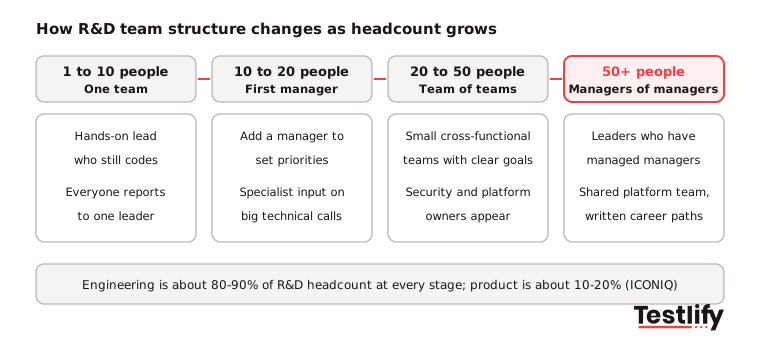
Bessemer's guide to scaling an engineering team to 50 and beyond gives the stage view in detail:
- 1 to 10 people. One hands-on leader who still writes code. Everyone reports to that leader, and process stays light.
- 10 to 20 people. Add at least one manager to set priorities and balance workloads. Bring in specialists for high-stakes technical choices. Around 15 to 20 engineers, add security expertise.
- 20 to 50 people. Split into small cross-functional teams, each with a clear goal and an embedded product owner. Decide whether you need a people-focused leader or a product-focused one, and write down the CTO's role.
- 50+ people. Hire leaders who have managed managers. A shared platform team keeps product teams from rebuilding the same tools, and written career paths keep strong people from leaving.
Across the teams in the ICONIQ data, the engineering-to-product mix stays roughly the same as companies grow. A team that adds engineers without product capacity, or the reverse, usually ends up with work that nobody has decided is worth doing.
How do you hire for R&D without lowering the bar?
R&D hiring keeps the bar high at speed when it tests the skills the role needs before anything else, uses the same structured interview for every candidate, and checks scores against a shared rubric. Speed comes from cutting rework and bad hires, not from skipping steps.
Skills-first hiring also widens the pool. The LinkedIn Economic Graph Skills-Based Hiring 2025 report found that a skills-based approach expands talent pools a median 6.1x globally, and 8.2x for AI roles.
For R&D teams competing for scarce people, that is the difference between waiting months and filling a role in weeks.
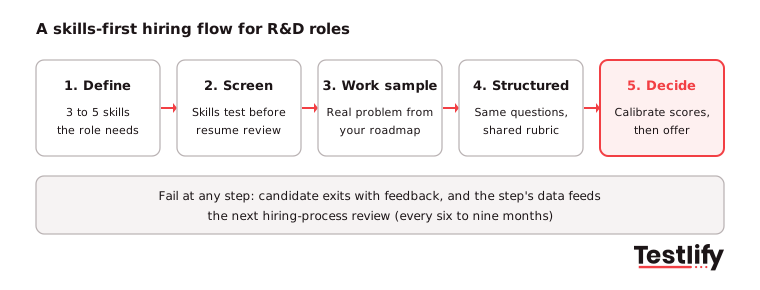
- Define 3 to 5 skills per role. Write them from the roadmap, not from an old job description. A research engineer on a new AI product needs different skills from one maintaining a mature system.
- Screen with a skills test first. Test coding, problem solving and domain knowledge before reading resumes. A problem-solving test and a creativity test show how a candidate approaches problems with no single right answer, which is the core of R&D work.
- Use a work sample from your roadmap. A short, paid or time-boxed task based on a real problem shows more than any portfolio.
- Run structured interviews. Ask every candidate the same questions and score answers on a shared rubric. See this guide to structured interviews.
- Calibrate, then decide. Compare interviewer scores before the debrief so the loudest voice does not decide.
Stripe's guide to scaling engineering organizations recommends revisiting the recruiting process every six to nine months as the team grows. For a step-by-step rollout, read how to implement skills-based hiring.
Pro tip: Write the scoring rubric before the first interview. If interviewers cannot agree on what a strong answer looks like, the problem is the role definition, not the candidates.
How do you keep innovation alive as the team grows?
Innovation stays alive in a growing R&D team when small teams own clear problems, new hires ship real work within weeks, and some time is protected for exploration that is not on the quarterly roadmap. Growth kills new ideas through slow decisions and crowded calendars far more often than through a lack of talent.
- Keep teams small and goal-led. Give each team an outcome to own, not a list of tasks. Small teams make decisions without waiting for a meeting.
- Get new hires shipping fast. Stripe puts new engineers in small groups with a mentor, and each group ships a real change within three to four weeks. Fast first wins build confidence and surface problems in onboarding. Our employee onboarding guide covers the basics.
- Protect exploration time. Set aside a fixed share of time, or run regular hack weeks, for ideas outside the roadmap. Track what ships from it.
- Pay down technical debt on a schedule. EY found technical debt was named the top unsolved R&D challenge by 45% of CTOs at companies with declining revenue and 33% at growing ones. Debt left alone eats the time that new ideas need.
- Hire for range, not copies. Teams built from one background solve problems one way. Skills-first hiring brings in people from adjacent fields who see problems differently, a point we also make in hiring a creative marketing team.
- Make internal moves easy. Rotations between teams spread knowledge and keep strong people from leaving to find a new challenge.
Which metrics show scaling is hurting innovation?
The metrics that show scaling is hurting innovation are the ones that link headcount to outcomes: how fast new hires become productive, how much roadmap time goes to new products, how good recent hires are, and whether strong people are leaving. Track them every quarter so problems show up before a launch slips.
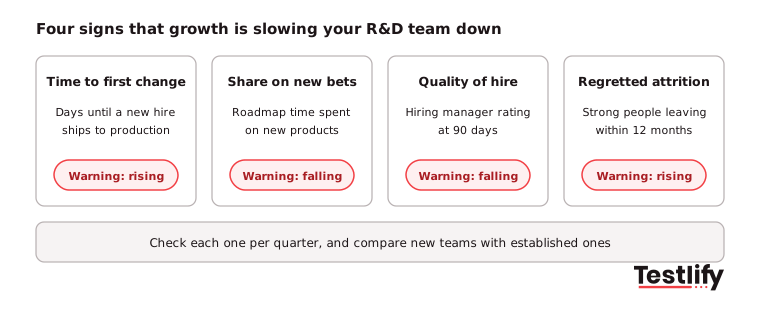
Metric | How to measure it | Warning sign |
|---|---|---|
Time to first shipped change | Days from start date to first change in production | Rising quarter on quarter |
Share of roadmap on new bets | Percent of team time on new products or experiments | Falling below the share you planned |
Quality of hire | Hiring manager rating at 90 days, plus 12-month retention | Falling for recent hiring cohorts |
Regretted attrition | Strong performers leaving within 12 months | Rising, especially among early hires |
Time to market | Weeks from approved idea to customer release | Rising as headcount grows |
R&D spend as share of revenue | Total R&D cost divided by revenue | Rising with no rise in output |
ICONIQ's benchmark that R&D spend levels off at about 20-30% of revenue at scale is a useful sanity check for the last row. For how to define and track these, see our glossary article on key performance indicators and this guide on improving quality of hire.
What mistakes should you avoid when you scale R&D teams?
The most common mistakes when teams scale R&D are hiring before re-planning, hiring for speed over skills, and adding people without adding structure. Each one is cheap to prevent and expensive to undo once a team of 40 has formed around it.
- Hiring to fix a priorities problem. More people on a roadmap with too many projects means more meetings, not more launches.
- Lowering the bar to fill seats. One weak hire on a small team slows everyone. Test skills even when you are in a hurry.
- Adding managers too late. Past 10 people, a leader who also codes cannot both ship and coach. Plan the first manager hire before the team needs it.
- Leaving contractors on the side. Contractors working alone take knowledge with them when they leave. EY advises embedding them with full-time staff or keeping them on noncritical work.
- Skipping onboarding. Without a plan to reach a first shipped change, new hires take months to become productive.
- Measuring headcount instead of output. Headcount is a cost, not a result. Track the metrics above instead.
How can Testlify help you hire R&D talent at scale?
Testlify helps R&D teams hire on proof of skill instead of resumes, so hiring can speed up without lowering the bar. Hiring teams can screen engineers, researchers and analysts with role-specific tests and structured AI interviews, then compare candidates on the same scored evidence.
- Tests for R&D roles. 3,500+ tests cover coding, problem solving, critical thinking, creativity and research analysis, and the AI test builder creates a role-specific assessment from a job description. Browse the test library.
- Fair, consistent scoring. Every candidate gets the same questions, automated scoring and a per-skill report, with 20+ proctoring checks to keep results honest. See anti-cheating and proctoring.
- Fits your stack. 100+ ATS and HRIS integrations, including Greenhouse, Lever and Workday, keep scores in the system your recruiters already use.
Book a demo to see how Testlify screens R&D candidates on proof of skill and helps you identify the best candidates available within your talent pool.
Frequently asked questions (FAQs)

People and Talent Partner
Arushi Shah runs day-to-day talent acquisition and candidate experience at Testlify. She writes on interviewing, structured hiring, and giving candidates a fair, fast process.
LinkedInRelated resources
View all
HR & recruitment
How can the Emotional Intelligence test help you identify training and development needs?

HR & recruitment
Pros and Cons of Emotional Intelligence Test in Hiring

HR & recruitment
Does the Emotional Intelligence test belong in the workplace

HR & recruitment
Find product managers with our scenario-based evaluations

HR & recruitment
Should the Emotional Intelligence test be Used In Hiring?
HR & recruitment
7 reasons why you should use the emotional intelligence test in recruitment
Get started.
Hire on proof, not resumes.
Run your first skills-based assessment free — no credit card required.