
Goal skills: what they are and how to assess them in hiring
Goal skills are how people turn targets into results. See the five core goal skills and how to test them with tests, questions and a rubric.

Goal skills are the abilities a person uses to set a clear target, plan the steps to reach it, track progress and adjust when plans meet reality. In hiring, goal skills show up as evidence: a candidate who can name a measurable target, explain how they broke it down and show what they changed when it slipped.
TL;DR / Key Takeaways
- Goal skills are five linked abilities: clarity, planning, prioritizing, tracking and adapting. Alignment with team goals ties them together.
- Ambition is not the same thing. A candidate can want a lot and still lack the skills to plan and deliver it.
- Hiring teams should assess goal skills because only 46% of US employees clearly know what is expected of them at work, according to Gallup.
- Test goal skills twice: a planning, time management or situational judgment test at screening, then structured behavioral questions in the interview.
- Score every answer on a 1, 3, 5 scale for target, plan, measure and adjustment, so two interviewers reach the same score.
- The biggest red flag is a goal with no number and no date. The second is a candidate who never changed a plan.
 ChatGPT
 Gemini
 Claude
 Grok
 Perplexity
What are goal skills?
Goal skills are the practical abilities behind reaching a goal: turning an intention into a specific target, breaking it into steps, choosing what to do first, measuring progress and changing course when needed. To define goal skill in one line for a scorecard: the ability to set a target worth hitting and then hit it.
Goal skills sit between motivation and results. Motivation explains why someone wants an outcome. Goal skills explain how they get there. That is why two equally driven candidates can deliver very different results in the same role.
Clarity is the goal skill most workplaces are short of. Gallup's 2025 engagement update found that just 46% of US employees clearly know what is expected of them at work, down 10 points from 56% in March 2020. People with strong goal skills create that clarity for themselves.
Most frameworks for good goals come back to the same elements. SMART goals are specific, measurable, achievable, relevant and time-bound. The goal-setting theory of Edwin Locke and Gary Latham adds five principles: clarity, challenge, commitment, feedback and task complexity. For the general idea of goal setting as an HR practice, see the Testlify HR glossary. This guide focuses on the skills behind it and how to assess them in candidates.

What are the five core goal skills?
The five core goal skills are clarity, planning, prioritizing, tracking and adapting. Each one is visible in how a person talks about past work, and each one fails in a different way, which is why it pays to assess them separately instead of asking a candidate whether they are "goal-oriented".
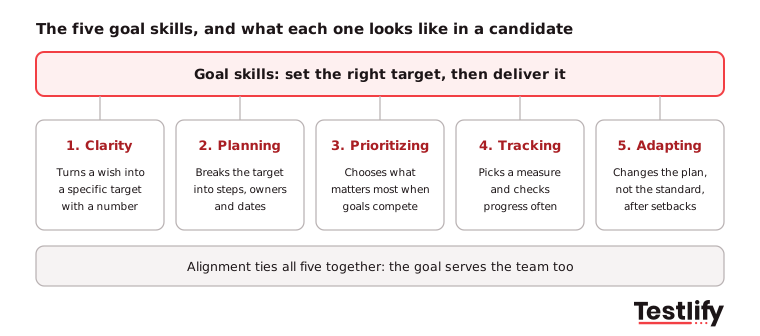
- Clarity: Turning a vague wish ("grow the account") into a specific target with a number and a date ("raise renewals from 80% to 90% by Q3").
- Planning: Breaking the target into steps, owners and deadlines, and spotting the risks before they hit.
- Prioritizing: Choosing what matters most when several goals compete for the same week.
- Tracking: Picking a measure that shows progress early, not only at the end, and checking it on a routine.
- Adapting: Changing the plan when the data says so, without quietly lowering the standard.
A sixth thread runs through all five: alignment. Strong goal skills connect a personal target to what the team and the business need. A salesperson who hits a personal number by discounting every deal has goal skills, but poorly aligned ones.
Goal skill | What a strong candidate shows | What a weak answer sounds like |
|---|---|---|
Clarity | A target with a number, a baseline and a date | "I wanted to do better" |
Planning | Steps, owners and checkpoints | "I just worked hard" |
Prioritizing | What they said no to, and why | "Everything was important" |
Tracking | The measure they watched and how often | "We saw it at the end of the year" |
Adapting | What changed, when and why | "Nothing really went wrong" |
Why do goal skills matter in hiring?
Goal skills matter in hiring because they predict whether a new hire can turn a job description into delivered work without constant direction. The importance of assessing goal setting skills grows as roles get less scripted: hybrid teams, new markets and AI tools all leave more of the planning to the individual.
Three data points explain the pressure on hiring teams:
- Goals are everywhere, alignment is not: SHRM's December 2025 Current Events Pulse found that 94% of HR professionals say employees at their organizations set individual goals, yet 37% say company goals do not cascade down to individual ones.
- Engagement is at a low: Gallup found that only 31% of US employees were engaged in 2024, the lowest level in a decade, with unclear expectations one of the sharpest drops. Hires who set their own clear targets offset part of that gap.
- Skills drive quality of hire: According to LinkedIn's Future of Recruiting 2025, 93% of talent acquisition professionals say accurately assessing candidate skills is crucial to improving quality of hire.
For a TA team, the business case is simple. A hire with weak goal skills needs more manager time, misses more deadlines and is harder to coach, because there is no plan to coach against. A hire with strong goal skills makes performance reviews easier, since the targets were clear from the start.
Pro tip: Decide which two or three goal skills the role really needs before you write a single question. A support agent needs tracking and prioritizing far more than long-range planning. A team lead needs all five.
How do you assess goal skills in candidates?
Hiring teams assess goal skills best with two methods in sequence: an online test at screening that shows how a candidate plans and prioritizes, then structured behavioral questions in the interview that show how they have actually delivered. Neither method is enough alone. Tests show approach, interviews show track record.
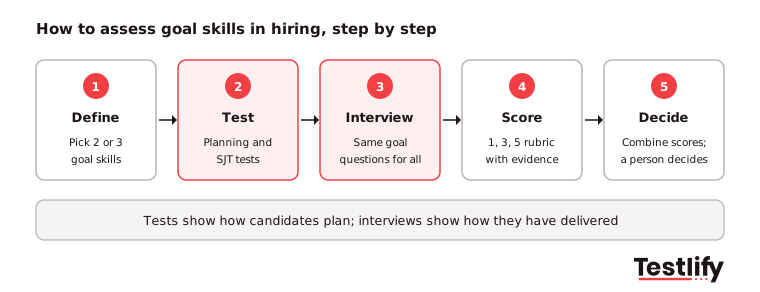
Testlify's test library includes a time management test, an organizing skills test and a strategic planning test that fit the screening step. Scenario questions work well too: a situational judgment test shows what a candidate does first when three deadlines collide.
Scored evidence from both steps also helps later. LinkedIn's Future of Recruiting 2025 found that only 25% of talent acquisition professionals feel highly confident they can measure quality of hire, and goal-skill scores give them a baseline to compare with on-the-job results.
Keep the interview step structured: the same questions, in the same order, scored on the same scale. Structured interviews make answers comparable across candidates and interviewers.
Which interview questions reveal goal skills?
Behavioral questions reveal goal skills because they ask for a real goal, a real plan and a real result. Ask for one specific example per question, then follow up on the number, the steps and what changed. Hypothetical questions ("How would you...") show intent, not skill.
- Clarity: "Tell me about a goal you set in the last year. What exactly was the target, and how did you know you had hit it?"
- Planning: "Walk me through how you broke that goal into steps. Who else was involved, and what were the checkpoints?"
- Prioritizing: "Describe a time two goals competed for your time. What did you drop or delay, and what happened?"
- Tracking: "Which number did you watch week to week, and what did you do when it fell behind?"
- Adapting: "Tell me about a goal you missed or had to change. What did you change, and what would you do differently?"
- Alignment: "How did your personal goal connect to your team's targets? Who did you check that with?"
Useful follow-ups for any answer: "What was the starting point?", "What was your part, not the team's?" and "What did you learn that you use now?"
How should you score answers about goals?
Interviewers should score answers about goals on a fixed 1, 3, 5 scale with written anchors for each level. Anchors stop the most confident speaker from winning by default and let two interviewers reach the same score from the same answer.
Score | Target | Plan | Measure | Adjustment |
|---|---|---|---|---|
1 | Vague, no number or date | No steps described | Result unknown or guessed | No change, or blames others |
3 | Specific target, partial detail | Some steps, no owners or dates | Final result known | Changed course late |
5 | Number, baseline and deadline | Steps, owners and checkpoints | Tracked a leading measure on a routine | Spotted the slip early and adjusted with a reason |
Score each of the four columns, average them, and write one line of evidence per score. If two interviewers differ by more than one point, they compare evidence before the debrief, not after.
Key takeaway: Score the process, not the size of the ambition. A modest goal planned, tracked and adjusted well is stronger evidence of goal skills than a huge goal described with no plan behind it.
What are the red flags in goal skills?
The red flags in goal skills are goals with no measure, plans with no steps and stories where nothing ever went wrong. Each one suggests the candidate either did not set the goal themselves or did not manage it closely.
- No number, no date: "I wanted to improve customer satisfaction" is a wish, not a goal.
- Only team results: The candidate cannot separate their own part from the team's outcome.
- Never adjusted: Every plan worked first time, which usually means the goals were too easy or the story is polished.
- Moving the goalposts: The target quietly shrank so it could be reported as met.
- Misaligned wins: A personal goal hit at the expense of the team, with no sign the candidate noticed.
Be fair about context. Early-career candidates may draw on studies, volunteering or side projects, and those examples are valid evidence. Judge the same four elements, not the setting. Candidates who are driven but light on structure may still be strong hires for roles with close coaching, so read goal skills alongside self-motivation and the needs of the role.
How does Testlify help assess goal skills?
Testlify helps hiring teams assess goal skills by combining skills tests and structured AI interviews in one platform, so every candidate answers the same questions and gets scored against the same criteria. Teams pick from 3,500+ validated tests or generate a custom assessment from a job description.
- Tests for planning and judgment: Time management, organizing, strategic planning, motivation and situational judgment tests sit in the same library as role-specific skills tests. Browse the test library
- Structured interviews at scale: Video AI, Voice AI and Chat AI interviews ask the same goal questions to every candidate and score every response, with AI-suggested competencies and scoring criteria for the role.
- Evidence for reviewers: Reports show a per-skill breakdown, AI-written strengths and gaps, and suggested follow-up questions for the human round.
- Fits the stack: Results sync with 100+ ATS and HRIS tools, and 20+ proctoring checks protect test integrity.
Ready to see goal skills in action?
Add a time management or strategic planning test and a short set of structured goal questions to your next open role. Start a 7-day free trial of Testlify, no credit card required, or book a demo to see scored reports on a real role.
Frequently asked questions

Wordpress Developer
Yash Patel is a Wordpress and SEO Specialist at Testlify with 3+ years of experience in technical SEO, on-page optimization, and content strategy. He works on improving Testlify's organic presence and produces content focused on hiring, talent assessment, and HR technology.
LinkedInRelated resources
View all
Skill assessment
Importance of assessing self-discipline in the workplace

Skill assessment
Importance of assessing self-awareness in workplace growth

Skill assessment
Importance of assessing patience for dealing with challenging moments

Skill assessment
Importance of assessing tolerance for a respectful work environment

Skill assessment
Ethical integrity at work: how to assess it in hiring

Skill assessment
Dependability in the workplace: what it is and how to assess it
Get started.
Hire on proof, not resumes.
Run your first skills-based assessment free — no credit card required.