
SEO Specialist hiring guide
A practical kit for hiring an SEO specialist: steps, job description, job boards, emails, skills tests and interview questions to copy.
SEO Specialist hiring guide
An SEO specialist makes a company's website easy to find in Google and in AI search answers, through keyword research, technical fixes, content guidance and reporting that ties organic traffic to revenue. Knowing how to hire an SEO specialist matters because the role mixes technical, content and analytics skills, results take months to show, and a polished portfolio is hard to verify in a one-hour interview.
How to hire an SEO specialist
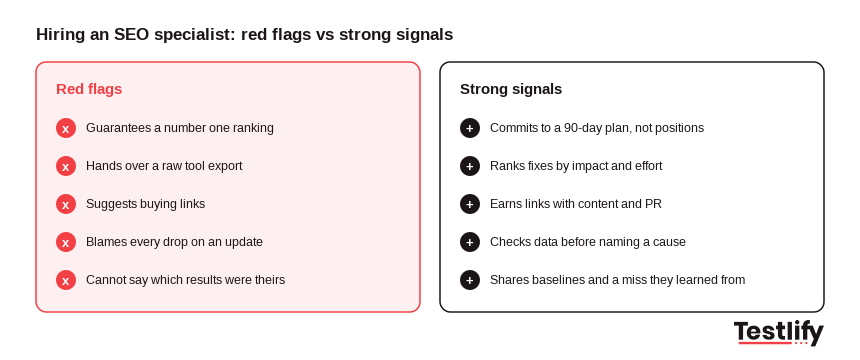
Hiring an SEO specialist works best when you test how a candidate diagnoses a real site problem, not how many tools they list. According to Google's own advice in Do you need an SEO?, you should ask for past work, ask how they measure success and over what timeframe, and walk away from anyone who guarantees a number one ranking. Google also lists optimizing for generative AI among the services an SEO can offer, so AI Overviews and answer engines belong in your interviews now.
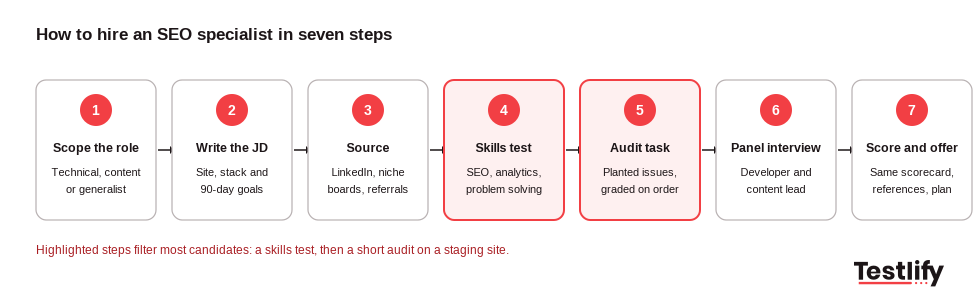
Key steps in hiring an SEO specialist
- Decide the scope first: Check whether your site mainly has a technical problem (crawling, indexing, site speed, migrations), a content and demand problem, or both. A technical SEO, a content SEO and a generalist are different hires, and the job description should name one.
- Confirm the support around the role: Agree how much developer time, content capacity and budget the new hire will get. An SEO specialist with no access to a developer or a writer can find problems but cannot fix them.
- Write a job description built on outcomes: Describe your site, your stack (CMS, analytics, Search Console) and what the first 90 days should deliver. Strong candidates look for a clear mandate more than a long tool list.
- Source where SEO people spend time: Post on LinkedIn and a niche board such as SEOJobs.com, ask your content and web teams for referrals, and reach out to practitioners who publish audits or case studies.
- Screen with a skills test: Use a short online assessment to check SEO fundamentals, analytics and problem solving before anyone spends time on interviews. This removes keyword-stuffed resumes early and gives every candidate the same first hurdle.
- Run a short audit task: Give finalists a small staging site or a few real pages with planted issues, such as a blocked folder in robots.txt, a canonical tag that points at a redirect, duplicate title tags and thin pages. Grade the order of their fixes and their reasons, not the length of the report.
- Interview with a developer and a content lead on the panel: The developer judges whether the candidate can specify a fix precisely; the content lead judges how they brief writers and read search intent.
- Score, decide and onboard: Score every finalist on the same scorecard, check references, then agree a first-quarter plan: a technical audit, a keyword and page map, and a reporting baseline in Google Search Console and analytics.
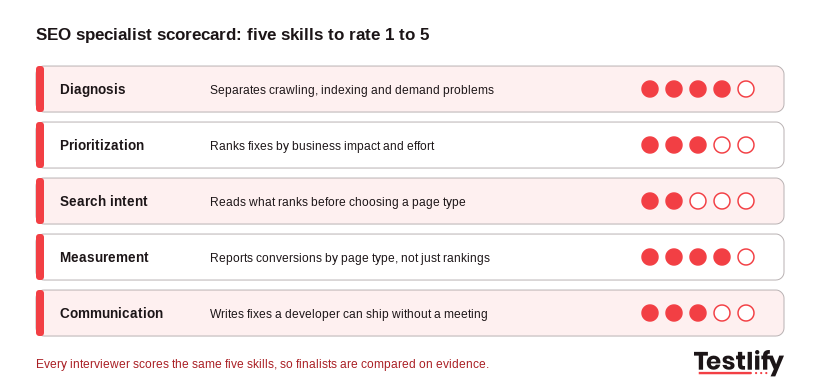
Most teams can run this process in 4 to 6 weeks. Use the scorecard below so every interviewer rates the same five things.
Skill to score | Strong signal | Weak signal |
|---|---|---|
Diagnosis | Asks for data, separates crawling, indexing and demand problems | Jumps to "write more content" for every drop |
Prioritization | Ranks fixes by business impact and effort | Hands over a raw tool export |
Search intent | Reads what already ranks before choosing a page type | Chooses keywords by volume alone |
Measurement | Reports by page type and conversions, not only sessions | Reports rankings only |
Communication | Writes a fix a developer can ship without a meeting | Uses jargon with non-SEO stakeholders |
Pro tips for hiring an SEO specialist
These SEO hiring tips help you separate real practitioners from confident talkers:
- Ask what went wrong: Strong candidates can describe a migration, an update or a test that hurt traffic and what they changed afterwards. A perfect track record with no misses is a warning sign.
- Verify case studies: Ask which changes in a case study were theirs, what the baseline was and how they ruled out seasonality. Shared credit is fine; vague credit is not.
- Test AI search knowledge: Ask how they would get a page cited in Google AI Overviews or ChatGPT answers and how they would measure it. Good answers mention clear answers, structured data, internal links and brand mentions on trusted sites.
- Hire for the level you need: When you hire a head of SEO, test strategy, budgeting and team leadership; when you hire a specialist, test hands-on execution. Our employer guide to hiring a senior SEO specialist covers the senior end.
- Give read-only access during trials: If a candidate or contractor audits your live site, share read-only Search Console access, as Google recommends, never owner rights.
Key takeaway: Hire on evidence of diagnosis and prioritization. A skills test, a short audit task and one shared scorecard tell you more than a portfolio of ranking screenshots.
Job description template for an SEO specialist
The template below follows the tasks O*NET lists for search marketing strategists, the closest official occupation to an SEO specialist. Replace the bracketed placeholders before you post it.
Job title: SEO Specialist
Location: [City, State] / [Remote or hybrid]
Overview
[Company name] is looking for an SEO Specialist to grow organic traffic and leads from Google and AI search. You will own keyword research, on-page and technical SEO, and reporting for [website or product], working with our content, web development and marketing teams. You will report to [Manager title] and have a clear mandate for your first 90 days.
Responsibilities
- Run technical audits covering crawling, indexing, site speed, structured data and internal links, and turn findings into prioritized tickets for developers.
- Research keywords and search intent, and map them to existing or new pages.
- Write SEO briefs for writers and review content before it goes live.
- Improve titles, meta descriptions, headings and internal links on priority pages.
- Track rankings, organic traffic, AI search visibility and conversions in Google Search Console and [analytics tool], and report monthly to [team or stakeholders].
- Plan and check site migrations, redesigns and new sections so they keep their search traffic.
- Earn links through content, digital PR and partnerships, never through paid link schemes.
Requirements
- [2 to 4] years of hands-on SEO experience, in-house or agency.
- Working knowledge of Google Search Console, [analytics tool] and a crawler such as Screaming Frog.
- Basic HTML and an understanding of how JavaScript rendering affects indexing.
- Experience with [CMS, for example WordPress] and with Google Search Essentials.
- Clear written English for briefs, tickets and reports.
Competencies
- Diagnoses traffic changes with data before proposing fixes.
- Prioritizes work by business impact and effort.
- Explains technical issues in plain language to non-SEO colleagues.
- Keeps up with Google updates and AI search changes and tests before acting.
Benefits
- [Salary range] plus [bonus or equity]
- [Health, dental and retirement benefits]
- [Remote or hybrid policy] and [paid time off]
- Budget for SEO tools, courses and conferences
- [Other benefits]
Job boards to source the best candidates for the SEO specialist role
Competition for search marketing talent is steady. According to the US Bureau of Labor Statistics, SEO work falls under market research analysts and marketing specialists, a field with a median wage of $78,760 in May 2025 and about 82,000 openings a year. Post where both active and passive candidates look:
- LinkedIn: The largest pool of in-house and agency SEO profiles, with filters for skills such as technical SEO and Google Analytics, and the best channel for direct outreach.
- Indeed: High application volume for generalist and junior SEO roles; add a screening question about tools and site size to cut noise.
- SEOJobs.com: A niche board where most applicants already work in search, so the baseline skill level is higher than on general boards.
- Glassdoor: Useful when your employer brand is strong, since SEO candidates often check company reviews and marketing investment before applying.
- Wellfound (formerly AngelList Talent): A good fit for startups and SaaS companies hiring their first SEO person who must work across content and product.
- We Work Remotely: Reaches experienced remote SEO specialists, a large share of the talent pool for this role.
Social media shoutout templates for an SEO specialist
LinkedIn post:
We're hiring an SEO Specialist at [Company name]. You'll own technical SEO, keyword research and content briefs for [website or product], with a developer and writers ready to ship your fixes. If you can explain why a page dropped and what you'd fix first, we'd like to talk. [Location or Remote] | [Salary range] | Apply: [link]
X (Twitter) post:
Hiring: SEO Specialist at [Company name]. Technical audits, search intent, briefs and reporting, with dev support to actually ship fixes. [Location or Remote]. Apply: [link] #SEOjobs #hiring
Outreach email templates to attract candidates for an SEO specialist position
Email 1: passive candidate
Subject: SEO Specialist role at [Company name]
Hi [Candidate name],
I came across your [audit, case study or post] on [topic] and liked how clearly you explained [specific point]. We're hiring an SEO Specialist at [Company name] to own technical and on-page SEO for [website or product].
The role has dedicated developer time, a content team and a clear 90-day plan, so your recommendations get shipped. The range is [salary range], and the role is [remote, hybrid or on-site].
Would you be open to a 20-minute call next week? Happy to share the full job description first.
Best regards, [Your name] [Your title], [Company name]
Email 2: referral request
Subject: Do you know a strong SEO specialist?
Hi [Name],
We're hiring an SEO Specialist at [Company name] to lead technical SEO, keyword research and reporting for [website or product]. Since you work in [search or marketing], I thought you might know someone good.
We're looking for someone who can diagnose traffic changes, prioritize fixes and work well with developers and writers. The range is [salary range]. If someone comes to mind, I'd be grateful for an introduction or a share of this link: [job link].
Thank you, [Your name] [Your title], [Company name]
Relevant assessment tests for an SEO specialist
Testlify has 3,500+ tests, and these five cover what an SEO specialist does day to day. Combine two or three in one assessment and send it right after resume screening.
Test | What it measures | Best for |
|---|---|---|
Keyword research, on-page and technical SEO, link building | Every SEO specialist role | |
Strategy, audits, migrations and prioritization at scale | Senior and lead roles | |
Reading traffic and conversion data, reporting | Roles that own SEO reporting | |
Writing and optimizing content for search intent | Content-led SEO roles | |
Logical reasoning and structured thinking | Diagnosing ranking and traffic drops |
For guidance on scoring the results of a search engine optimization skills test, see our tips on evaluating SEO skills.
5 general interview questions for an SEO specialist
- Tell me about an SEO project that went well. What did you change, and how did you measure the result? A good answer gives a baseline, the specific changes the candidate made, the time it took and a business metric such as leads or revenue, not only rankings.
- Describe a time traffic dropped on a site you managed. What did you do first? A strong candidate checks data before acting: Search Console, analytics annotations, recent releases and known Google updates, then narrows the drop to pages, queries or devices.
- How do you decide what to work on first when you join a new site? Look for an audit, a quick-win list and a ranking of fixes by impact and effort, plus a conversation with stakeholders about goals.
- How do you explain an SEO recommendation to a developer or a manager who is not an SEO? A good answer shows plain language, a clear ticket with acceptance criteria and the expected impact in business terms.
- How is AI search changing your work, and how would you measure visibility in AI answers? Strong candidates mention AI Overviews and assistants, clear and quotable answers, structured data and brand mentions, and a way to track citations alongside clicks.
For a longer question bank, see our SEO specialist interview questions.
5 technical interview questions for an SEO specialist
- A site has 50,000 pages but only 10,000 are indexed. How would you find out why? A good answer covers Search Console page indexing reports, crawl data, robots rules, noindex tags, canonicals, duplicate or thin pages and internal linking.
- When should you use a canonical tag instead of a 301 redirect? Look for the difference between keeping duplicate URLs live and retiring a URL, and awareness that Google treats a canonical as a hint, as its guide to consolidating duplicate URLs explains.
- How do you plan a site migration so it keeps its traffic? A strong candidate mentions a full URL map, one-to-one redirects, a staging crawl, benchmark data and monitoring for several weeks after launch.
- How does JavaScript rendering affect SEO, and how would you check it? A good answer separates server-side and client-side rendering, uses the URL Inspection tool to see the rendered page and flags content or links that load only after user actions.
- What structured data would you add to a product or article page, and how would you test it? Look for matching schema types to the page, using the Rich Results Test and checking that the markup reflects visible content. Candidates should also know why HTTPS and fast Core Web Vitals still matter.
Rejection email templates for the SEO specialist
After screening:
Subject: Your application for SEO Specialist at [Company name]
Hi [Candidate name],
Thank you for applying for the SEO Specialist role at [Company name] and for taking the time to complete our assessment.
We've reviewed all applications and decided to move forward with candidates whose experience more closely matches what this role needs right now. We'll keep your details on file and may contact you about future openings.
We wish you the best with your search.
Best regards, [Your name] [Company name]
After interview:
Subject: Update on the SEO Specialist role
Hi [Candidate name],
Thank you for meeting with our team and for your work on the audit task. We enjoyed hearing about [specific project or idea].
After careful thought, we've decided to offer the role to another candidate whose experience in [area, for example technical SEO for large sites] fits our current priorities more closely. This was a close decision.
If you'd like feedback on your audit or interviews, reply to this email and I'll be glad to share it. We'd also welcome your application for future roles.
Best regards, [Your name] [Company name]
Ready to hire an SEO specialist on skills? Start a 7-day free trial of Testlify with no credit card, or book a demo to see the SEO tests in action.
FAQs: what do teams ask about how to hire an SEO specialist?
Hiring an SEO specialist usually takes 4 to 6 weeks from posting to offer. A skills test at the screening stage and a short audit task for finalists keep the process short without lowering the bar.