
Event Planner hiring guide
Hire an event planner with a clear process, a ready-to-paste job description, outreach and rejection emails, skills tests and questions.
A polished portfolio can hide the planner who freezes when a vendor drops out a week before launch. Knowing how to hire an event planner means testing for that moment, because a bad hire shows up in public at your first event.
Use the steps, templates and tests below to shortlist planners on proof of skill, whether you hire in-house or on contract.
How to hire an event planner
To hire an event planner, decide first whether you need an in-house hire or a contract planner, then write a job description around your event types and budget size. Post on LinkedIn, Indeed and event associations, screen with a skills test and a remote work sample, run structured scenario interviews, check references with past clients, and make an offer in line with market pay.
Demand for the role is steady. The US Bureau of Labor Statistics puts the median pay of meeting, convention and event planners at $61,160 a year (May 2025), with 172,100 jobs in 2025 and employment projected to grow 6% from 2025 to 2035, faster than average.
The same source expects about 16,800 openings a year, so good planners get several offers and a slow process loses them.
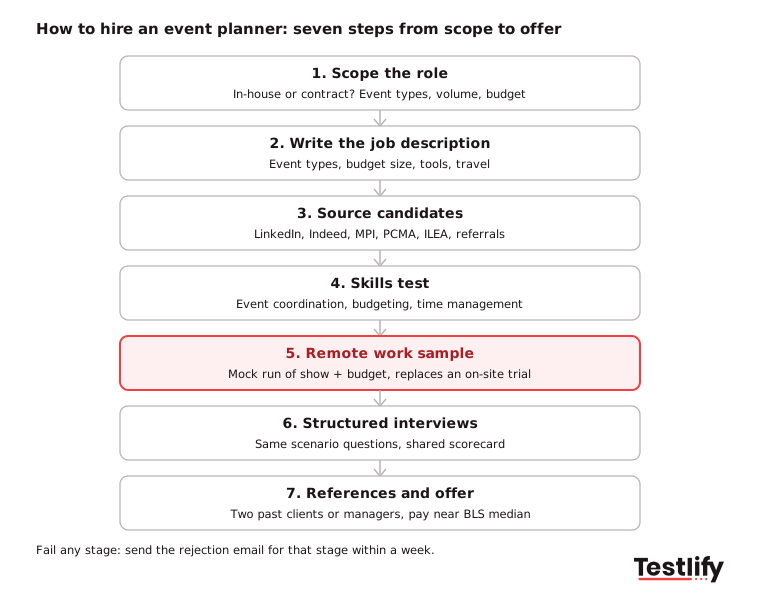
Key steps in hiring an event planner
1. Scope the role first
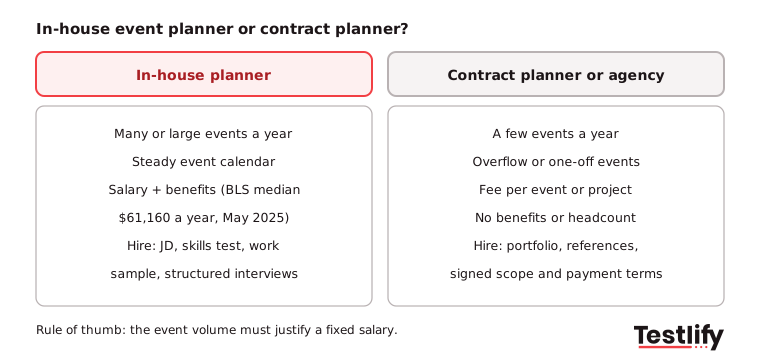
List the events you run in a year, their size, format (in person, virtual, hybrid) and budget. Many large events or a steady calendar justify an in-house planner; a few events a year are usually cheaper with a contract planner or agency. Decide if you need a specialist (user conferences, trade shows, incentive trips) or a generalist who covers everything from town halls to client dinners.
2. Write a job description around real events
Name the event types, typical headcount and budget range, the tools you use and how much travel the role involves. Specify whether the role is full-time in-house, project-based or hybrid, because each draws a different talent pool. A ready-to-paste template follows below.
3. Source in more than one place
Combine a general job board with event associations and referrals. Search with the event type in the query, such as "corporate event planner" or "conference planner", to find people with the right experience. Referrals from your network and vendors are a strong start, but put referred candidates through the same steps as everyone else.
4. Screen with a skills test, not the resume
Send every applicant the same short assessment on event coordination, budgeting and time management, then compare scores side by side. This cuts a pile of similar resumes down to a shortlist you can defend.
5. Replace the on-site trial with a remote work sample
Unpaid or paid trial days at a real event are hard to arrange and unfair to compare. Instead, send a mock brief, for example a 200-person product launch with a fixed budget, and ask for a one-page run of show, a budget sheet and a vendor shortlist within 48 hours. Every candidate gets the same brief, so you compare like with like.
6. Run structured interviews by video
Ask every finalist the same scenario questions (last-minute venue change, vendor no-show, budget cut) and score answers on a shared scorecard. A video interview works well here, since a planner's job is to explain a plan clearly to clients and vendors they rarely meet in person.
7. Check portfolios and references
Review past events for scale, budget handled, headcount and results, not only photos. Call two past clients or managers and ask how the candidate handled a problem on the day.
8. Make the offer and onboard with a plan
Offer pay close to the market median for your region and seniority, and say which events the new hire owns first. A 30-60-90 day plan with clear goals (first event delivered, vendor list rebuilt, post-event report written) gets a new planner productive faster.
Hiring stage | What it proves | Evidence to collect |
|---|---|---|
Skills test | Coordination, budgeting, time management | Scores on the same test for every applicant |
Remote work sample | Can plan a real event on paper | Run of show, budget sheet, vendor shortlist |
Structured interview | Judgment under pressure, client communication | Scorecard per scenario question |
Portfolio review | Scale and range of past events | Headcount, budget, format, outcome per event |
Reference calls | How they behave when plans go wrong | Two calls with past clients or managers |
Key takeaway: The work sample and the skills test do the job an on-site trial used to do, at lower cost and with a fairer comparison, so you can hire a remote or out-of-town planner with confidence.
Pro tips for hiring an event planner
The steps above give you a process, but small habits decide who you end up hiring. These tips help you read portfolios, references and credentials with a sharper eye. They also cover the written terms to agree when you bring in a contract planner.
Read portfolios for numbers
Strong portfolios show the budget managed, attendee count and outcomes such as attendance against target or repeat clients. A planner who ran a 1,000-person conference has a different skill set from one who ran small private dinners, so match their past events to yours.
Ask for a live reference call
How past clients describe working with a planner reveals communication and composure better than a written letter. Ask the reference about the worst moment of an event and what the planner did.
Listen for a plan B
Good planners name backup caterers, alternate AV suppliers and weather plans without being asked. Candidates who only describe the happy path tend to struggle on event day.
Treat certifications as a plus, not a filter
Most planners hold a degree in hospitality, marketing or communications, and certifications like CMP (Certified Meeting Professional) or CSEP (Certified Special Events Professional) show deeper training. Practical experience and a strong portfolio usually carry more weight, so do not reject good candidates for a missing credential.
Put the terms in writing for contract planners
When you hire a freelance planner or agency instead of an employee, agree the scope, deliverables, update cadence, payment terms and contingency plans (weather, cancellations, vendor failure) in a signed agreement before any deposit is paid.
Job description template for an event planner
Copy this template and replace the square-bracket placeholders. The duties follow the core tasks listed for this occupation by O*NET, adjusted for an in-house role.
For a more senior role, see the event manager job description template.
Job title: Event Planner
Location: [City, State] / [Hybrid or remote]
Reports to: [Head of Events / Marketing Manager]
Overview
[Company name] runs [number] events a year, from [event types, for example customer conferences, partner dinners and internal town halls]. We are hiring an Event Planner to plan and deliver these events on time and on budget.
You will work with [teams] and a network of venues and vendors, and you will own each event from the first brief to the post-event report.
Responsibilities
- Plan and run events from brief to debrief, including objectives, timelines, run of show and post-event reports.
- Source venues, negotiate contracts and manage vendors for catering, AV, transport, lodging, signage and security.
- Build and track event budgets, review vendor bills and reconcile invoices after each event.
- Manage on-site logistics, including registration, seating, AV setup and day-of problem solving.
- Coordinate with [marketing, sales, leadership] on goals, invitations, speakers and promotion.
- Measure results through attendee feedback, attendance against target and budget against plan.
- Keep accurate records: vendor contracts, budget trackers, checklists and run-of-show documents.
Requirements
- [2 to 4] years of experience planning events of [size or type].
- Bachelor's degree in hospitality management, marketing, communications or a related field, or equivalent experience.
- Track record of delivering events at or under budget.
- Experience with event and registration tools such as [Cvent, Eventbrite, Bizzabo or similar] and with spreadsheets and project tools.
- Willingness to travel [percentage] of the time and to work some evenings and weekends around events.
- CMP or CSEP certification is a plus.
Competencies
- Organization and the ability to run several events at once.
- Clear written and spoken communication with clients, vendors and internal teams.
- Negotiation with venues and suppliers.
- Calm, practical problem solving when plans change at short notice.
- Attention to detail in contracts, budgets and timelines.
- Creativity in event concepts that fit the brand and the audience.
Benefits
- [Salary range] plus [bonus or benefits package].
- [Health insurance, retirement plan, paid time off].
- Budget for training and certification such as CMP or CSEP.
- Attendance at industry events and conferences.
- [Flexible or hybrid work policy].
To apply, send your resume and two examples of events you planned, with the budget and headcount for each, to [email address].
Job boards to source the best candidates for the event planner role
A mix of general boards and event-industry communities works better than a single source, because experienced planners often find work through associations and referrals.
- LinkedIn: The widest pool of corporate and agency planners. Search by titles like event manager or conference planner and reach passive candidates directly.
- Indeed: High applicant volume for in-house and entry-level planning roles, with screening questions to filter by experience.
- Glassdoor: Useful when your employer reviews are strong, since planners research company culture before they apply.
- MPI (Meeting Professionals International): A large community of meeting and event professionals; share the role through its chapters and member network.
- PCMA (Professional Convention Management Association): The best fit for conference, convention and association event roles.
- ILEA (International Live Events Association): Strong for creative, live and special event planners, and the body behind the CSEP certification.
- Hcareers: A hospitality job board that reaches planners coming from hotels, venues and catering.
Social media shoutout templates for an event planner
LinkedIn post:
We are hiring an Event Planner at [Company name]. You will plan and run [number] events a year, from [event types] to [event types], with a budget of [range] per event.
Know someone great? Tag them below. #EventPlanner #EventProfs #Hiring
If you have run events of [size] and you keep calm when a vendor drops out on the day, we want to hear from you. Apply here: [link].
X post:
[Company name] is hiring an Event Planner in [City / remote]. Conferences, launches and team events, with real budgets and creative freedom.
Apply: [link] #EventPlannerJobs #NowHiring
Outreach email templates to attract candidates for an event planner position
Email to a passive candidate:
Subject: Your [event name] work and an Event Planner role at [Company name]
Hi [Candidate name],
I came across [event or portfolio piece] and liked how you handled [specific detail, for example a 500-person hybrid conference]. At [Company name] we run [number] events a year, and we are hiring an Event Planner to own [event types].
The role comes with [salary range or key benefit], a budget of [range] per event and [hybrid or travel details]. Would you be open to a 15-minute call this week or next?
Best regards, [Your name] [Your title], [Company name]
Email asking for a referral:
Subject: Do you know an event planner we should talk to?
Hi [Name],
We are hiring an Event Planner at [Company name] to run [event types] for audiences of [size]. You know the event world well, so I wanted to ask: is there anyone you have worked with who is organized, good with vendors and calm on event day?
Here is the job description: [link]. If someone comes to mind, I would be grateful for an introduction or their name.
Thanks, [Your name] [Your title], [Company name]
Relevant assessment tests for an event planner
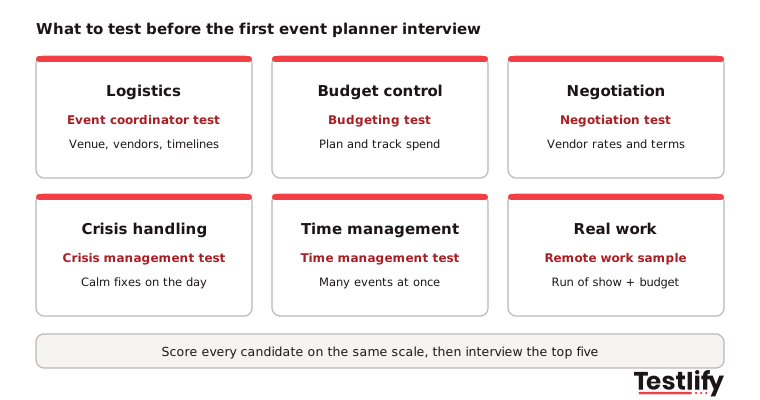
A skills test early in the process shows who can do the work before you spend time on interviews. Keep the stack short, use the same tests for every applicant, and choose tests that are related to the job, which the EEOC expects: tests must be necessary and related to the job, and employers should not ask for an applicant's photograph before an offer.
Testlify test | What it measures for an event planner |
|---|---|
Venue and vendor coordination, scheduling and event logistics | |
Building a budget, tracking spend and keeping to a limit | |
Getting better rates and terms from venues and suppliers | |
Staying calm and choosing the right fix when something fails on the day | |
Prioritizing tasks across several events and deadlines |
The event coordinator, budgeting, crisis management and time management tests together cover the most common reasons a planner hire fails: weak logistics, budget overruns, poor crisis handling and missed deadlines. Add the negotiation test when the role owns vendor contracts.
Testlify also lets you add the remote work sample to the same assessment. Its 25+ question types include file upload and spreadsheet tasks, so candidates can submit a run of show and a budget sheet, and one-way video questions let them walk you through their plan.
Scores land in one ranked report, and 20+ proctoring checks help keep results honest when candidates test from home.
5 general interview questions for an event planner
Ask every finalist the same questions in the same order and score each answer on a shared scale, as in a structured interview. Follow each answer with "What was the result?" and "What would you do differently?".
According to LinkedIn Talent Solutions' event planner hiring guide, good answers show detail orientation, a systematic intake process, comfort with planning tools and composure with difficult clients. For a longer list by category, see our event planner interview questions.
1. Can you describe a challenging event you planned and how you overcame the obstacles?
What a good answer shows: A specific event with size and budget, a clear problem, the steps the candidate took and a measurable result. Vague stories with no numbers are a warning sign.
2. How do you prioritize tasks when you are planning several events at the same time?
What a good answer shows: A system, such as a master calendar, critical-path checklists and set review points, plus an example of moving a deadline without hurting either event.
3. What questions do you ask a client or internal stakeholder in the first briefing?
What a good answer shows: A structured intake covering goals, audience, budget, dates, must-haves and how success will be measured. Good planners ask before they propose.
4. How do you handle client requests that are hard to deliver within the budget?
What a good answer shows: Honest conversations early, two or three options with costs, and a record of saying no politely while keeping the relationship.
5. How do you keep up with new event formats, tools and trends, and how have you used one?
What a good answer shows: Real curiosity backed by an example, such as a hybrid format, a registration tool or a sustainability change they introduced and the result it had.
5 technical interview questions for an event planner
These questions test whether a candidate can run the operations of an event, not only plan its concept. Workable's interview guide for the role notes that situational questions work best because every event is different, so ask for a real example each time.
1. How do you select and negotiate with event vendors?
What a good answer shows: Clear selection criteria (quality, price, reliability, insurance), competing quotes, written contracts with cancellation terms, and a real example of savings or better terms.
2. How do you build an event timeline and run of show?
What a good answer shows: Working backward from the event date, owners for each task, buffers before hard deadlines, and a minute-by-minute run of show shared with vendors and speakers.
3. What do you do when a key vendor cancels 48 hours before an event?
What a good answer shows: A backup vendor list, quick communication with the client, a decision on cost versus quality, and a calm account of a time it actually happened.
4. How do you plan and track an event budget from first estimate to final invoice?
What a good answer shows: A line-item budget with a contingency of around 10%, regular tracking against actuals, approval rules for changes, and reconciliation of every invoice after the event.
5. How do you measure the success of an event after it ends?
What a good answer shows: Goals set before the event, then attendance against target, attendee feedback, budget against plan, leads or business outcomes, and a short report with lessons for next time.
Rejection email templates for the event planner
Send a short, kind rejection at every stage so candidates are not left waiting. More options are in our candidate rejection email templates.
After screening:
Subject: Your application for Event Planner at [Company name]
Dear [Candidate name],
Thank you for applying for the Event Planner role at [Company name] and for the time you spent on your application.
After reviewing all applications, we have decided to move forward with candidates whose experience more closely matches the needs of this role. We will keep your details on file and encourage you to apply for future openings on our careers page.
We wish you the best in your search.
Sincerely, [Your name] [Your title], [Company name]
After interview:
Subject: Update on the Event Planner role at [Company name]
Dear [Candidate name],
Thank you for meeting with our team and for the work you put into the planning exercise. We enjoyed hearing about [specific event or idea they shared].
After careful thought, we have offered the role to another candidate whose experience is a closer fit for our current event calendar. This was a close decision, and we would be glad to stay in touch about future roles.
If feedback on your interview would help, reply to this email and we will share a few notes.
Thank you again, and all the best.
Sincerely, [Your name] [Your title], [Company name]
Ready to shortlist event planners on proof instead of polish? Build your test stack from the Testlify test library with a 7-day free trial, no credit card needed, or book a demo to see it with your team.
Frequently asked questions (FAQs)
Event coordination, budgeting, negotiation, crisis handling and time management are the core skills to test. Add a remote work sample, such as a run of show and a budget sheet, to see those skills applied.
Start hiring on skill.
Your next great hire is already in your pipeline
Build your first assessment in about two minutes and start surfacing proven talent today.