
Testlify vs EmployTest: A detailed comparison
Looking for a reliable way to assess your job applicants’ skills? Testlify is the ultimate alternative to EmployTest.
Testlify and EmployTest both test candidates before you hire them, but they are not the same kind of purchase. EmployTest sells test credits: buy a five-pack for $199, email a candidate a link, read the score, no contract. Testlify sells an assessment platform you run continuously, with role-specific and technical tests, proctoring, and ATS sync, from $139 a month.
So the honest question is not which tool is better. It is how many people you assess in a year, and whether a score on its own is enough to decide with. Both answers are easier to work out than either pricing page makes them look.
 ChatGPT
 Gemini
 Claude
 Grok
Grok Perplexity
TL;DR: Testlify vs EmployTest
- EmployTest is a pay-as-you-go test shop. You buy credits, send a link, and get a report back. No subscription, no workflow to set up.
- Testlify is a hiring workflow. Assessments, video responses, proctoring, and ATS sync run as one process rather than as a one-off purchase.
- The money crosses over around 60 to 65 candidates a year. Below that, EmployTest's packs are genuinely cheaper. Above it, Testlify's annual plan costs less per candidate.
- EmployTest's strongest ground is office and clerical screening: Microsoft Office, typing, attention to detail. It has been doing that since 2006.
- Testlify's strongest ground is anything role-specific, technical, or high-volume, where one test score is too thin a signal to hire on.
- Neither is the right answer for everyone, and this page says plainly where EmployTest wins.

What is EmployTest, and who is it for?
EmployTest is a credit-based pre-employment testing service. You pick a test, email the candidate a link, and the score comes back to your inbox and dashboard. There is no annual contract and no platform to implement. Its homepage lists 200+ skills, aptitude, knowledge and work behavior tests, used by 13,000+ companies across the US, Canada and 17 countries since 2006.
The tests are not thrown together. Every question is developed by a PhD or Master's level industrial-organizational psychologist, and the company builds to the US Department of Labor's Uniform Guidelines on Employee Selection alongside EEOC guidance. For a hiring manager who needs to know whether someone can really work a spreadsheet, that is a solid, defensible answer at a low price.
Where it stops is workflow. EmployTest measures one thing at a time and hands you a report. It does not run your pipeline, and it does not pretend to.
What is Testlify, and who is it for?
Testlify is a pre-hire assessment platform built around running hiring as a repeatable process. Its published plans include 3,500+ tests and 100+ ATS integrations on every tier, alongside coding and technical assessments, video and audio responses, proctoring controls, and multi-reviewer scoring.
The design idea behind it is the Testlify Multi-Signal Talent Evaluation Model: one signal is fragile, several pointing the same way create confidence. A candidate should not move forward on one strong test score any more than on one polished interview. They should move forward when the skills test, the work sample, the recorded answer, and the reviewer's notes all agree.
That is a heavier setup than emailing a link. It earns its keep when you are hiring the same roles repeatedly and need every candidate scored the same way.
How do the two platforms actually differ?
Here is the comparison stripped to the rows that change a buying decision. Everything in it comes from what both companies publish today.
What you are comparing | Testlify | EmployTest |
|---|---|---|
Pricing model | Subscription, credits included annually | Prepaid credit packs, no subscription |
Entry price | $139 a month, billed annually | $199 for 5 test credits |
Cost per candidate at 100 a year | $16.68 | $19.99 |
Test library | 3,500+ tests | 200+ tests |
Typing test | Yes | Yes, in 1, 3 or 5 minute formats |
Coding and technical tests | Yes | Not part of its published library |
Proctoring and anti-cheating | Identity checks, browser controls, AI-assistance detection | Not published; average completion times flag unusual sessions |
ATS integrations | 100+ | Not published |
Credit validity | Credits renew with the annual plan | Valid one year from purchase |
One correction worth making, because the old version of this page got it wrong: EmployTest does sell a typing test. It scores gross and net words per minute plus total errors, in one, three or five minute formats. Any comparison that marks that as missing is wrong, and a buyer who checks will stop trusting the rest of the table.
How much does each one cost in 2026?
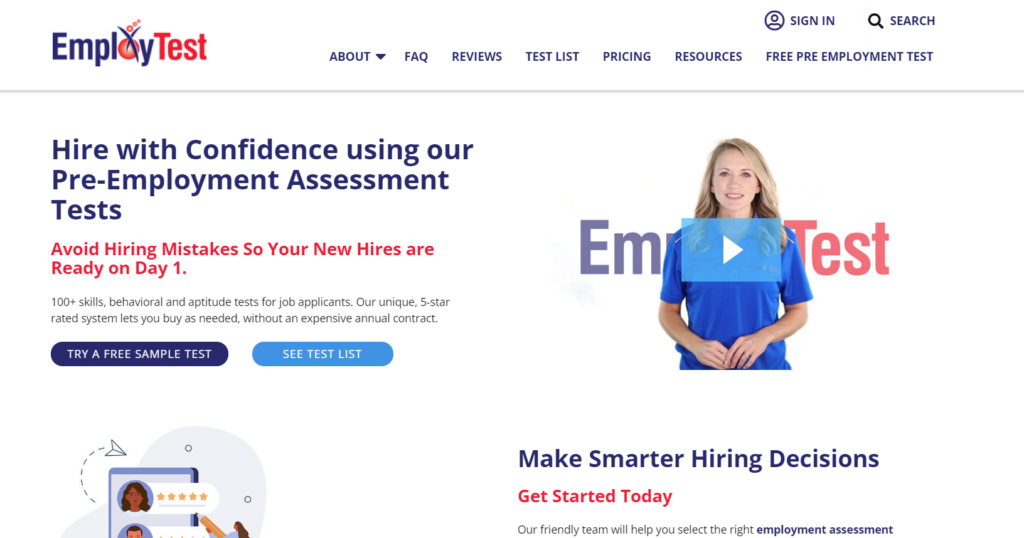
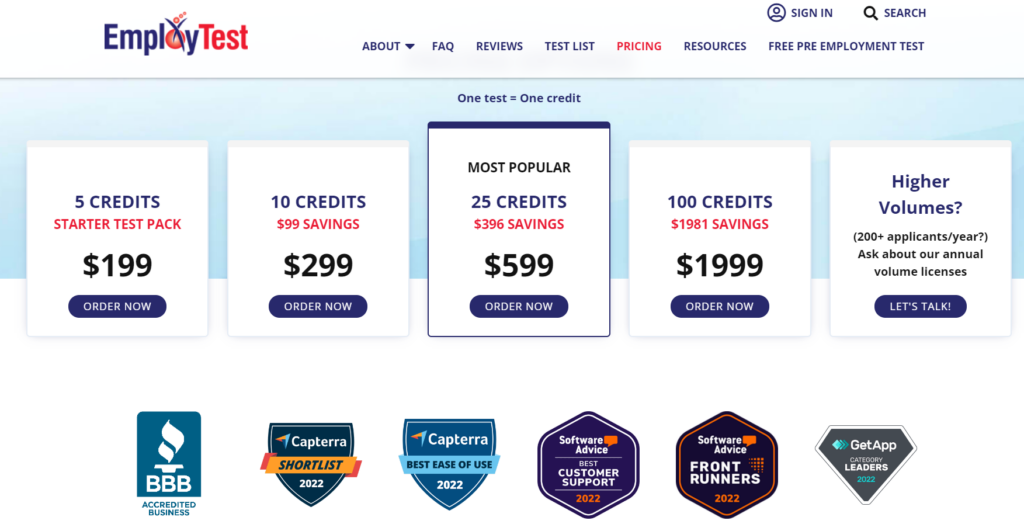
EmployTest sells credits in packs: $199 for 5, $299 for 10, $599 for 25, and $1,999 for 100. That works out to $39.80 per candidate at the smallest pack and $19.99 at the largest. Credits stay valid for a year, and one credit covers one completed assessment whatever the test.
Testlify's entry plan is $139 a month billed annually, which is $1,668 a year and includes 100 credits. That is $16.68 per candidate. Extra credits are $21 each, three user seats are included, and additional seats are $15 a month.
Put those side by side and the crossover is obvious. At 100 candidates a year, EmployTest costs $1,999 and Testlify costs $1,668, so Testlify is $331 cheaper and comes with the workflow attached. At 25 candidates a year, EmployTest costs $599 and Testlify still costs $1,668. EmployTest wins that one outright, and it is not close.
The turn happens near 65 candidates. Buying EmployTest packs efficiently, 60 credits costs $1,497 and 65 costs $1,696, which is the point the annual plan starts winning on price alone.
Pro tip: Work out your real annual assessment volume before you compare anything else, and count every candidate you screen, not the number you hire. Teams routinely underestimate this by half because they only count finalists. If the number lands under about 50, the prepaid-credit model almost always costs less.
Which one fits your hiring volume?
Volume is the cleanest way to decide, so here is the sequence worth following.
- Count the candidates you assessed in the last 12 months, including everyone who took a screen and did not advance.
- Add the roles you plan to open in the next year, then multiply by the number of people you typically screen per opening.
- If the total is under roughly 50, price the prepaid packs first. The subscription cannot beat them at that volume.
- If the total is over roughly 100, price the annual plan and count the admin time you stop spending on manual invitations and result chasing.
- If you sit between the two, decide on signal rather than money, because the cost difference is small enough to ignore.
That last point is the one people skip. Between roughly 55 and 75 candidates a year the two options land within a few hundred dollars of each other, so price stops being the deciding factor and the question becomes what evidence you need before saying yes to someone.
When is EmployTest the better choice?
Plenty of the time, and pretending otherwise would be useless to anyone reading this.
EmployTest is the better buy when you hire in bursts rather than continuously, when the roles are office and clerical, and when you want a defensible score without owning a platform. A property management company hiring two office administrators in March and nobody until October has no business paying for twelve months of anything. It might screen eight people all year, which is one $299 pack.
That pattern is common. BLS projects about 1.7 million openings each year in office and administrative support occupations over the 2025 to 2035 decade, most of them replacing people who left rather than new headcount. Hiring like that is lumpy by nature, and lumpy hiring suits prepaid credits.
The trade-off is what a single score cannot tell you. It will not show how someone explains a decision, handles an awkward customer, or works through a problem they have not seen before. For a role where that matters, one number is thin evidence.
How do you run a fair skills test?
The platform matters less than the process wrapped around it. Structured, job-relevant testing beats resume screening on either tool, and it falls apart the same way on both.
- Write down what the role actually requires before you look at any test. Two or three competencies, not ten.
- Pick a test that measures one of those competencies directly. Skip the ones that measure something adjacent because they were convenient.
- Send the same assessment to every candidate at the same stage. Changing it midway makes the comparison meaningless and the process harder to defend.
- Set the passing bar before the first result lands, not after you see who did well.
- Use the score to shape the interview rather than to replace it. A weak section is the best interview question you will get.
Speed is the other reason to get this right. SHRM's 2025 benchmarking data puts screening and interviewing at 8 to 9 days each, and a test placed before the first call takes days out of the screening half rather than adding to it. Placed after the interviews, it just adds a step.
Skills also move faster than they used to. The World Economic Forum expects 39% of workers' existing skill sets to be transformed or outdated between 2025 and 2030, which is a decent argument for testing what someone can do now instead of reading what they did four years ago. It is also an argument for reviewing your test choices yearly, whichever platform you buy.
Ready to see Testlify on your own roles?
The fastest way to tell whether a platform fits is to run it against a role you are actually hiring for. Testlify's free trial runs for 7 days with no credit card, and there is a 30-day money-back guarantee after that. If you would rather have someone walk through your roles with you first, book a demo. If you are still weighing options, the wider EmployTest alternatives comparison covers more ground, and the guide to types of pre-employment tests helps if you have not settled on what to measure yet.
FAQs
Related resources
View all
Competitor Comparisons
Testlify vs AQai: A detailed comparison
Competitor Comparisons
Testlify vs Aon: A detailed comparison
Competitor Comparisons
Testlify vs AccuRecruiter: A detailed comparison
Competitor Comparisons
Testlify vs the English Quiz: A detailed comparison
Competitor Comparisons
Testlify vs Talentoday: A detailed comparison
Competitor Comparisons
Testlify vs SHL: A detailed comparison
Get started.
Hire on proof, not resumes.
Run your first skills-based assessment free — no credit card required.