
CVs vs. online assessments: Which gives you better hires?
CVs vs. online assessments: discover which hiring method better predicts job performance
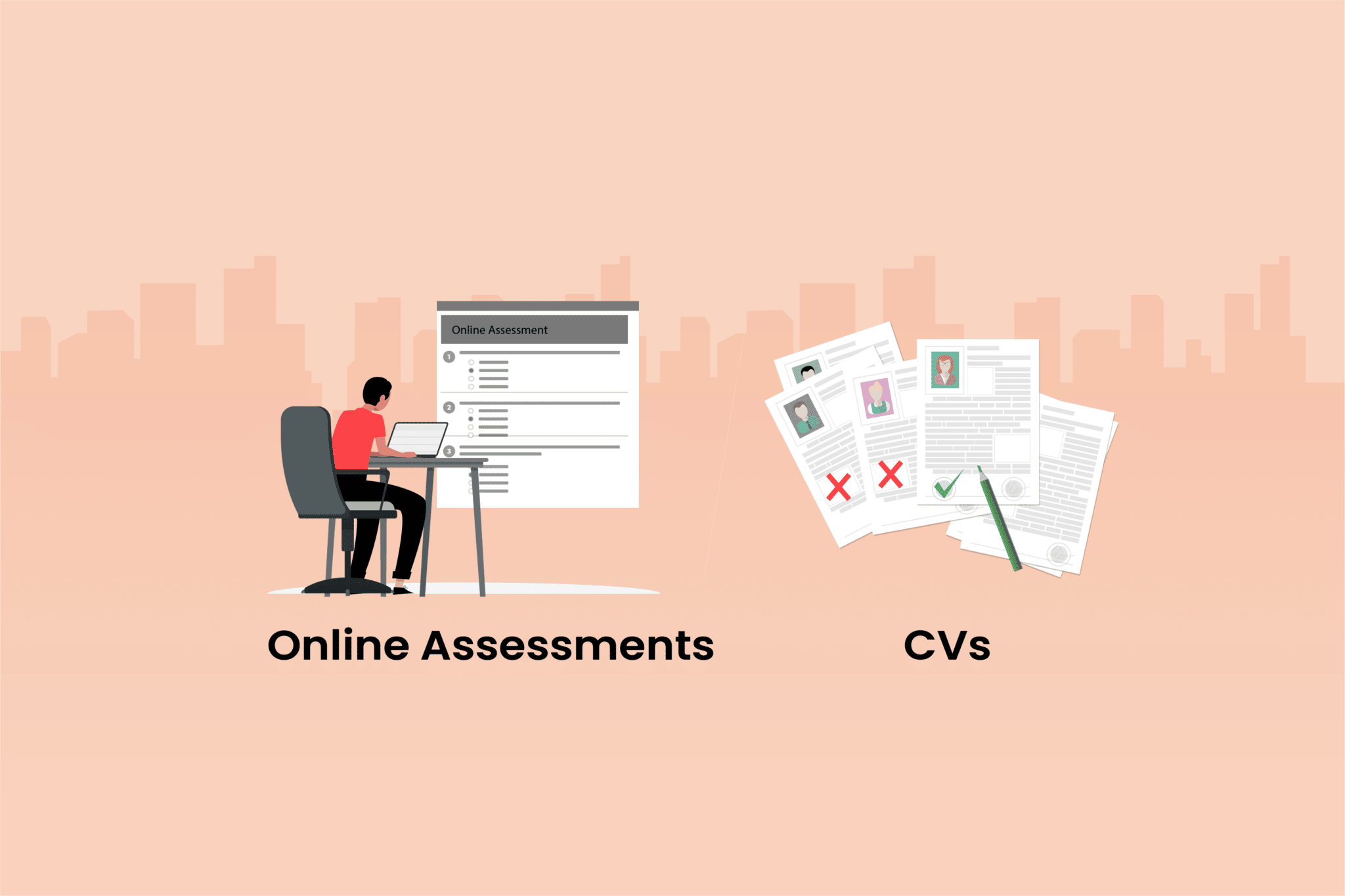
A CV tells you what someone has already been paid to do. An online assessment tells you what they can do right now, scored the same way for every applicant. Most hiring teams need both, in that order, and the order matters more than the choice.
The argument that resumes are dead is easy to sell and wrong in practice. The useful question is narrower: which decision does each document deserve to make? Get that wrong and you either reject good people on formatting, or you run a 40-minute test on 300 applicants who were never a fit.
This guide sets out where each method is strong, what the research actually supports, and how to sequence the two so neither one carries a job it cannot do.
 ChatGPT
 Gemini
 Claude
 Grok
Grok Perplexity
TL;DR
- A CV is self-reported history. An assessment is scored, comparable evidence. They answer different questions, so pick which one screens first rather than which one wins.
- The strongest research on selection methods puts years of education and general work experience, the two things a CV is built from, among the weaker predictors of job performance.
- CV screening carries measurable bias: in a study of 83,000 applications to 108 large US employers, distinctively Black names got fewer employer contacts than otherwise identical applications.
- Skills move faster than CVs record them. Employers expect 39% of workers' core skills to change by 2030.
- Assessments only beat CVs when they're job-relevant, time-boxed and scored consistently. A generic 60-minute test is worse than a careful CV read.
- The practical setup for a team under 200 people: two or three role-critical skills tested first, CV read second, structured interview third.

What is a CV assessment?
A CV assessment is the process of reviewing a candidate's CV or resume to judge whether their stated history, qualifications, and skills fit a role. It is a human or automated read of a self-reported document. It produces an opinion, not a score, and two reviewers looking at the same CV often reach different shortlists.
That last point is the one people skip. When a hiring manager and a recruiter disagree about a CV, there's no tiebreaker in the document itself. There's only whoever argues harder. An assessment removes that argument by giving both of them the same number to look at.
How do CV assessment and online tests differ?
A CV assessment reads a candidate's claims about the past. An online test measures performance on a task now, under the same conditions for everyone. The first is cheap, fast, and easy to game. The second costs candidate time and only works when the task genuinely resembles the job.
Dimension | CV assessment | Online assessment |
|---|---|---|
Data type | Self-reported claims | Scored performance |
Comparable across candidates | No, formats differ | Yes, same task and scale |
Reviewer time per candidate | Manual read, does not scale | Auto-scored and ranked |
What it is good at | Career context, credentials, progression | Current skill, judgment, reasoning |
Main failure mode | Polish beats substance | Test does not match the job |
Best position in the funnel | After the skill gate, before interview | First gate, once the role brief is clear |
Neither column is the villain. The CV is a bad ranking tool and a good context tool. The test is the reverse.
Screening CVs: what this assessment method misses
Screening CVs misses current ability, because a CV records job titles and dates rather than demonstrated skill. It also misses anyone whose path does not read conventionally, and it quietly imports bias from names, schools, and gaps that have nothing to do with the work.
Start with what the evidence says about the raw material. A major reanalysis of selection validity published in the Journal of Applied Psychology revised many long-standing estimates and placed years of education and general years of experience among the weaker predictors of job performance, with structured methods among the stronger ones. The exact coefficients are still argued over in the literature. The ranking is the part that survives every reanalysis, and a CV is built almost entirely out of the weak end.
Then there's who gets contacted at all. In a large correspondence experiment, researchers sent more than 83,000 fictitious applications to jobs at 108 of the largest US employers. Applications carrying distinctively Black names were contacted 2.1 percentage points less often than otherwise identical ones, and the gap varied widely between companies. That is a screening problem, not a candidate problem, and it happens before anyone has done any work.
There's a shelf-life issue too. Employers expect 39% of workers' core skills to change by 2030, according to the World Economic Forum's Future of Jobs Report 2025. A CV describes the skills someone used in a role they may have left three years ago.
What the CV exchange really tells a hiring team
The CV exchange is one-way by design. The candidate writes it, chooses what to include, and formats it to survive a keyword filter. You receive a document optimized for getting past you.
Tenure data makes this concrete. Median tenure with a current employer was 3.9 years in January 2024, and for workers aged 25 to 34 it was just 2.7 years, against 9.6 years for those aged 55 to 64, according to BLS employee tenure data. For a mid-level applicant, the CV's headline experience is often two or three short stints. Reading seniority into that is guesswork.
Pro tip: Before you write a single test question, take three people already doing the job well and read their CVs cold, with names removed. If your own current screen would have rejected two of them, your CV bar is measuring the wrong thing.
Resume screening vs. skills testing: what changes?
Moving from resume screening to skills testing changes what the first filter measures, from claimed history to demonstrated ability, and it moves recruiter effort from reading 300 documents to reviewing a ranked list. Time-to-shortlist drops. The work shifts upstream, into defining what the role actually requires.
That shift is the part teams underestimate. Resume screening needs no preparation, which is exactly why it's popular. Skills testing needs someone to decide, in writing, the two or three things a new hire must be able to do in month one. Teams that skip that step end up buying a generic test, watching 40% of candidates abandon it, and concluding that assessments don't work.
The honest caveat: a test only outperforms a CV when the task is job-relevant, standardized, and scored consistently. A poorly matched assessment is just a slower, more expensive way of guessing. If you cannot say what a good score means for the role, you are not ready to run one.
How do you evaluate candidates without relying only on CVs?
Evaluate candidates without relying only on CVs by making the first gate a scored, role-relevant task, then using the CV for context on the people who clear it. Add a structured interview with a fixed scorecard and a reference or work sample for finalists. No single signal decides.
That is the idea behind the Testlify: one signal is fragile, several pointing the same way create confidence. A candidate should not advance on one strong CV, one polished interview, or one test score alone. They advance when independent signals agree.
Signal | Question it answers | When to use it |
|---|---|---|
Can they think through an unfamiliar problem? | Analytical and management roles | |
Role-specific skills tests | Can they do the core task today? | First gate on almost any role |
Work simulation | How do they behave in a realistic task? | Ops, support, customer-facing |
Can they explain something clearly? | Sales, HR, client-facing | |
CV and career history | What scope and context have they had? | After the skill gate, before interview |
Structured interview | Do the signals hold up in conversation? | Final stage, scorecard-based |
For a wider view of which test suits which role, read types of skills assessment tests.
When does a CV still matter in a skills-first process?
A CV still matters in three cases: senior roles where the scope of prior accountability is the thing you're buying, licensed roles where a credential is a legal gate, and regulated industries where qualifications must be evidenced. In each, the CV carries information no test can generate.
There's a fourth, quieter case. When two candidates score within a point of each other, career history is a reasonable tiebreaker, because it tells you which environments they've operated in. Just make sure it's the tiebreaker and not the opening filter.
Screening design shapes who ever reaches that stage, which is worth understanding on its own terms. Our piece on screening in vs screening out covers the practical difference.
How do you combine CVs and assessments?
Combine them by sequencing, not by doubling up. Run a short role-relevant assessment on everyone who meets two or three hard criteria, shortlist by score, then read the CVs of the people who cleared the bar. Interview against a scorecard. Each filter works on a smaller, better pool than the one before it.
Stage | What happens | What to watch |
|---|---|---|
1. Intake | Filter on 2 to 3 non-negotiables only | Do not filter on years of experience |
2. Skill gate | Everyone who passes intake takes a 15 to 25 minute test | Completion rate above 70% |
3. Shortlist | Rank by score, set the cut-off before you look at names | Cut-off fixed in advance, not adjusted to fit |
4. CV read | Read career context for the shortlist only | Context, not re-ranking |
5. Structured interview | Same questions, same scorecard, every candidate | Interviewers score before discussing |
Testlify fits at stage two and three. For teams that already run Greenhouse, Workday or Lever, it works as the screening and interviewing layer and leaves the ATS as the system of record, with 100+ ATS integrations available. For a team with no ATS at all, Testlify also ships a simple built-in pipeline: post the job, collect applications, screen with evidence, and move candidates through stages.
For the setup mechanics, read our guide to how to automate your candidate screening process.
How do you know if your screening method is working?
Four numbers tell you: screen-to-interview rate, offer acceptance, 90-day retention, and how often hiring managers reject your shortlist. If managers keep rejecting the people you send, the filter is measuring the wrong thing, whatever the other three say.
Track them over two or three hiring cycles rather than one role. A single cohort is too small to separate a bad screen from a bad week. And record the cut-off score you used, because a filter you keep quietly adjusting is not a filter.
Ready to put a scored first gate in front of your CV pile? Start a free Testlify trial and build a role-specific test in about 10 minutes, or book a walkthrough to map it onto your current process.
Frequently asked questions (FAQs)

Related resources
View all
Skill assessment
How to assess computer skills to increase technical hiring accuracy

Skill assessment
Assess the personality and attitude of candidates to find the best fit

Skill assessment
What skills-based hiring data shows beyond the US and UK

Skill assessment
How do skills assessments correlate with on-the-job performance?

Skill assessment
How does skills mapping enable skills-based organizations?

Skill assessment
Skills mapping vs competency mapping
Get started.
Hire on proof, not resumes.
Run your first skills-based assessment free — no credit card required.