+1 (844) 755 8378


Hiring top talent is the ultimate goal of every recruitment drive. Yet challenges like resume manipulation and interview cheating often make it difficult to identify truly qualified candidates. This is why more employers are turning to skills-based hiring.
Out of skills assessments, aptitude tests are proven to be one of the most reliable predictors of employee performance. In fact, over 75% of Fortune 500 companies use them in their hiring assessments, and industry reports show that more than 60% of large organizations rely on aptitude tests for entry-level recruitment.
This is essentially important as one bad hire can cost up to 30% of the role’s salary. This blog explores various types of aptitude tests to help you find your next top candidate.
Summarise this post with:

What are aptitude tests?
Aptitude tests evaluate a candidate’s potential to succeed in a specific job by assessing their natural ability and cognitive skills, which are necessary for a particular job. These tests serve as highly accurate predictors of a candidate’s potential for job success.
Recruiters can use different aptitude types to evaluate candidates’ strengths and weaknesses, helping them identify the best fit for each role.
Different types of aptitude tests are used for various roles, ranging from entry-level to leadership roles. Testing aptitude for entry-level positions assesses general problem-solving, reasoning, and communication.
At the same time, for leadership and management roles, the test is used to target situational judgment, decision-making capabilities, and strategic thinking.

Different types of aptitude tests
From cognitive ability to situational judgment, each aptitude test reveals a different side of a candidate’s potential. Using the right mix helps recruiters uncover hidden strengths and predict real-world performance more accurately.

Numerical aptitude tests
Numerical aptitude tests or numerical reasoning tests play a vital role in the recruitment process, especially for positions that demand strong quantitative skills.
These tests are designed to assess a candidate’s ability to
- work with numbers
- perform mathematical calculations
- interpret data accurately
Proficiency in numerical reasoning is crucial for roles like financial analysts, data scientists, and engineers, where employees are required to make data-driven decisions and solve complex problems.
Example of numerical reasoning test from Testlify:
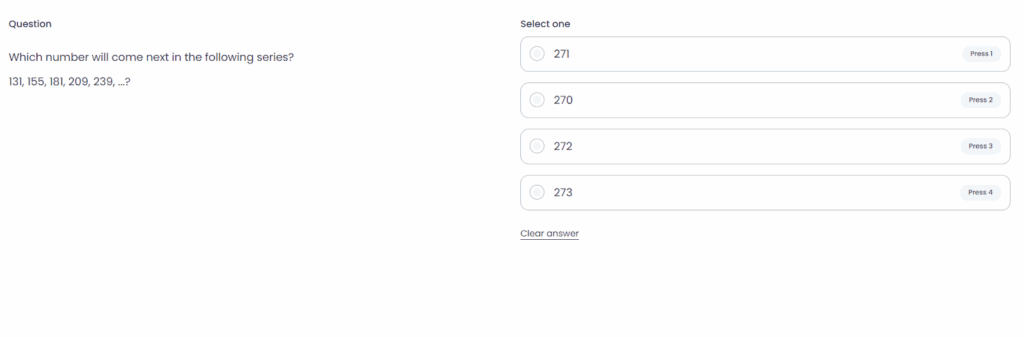
Candidates facing numerical aptitude tests can expect a range of questions involving arithmetic, algebra, statistics, and data interpretation.
These assessments measure candidates’ mathematical knowledge and also their ability to apply it in real-world scenarios. Employers often seek individuals who can analyze financial data, create statistical models, or solve complex engineering problems.
To make effective use of numerical aptitude tests, recruiters need to ensure that the content or question bank aligns with the specific demands of the job role.
A well-designed test provides valuable insights into a candidate’s quantitative abilities, helping organizations select individuals who can excel in positions where mathematical proficiency is essential.
For a detailed read: How to evaluate candidates’ skills with a numerical reasoning assessment
Verbal aptitude tests
Verbal reasoning tests are valuable for positions that emphasize strong language and communication skills.
These tests are designed to evaluate a candidate’s ability to
- comprehend written information
- identify errors in grammar
- effectively express ideas in a clear and concise manner
Such abilities are vital for roles like copywriters, editors, and public relations specialists, where written and verbal communication is a core aspect of the job.
Candidates facing verbal aptitude tests can expect questions that assess their grammar, vocabulary, reading comprehension, and writing skills.
Recruiters use the results to gauge how well candidates can convey information, tailor their communication to the intended audience, and maintain the organization’s brand voice.
Effective verbal aptitude tests should be carefully crafted to mirror the actual tasks and communication demands of the job.
Below is an example of a verbal reasoning test from Testlify:
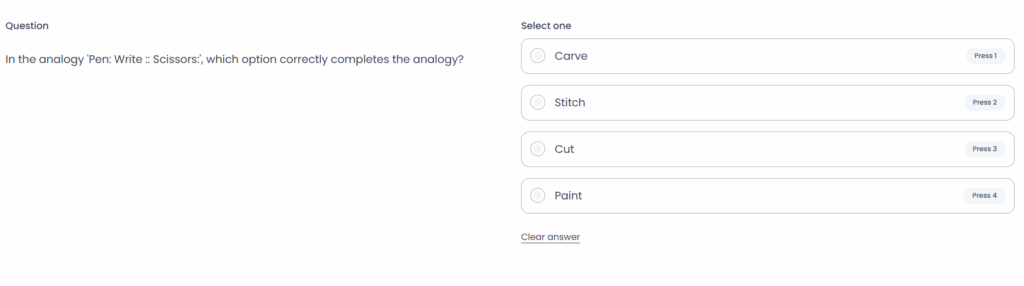
By utilizing these tests, recruiters can identify candidates who possess the essential language and communication skills required to excel in roles that rely on effective written and verbal interaction.
Abstract reasoning tests
Abstract reasoning tests are a critical component of the recruitment process, especially for positions that require creative problem-solving and critical thinking abilities.
These assessments aim to evaluate a candidate’s capacity to
- think logically
- recognize patterns
- solve complex problems in a non-verbal context
Typically, candidates are presented with abstract puzzles and patterns, and they must discern the underlying relationships and make inferences based on these visual cues.
Proficiency in abstract reasoning is highly relevant for roles like software developers and architects, where employees are tasked with designing innovative solutions, solving intricate problems, and thinking outside the box.
These tests serve as an effective means to identify individuals who possess the cognitive abilities necessary for excelling in positions that demand creativity and analytical thinking.
Example of abstract reasoning test form Testlify:
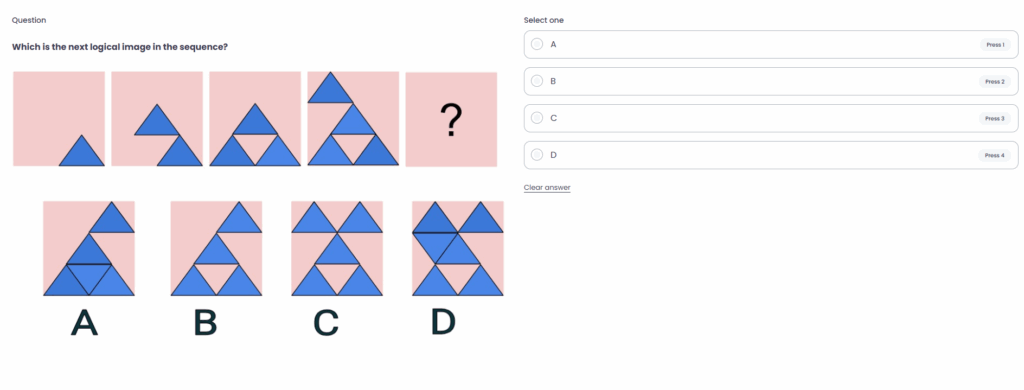
Recruiters must choose or design abstract reasoning tests that align with the specific demands of the job role.
By employing these tests, organizations can ensure that candidates selected for such positions are not only technically skilled but also possess the abstract thinking abilities required to tackle complex challenges.
For a detailed read: How to hire top talent using abstract reasoning test
Logical reasoning tests
Logical reasoning tests serve as an invaluable tool for recruiters in assessing a candidate’s analytical skills, decision-making abilities, and capacity to draw meaningful conclusions from data or information.
These assessments present candidates with a set of data or statements and evaluate their capability to analyze, evaluate, and reach logical conclusions.
The relevance of logical reasoning tests extends to a wide array of job roles, from management positions that require strategic decision-making to marketing roles where data analysis plays a significant role. The ability to think critically and make informed decisions is a fundamental aspect of many professions.
Candidates facing logical reasoning tests can expect to encounter various question types that challenge their ability to solve problems and make well-reasoned judgments based on the information provided.
Recruiters can use logical reasoning tests to identify candidates who possess the essential cognitive skills for roles that demand analytical thinking, problem-solving, and decision-making.
These tests aid in selecting candidates who can contribute to an organization’s success by making informed, data-driven choices in their respective roles.
Mechanical aptitude tests
Mechanical aptitude tests are an indispensable part of the recruitment process for positions that require a deep understanding of mechanical concepts, technical proficiency with tools and equipment, and the ability to solve problems within a technical or engineering context.
These tests are specifically designed to evaluate a candidate’s practical mechanical knowledge and their capability to work with machinery, demonstrating their suitability for roles like mechanics, engineers, and technicians.
Example of mechanical aptitude tests from Testlify:
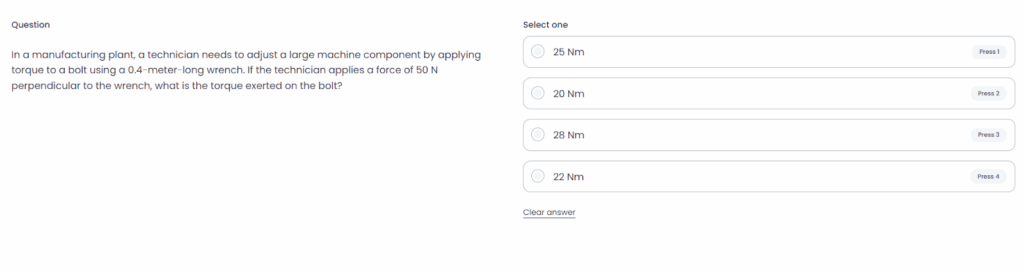
Candidates taking mechanical aptitude tests can expect to encounter questions that assess their
- knowledge of mechanical systems
- problem-solving skills when dealing with technical issues
- understanding of basic engineering principles
These tests help recruiters identify individuals who possess the necessary mechanical skills and practical problem-solving capabilities required for success in technical and engineering positions.
By employing these tests, organizations can make well-informed, faster hiring decisions, selecting candidates who are academically qualified and also possess the hands-on skills essential for technical and engineering roles.
Spatial reasoning tests
Spatial reasoning tests play a crucial role in evaluating a candidate’s ability to understand and manipulate three-dimensional objects and navigate through complex spatial environments.
These tests are particularly relevant for roles in architecture, interior design, and other professions where spatial visualization skills are of paramount importance.
Candidates undertaking spatial reasoning tests can anticipate questions that challenge their
- ability to manipulate objects in space mentally
- understand spatial relationships
- interpret complex designs
These talent assessments are designed to identify individuals who possess the spatial acumen necessary for success in professions that involve creating or working with intricate spatial structures and designs.
Recruiters use spatial reasoning tests to ensure that candidates can excel in roles where spatial visualization, problem-solving, and the ability to work with complex architectural or design concepts are essential.
By incorporating these tests into the hiring process, organizations can select candidates who are well-suited for roles that demand proficiency in spatial reasoning and three-dimensional thinking, ultimately contributing to the success of their projects and designs.
Data entry tests
Data entry tests serve a crucial role in assessing a candidate’s proficiency in efficiently and accurately inputting data into a computer system.
These tests are particularly relevant for positions that require frequent data input, such as administrative assistants, data entry clerks, and other roles where meticulous record-keeping is essential.
Candidates undergoing data entry tests typically encounter a series of exercises that evaluate their typing speed, accuracy in data input, and attention to detail.
Recruiters rely on data entry tests to identify qualified candidates who not only possess the required keyboarding skills but also demonstrate a high level of precision.
By utilizing these tests, organizations can ensure that individuals selected for data-intensive roles are equipped to handle the demands of data entry accurately and efficiently.
For those considering starting a new business, understanding the importance of data accuracy can be a significant advantage. This minimizes errors and maximizes productivity in positions where data accuracy is paramount.
Situational judgment tests
Situational judgment tests are a powerful tool for assessing a candidate’s ability to handle real-life job-related scenarios effectively.
These tests present candidates with hypothetical situations they may encounter in their prospective job roles and require them to choose the most appropriate course of action from a set of options.
Situational judgment tests are highly relevant for a broad range of job roles, from customer service representatives to management positions, as they assess an individual’s decision-making skills, problem-solving abilities, and their capacity to act in alignment with the organization’s values and objectives.
Candidates taking situational judgment tests can expect to navigate a series of scenarios that mirror the challenges they might encounter on the job. Recruiters rely on these assessments to identify top candidates who exhibit sound judgment, critical thinking, and a keen understanding of the role’s requirements.
These tests play a vital role in ensuring that candidates are well-prepared to handle the complexities of real-life work situations effectively.
For a detailed read: How Situational Judgement Tests (SJTs) find the best fits
Personality tests
Personality tests, though not technically aptitude tests, play a pivotal role in the recruitment process by offering valuable insights into a candidate’s personality traits, preferences, and work style.
Recruiters use these assessments to gauge whether a candidate’s personality aligns with the organization’s culture, values, and specific job requirements. These tests are indispensable for building cohesive and high-performing teams and ensuring that new hires not only possess the necessary skills but also fit seamlessly into the company’s environment.
Personality assessments are designed to reveal an array of characteristics, including traits like extraversion, conscientiousness, emotional stability, and openness to new experiences.
The test also assesses a candidate’s interpersonal skills, communication style, and preferred approach to problem-solving. Understanding these aspects of a candidate’s personality helps recruiters make more informed decisions about whether they are a good fit for the role and the organization.
In the modern workplace, where collaboration, adaptability, and teamwork are highly valued, personality tests are instrumental in determining whether a candidate will thrive in a given work environment.
A candidate may have the technical skills required for a job but may not be a cultural fit, which can lead to reduced job satisfaction and turnover.
By incorporating personality assessments, recruiters can ensure that new hires have the right qualifications and possess the temperament and disposition that align with the organization’s ethos, ultimately contributing to a harmonious and productive workplace.
Why aptitude tests matter in talent acquisition?
Traditional screening methods are falling short. LinkedIn research shows that companies that use skills-based hiring are 12% more likely to get qualified hires compared to those relying on conventional methods like a resume screening.
An aptitude test is designed to assess candidates’ core competencies based on specific skills, providing recruiters with what candidates can actually do rather than focusing on what they say they can do.
Below are the main advantages of including different types of aptitude tests in the recruitment process.
Accurate skill-filtering
Aptitude testing platform allows global benchmarking of candidates and skills matrix to provide detailed performance insights on each candidate, giving recruiters a 360-degree view of candidates’ skills.
Time-saving
Unlike resumes and lengthy interviews, aptitude test types don’t require recruiters to sit and sift through each candidate. Most platforms that offer such a type of skills assessment are AI-powered or automated, providing recruiters with a curated list of candidates who passed (and failed) in the evaluation.
Note: Such platforms don’t make decisions for recruiters; they merely assist by showing the insights and data.
Better talent pool
Since aptitude assessments are conducted online, allowing candidates across the globe to take up tests at the same time without any location restrictions, this allows for a wider talent pool. This means recruiters are not restricted to any particular geography and can perform evaluations at scale.
Anti-cheating features
Platforms that provide aptitude tests like Testlify often come with advanced proctoring features like live environment scan, IP address tracking, screen recording and sharing, and more.
Test hard and soft skills
Recruiters can strategically schedule multiple aptitude tests at different stages of the hiring process to refine their talent pool.
For example, an initial test might measure core numerical and verbal abilities, while later assessments could focus on advanced verbal reasoning, situational judgment, or other soft or hard skill areas.
By combining evaluations of both hard and soft skills, recruiters gain a complete, data-backed view of each candidate’s potential.
Assess aptitude tests with Testlify
Aptitude tests are easily one of the most effective ways to screen candidates. Since there are different types of aptitude tests available, employers need to make sure they select the right test.
Companies using Testlify’s skills assessment have reported 6x recruiter efficiency and 94% improved candidate experience.
Book a 15-minute demo if you are unsure where to start. Or try for free and see a 55% reduction in time-to-hire.